

SMSF Loans in Australia (2026): Which Lenders Still Lend, How Much a Fund Can Borrow, and What the 10 August Ban Changed
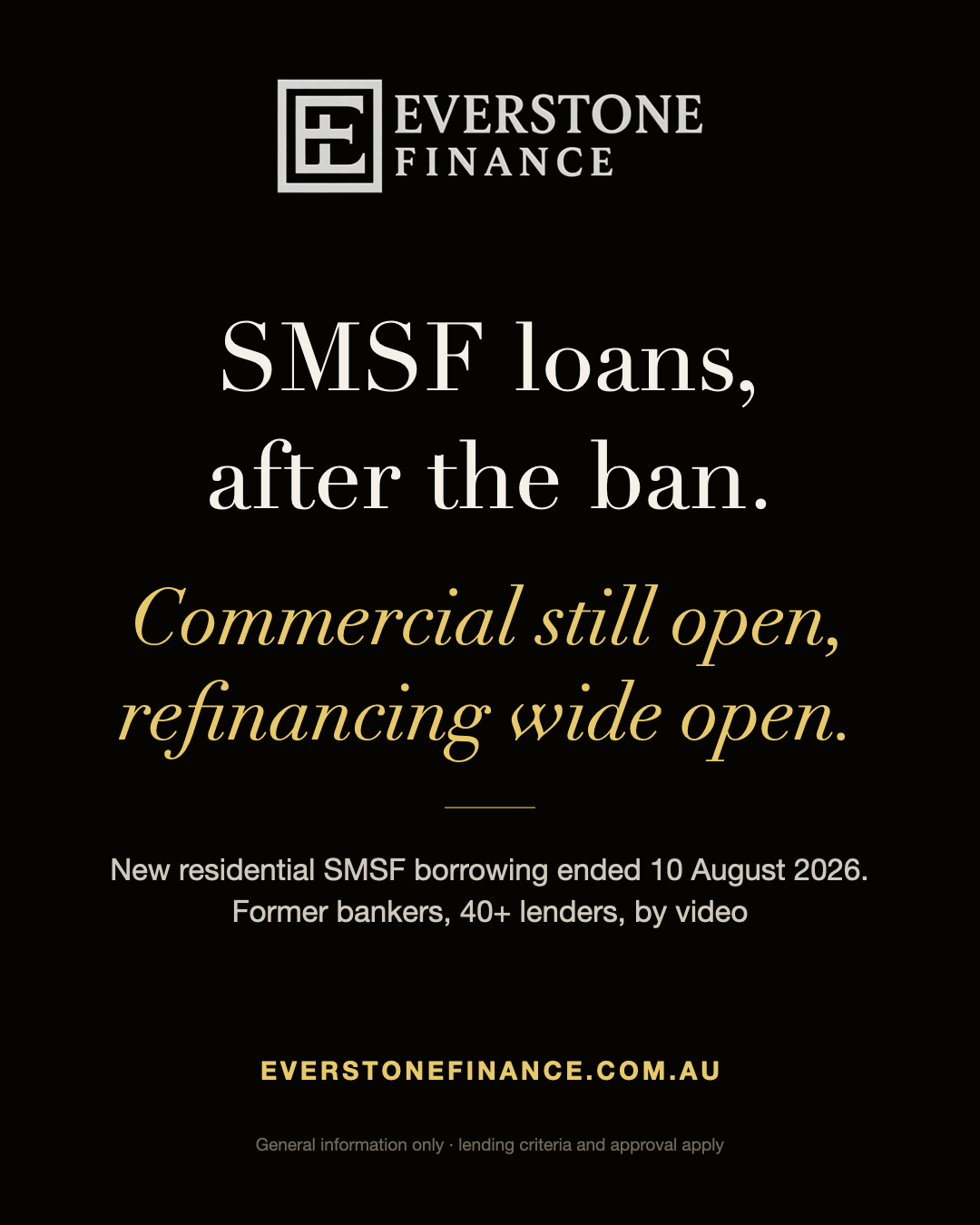
An SMSF loan lets a self managed super fund borrow to buy a single property through a limited recourse borrowing arrangement, with the property held in a separate holding trust and the lender’s claim limited to that one asset. Since 10 August 2026 a new SMSF loan can only be used to buy business real property, meaning commercial premises; residential borrowing inside super is closed to new arrangements, existing loans are grandfathered, and refinancing stays open provided it does not release equity or fund another asset. Specialist lenders typically lend around 65 to 75 per cent of the price and want a fund balance of roughly $200,000 to $300,000 with cash left over after settlement. Everstone Finance arranges commercial SMSF purchases and SMSF refinances across a 40+ lender panel, by video, Australia wide.
What is an SMSF loan, and how does it work?
An SMSF loan is a limited recourse borrowing arrangement, or LRBA. The fund borrows to acquire one asset, the asset sits in a holding trust, usually a bare trust, while the fund remains the beneficial owner, and if the loan goes bad the lender can take that asset and nothing else in the fund. The Australian Taxation Office sets out the structure and the superannuation law that applies to it on its limited recourse borrowing arrangements page.
The structure exists because superannuation law generally prohibits a fund from borrowing. The LRBA is the carve-out, and its conditions are strict: one acquirable asset per arrangement, a separate trustee holding legal title until the loan is repaid, rent and other income flowing to the fund, and every dealing at arm’s length. A member cannot live in a residential property the fund owns, and a member’s relatives cannot rent it. Business real property is the exception that makes commercial SMSF lending work: the fund can own premises and lease them to a member’s own business at market rent, because business real property is excluded from the in-house asset rules.
Trustees must also keep the fund’s investment strategy current, have the fund audited every year by an approved SMSF auditor, and satisfy the sole purpose test, which requires everything the fund does to be for members’ retirement benefits. The investment strategy must consider whether the fund should hold insurance cover for its members. None of that is optional, and a lender will ask for evidence of it before it lends.
What changed on 10 August 2026?
From 10 August 2026, an SMSF can no longer establish a new limited recourse borrowing arrangement to acquire residential property. The change comes from the Treasury Laws Amendment (Tax Reform No. 1) Act 2026 (Royal Assent 26 June 2026), which limits new SMSF borrowing for real property to business real property under section 67A of the SIS Act. Loans already in place before that date continue to their end, a contract exchanged before 10 August is treated under the old rules even where settlement falls later, and a grandfathered loan may be refinanced whenever the trustees choose, so long as the refinance does not release equity or fund another asset.
The ATO’s LRBA guidance now carries an alert confirming that the legislative changes commence on 10 August 2026 and that its guidance is being updated to reflect the new rules. Separately, from 1 July 2026 the Division 296 measure applies an additional tax on the superannuation earnings of individuals whose total super balance exceeds $3 million. It does not stop anyone borrowing, but it belongs in any honest 2026 conversation about holding large property assets in super.
| Scenario | Residential property | Commercial (business real property) |
|---|---|---|
| New SMSF loan to buy | No longer permitted | Still permitted |
| Buy outright with fund cash | Still permitted | Still permitted |
| Existing loan established before 10 August 2026 | Grandfathered; can be refinanced for the balance owing plus refinancing costs | Grandfathered; can be refinanced for the balance owing plus refinancing costs |
| Contract exchanged before 10 August, settling after | Assessed under the old rules | Assessed under the old rules |
The practical map is simple. New purchases with borrowed money are commercial only. Existing residential loans keep every right they had, including the ability to switch to a lender with a sharper rate. What an SMSF refinance cannot do, and never could, is release equity, because refinance money can only repay the existing borrowing and cover the costs of refinancing.
Which lenders still do SMSF loans?
SMSF lending in Australia is written mostly by specialist non-bank lenders and a small number of smaller banks and mutuals, not by the mass-market home loan brands. After 10 August 2026 the panel splits in two: a shorter list that will fund a new commercial SMSF purchase, and a longer list competing for existing loans through refinancing. Lenders named in our guides for their published SMSF refinance pathways include RedZed, Pepper Money and La Trobe Financial, with Bluestone describing the refinance market as untapped.
Two things matter more than the brand names, which change. The first is appetite for your asset: a warehouse, a medical suite, a shopfront and a childcare centre are all business real property, but lenders price and cap them differently, and some will not touch specialised assets at all. The second is the fund’s shape: corporate trustee or individual trustees, balance after settlement, contribution history and whether the fund is currently compliant with the ATO. A broker’s job is to read those two things against the current panel rather than send the file to the lender whose name you already know.
We publish the panel comparison for a specific file, not a public rate table, because SMSF pricing moves with the asset and the fund. Book a call and you get the live comparison for your situation.
Your fund’s numbers, read against the lenders that still say yes.
A former banker checks the balance, the liquidity buffer and the asset type against the SMSF lenders on our panel, tells you what the fund can borrow, and flags anything the auditor or the ATO would question before you commit to a contract. No credit enquiry until you decide to apply.
Book a free SMSF lending call with a former bankerRather message than book? WhatsApp, text or call Ahmed about your fund and whether an SMSF loan still fits after the rule change. His own mobile, no call centre, and no obligation.
How much can an SMSF borrow?
As an indicative guide, specialist SMSF lenders lend around 65 to 75 per cent of the property value, look for a fund balance somewhere between $200,000 and $300,000 as a starting point, and require cash remaining in the fund after settlement for repayments, running costs, insurance and any pension payments. On those numbers a $700,000 commercial property at 70 per cent means a $490,000 loan, with the fund contributing $210,000 plus stamp duty and costs, and still holding cash afterwards.
Serviceability inside super is assessed on the fund, not on you. The lender adds the rent the property will earn to the contributions the members reliably make, deducts the fund’s expenses and the proposed repayments, and wants a margin left over. Concessional contributions are capped, so a fund cannot simply promise to tip in more; the history of what has actually been contributed carries most of the weight. Where the tenant will be a member’s own business, the lease must be at a genuine market rent, and lenders will check the rent against comparable premises rather than take the figure in the lease.
Maximum loan sizes, buffer rules and balance thresholds differ by lender. Some require no liquidity buffer at all, others want meaningful cash left in the fund after settlement, and the asset type moves the ceiling: standard commercial premises sit at the top of the range, specialised assets lower. The balance threshold is not bureaucracy; a fund that scrapes together the deposit with nothing left over fails the liquidity test, and arguably should.
What does an SMSF loan cost?
Three cost lines sit on every SMSF loan: the lender’s interest rate and fees, the legal and structuring work to establish the holding trust and, where needed, a corporate trustee, and the fund’s ongoing compliance costs, including the annual audit by an approved SMSF auditor. Rates and fees differ by lender and by asset type, so we quote them live for a specific fund rather than printing a table that would be stale within weeks.
Two cost points are worth knowing before you start. If the fund’s structure has not changed, the legal opinion from the original loan is often accepted again, and one lender, RedZed, currently waives its own legal fees on eligible streamlined refinances. And because refinance money can only repay the existing borrowing and cover the costs of refinancing, the new loan is sized to the old balance plus those costs, and Pepper Money’s pathway allows only loan setup fees on top.
The 5 per cent rule, and the other rules that catch people
The 5 per cent rule is the in-house asset limit: the market value of a fund’s in-house assets, broadly investments in or loans to related parties, must not exceed 5 per cent of the total market value of the fund’s assets, and an acquisition that would push the fund over that line is prohibited. The ATO’s investment restrictions page sets it out. Business real property leased to a related party is a specific exception, which is exactly why a fund can own a member’s business premises with a loan.
The other rules that decide files are the sole purpose test, arm’s length dealing and the related-party restrictions. If an asset is not acquired or sold at arm’s length, the income can be treated as non-arm’s length income and taxed at the highest marginal rate. A related party cannot live in or use a residential property the fund owns. Unpaid distributions from a related trust can breach the in-house asset rules. Trustees who get these wrong face penalties and, in the worst case, the fund being made non-complying, which is why every SMSF lender wants to see a compliant fund with a current investment strategy and clean audit history before it lends.
Can I refinance an SMSF loan in Australia?
Yes. The 10 August 2026 ban closed new residential borrowing inside super but left refinancing untouched, and the long-standing limit still applies: a refinance cannot release equity or fund another asset. A grandfathered loan can therefore change lenders for its whole remaining life, and lenders now chase that business with streamlined pathways. RedZed’s EasyRefi looks at how the loan has been paid over the previous year, Pepper Money’s Super Easy Refi works from half a year of loan statements, and La Trobe Financial has a comparable fast track. The shared entry conditions are no cash out and a repayment no higher than the current one, and Pepper Money also requires a company as trustee.
- No cash out and no second asset. Refinance money can only repay the existing balance and cover the costs of the refinance, so nothing can be drawn out as cash or put toward a second asset.
- Same asset, same structure. The loan stays a limited recourse borrowing arrangement over the one property held in the holding trust, and the asset cannot be swapped during the refinance.
- A compliant fund. A current investment strategy, a clean audit history and arm’s length dealings are what every SMSF lender checks before it refinances. Funds with individual trustees can still refinance through a full assessment at some lenders.
- Why do it. A lower rate or lower ongoing fees at a specialist lender, with RedZed, Pepper Money and La Trobe Financial publishing streamlined refinance pathways that look at how the loan has been paid rather than re-underwriting the fund from scratch.
Residential SMSF lending is now a refinance-only market, which changes the incentives. Lenders that want to stay in the sector can grow only by winning loans that already exist, so a fund with clean payments and a company as trustee holds more cards than it did a year ago. A fund with, say, nine months of clean payments that misses a twelve-month test may still meet a six-month one. Our SMSF loan refinance guide covers the pathways, who qualifies, and how to run the rate review properly.
Buying your own business premises through your SMSF
Buying the premises your business already occupies is the SMSF purchase the 2026 rules leave wide open. The fund borrows to buy the warehouse, clinic, office or shop, your business pays market rent to the fund, and the rent builds retirement savings instead of a landlord’s. The lease must be genuinely at arm’s length, the rent must be paid in full and on time, and the property must be used wholly and exclusively in a business.
Lenders like these files because the tenant is known and the rent is bankable, but they still test the business as a tenant and the fund as a borrower separately. The full walkthrough, from the holding trust to settlement and the compliance that follows, is in our guide to SMSF commercial property loans, and the step by step process for a fund that is starting from scratch is in how to buy property with your super. If you hold a residential contract that was exchanged before 10 August 2026 and has not yet settled, read our explainer on the residential ban before you do anything else.
Where Everstone fits
Everstone Finance is a Melbourne mortgage broker run by former bankers, arranging SMSF commercial purchases and SMSF refinances Australia wide across a 40+ lender panel. We are not accountants, auditors or financial advisers, and an SMSF property decision needs those people too: your accountant or SMSF administrator on whether the fund should hold property at all, a lawyer on the holding trust and corporate trustee, and a licensed adviser if you want personal advice. Our job is the lending: which lenders will fund this asset for this fund, on what terms, and whether the numbers survive the liquidity test.
Where the fund’s numbers do not work, we say so early. Where they do, we run the panel comparison, prepare the fund’s file the way SMSF lenders want to read it, and manage the approval through to settlement. The lender pays us on settlement; there is no cost to you for the comparison.
Commercial still open, refinancing wide open. Find out which one fits your fund.
Tell a former banker what the fund holds, what it earns and what you want to buy or refinance. You get the borrowing figure across the SMSF lenders on our panel, the liquidity check, and the honest answer if the structure is wrong.
Book a chat with a former bankerRelated guides
- SMSF property loans in Australia (2026): commercial property in your super
- Refinancing an SMSF loan in Australia (2026)
- The SMSF residential loan ban of 10 August 2026: grandfathering and what still works
- How to buy property with your super in 2026
- Commercial property loans in Australia: deposits, LVRs and how lenders assess them
- Refinance your home loan in Australia (2026): the complete guide
Frequently asked questions
Which banks do SMSF loans in Australia?
SMSF loans are written mostly by specialist non-bank lenders and a small number of smaller banks and mutuals rather than the mass-market home loan brands. Since 10 August 2026 the list that will fund a new purchase is commercial only and shorter than the list competing for refinances. Lenders with published SMSF refinance pathways include RedZed, Pepper Money and La Trobe Financial. A broker compares the current panel for your fund and asset rather than sending the file to one name.
How does an SMSF loan work?
The fund borrows through a limited recourse borrowing arrangement to buy one asset. The property is held in a separate holding trust with the SMSF as beneficial owner, rent flows to the fund, and if the loan defaults the lender can only take that one asset. Every dealing must be at arm’s length, the fund must satisfy the sole purpose test, and a member cannot live in a residential property the fund owns.
How much can an SMSF borrow?
As an indicative guide, specialist lenders lend around 65 to 75 per cent of the property value, want a fund balance in the region of $200,000 to $300,000, and require cash left in the fund after settlement as a liquidity buffer. Serviceability is assessed on the fund: rent plus reliable member contributions, less expenses and repayments. Limits differ by lender and by asset type.
What is the 5 per cent rule for an SMSF?
It is the in-house asset limit. The market value of a fund’s in-house assets, broadly investments in or loans to related parties, must not exceed 5 per cent of the total market value of the fund’s assets, and the fund cannot make an acquisition that would push it over that line. Business real property leased to a related party at market rent is a specific exception, which is why a fund can own a member’s business premises.
Can an SMSF still buy residential property in 2026?
With borrowed money, no. From 10 August 2026 a new limited recourse borrowing arrangement to buy real property can only be used to acquire business real property, meaning commercial premises. A fund can still buy residential property outright with its own cash, residential loans that were already in place before 10 August 2026 are grandfathered, and a contract exchanged before that date is assessed under the old rules even if it settles later.
Can I refinance my SMSF loan after the ban?
Yes. Refinancing a grandfathered SMSF loan is still allowed as long as the refinance does not release equity or fund another asset. Streamlined pathways now exist: RedZed EasyRefi looks at a year of repayment history, Pepper Money Super Easy Refi at six months of loan statements, and La Trobe Financial offers a fast track. The shared conditions are no cash out and a repayment no higher than the current one, and Pepper Money also requires a company as trustee.
Can I refinance an SMSF loan in Australia?
Yes. Refinancing was left untouched by the 10 August 2026 change, and the long-standing limit still applies: a refinance cannot release equity or fund another asset, because refinance money can only repay the old loan and cover the costs of refinancing. The loan stays a limited recourse borrowing arrangement over the same property in the same holding trust, and the fund needs a current investment strategy and a clean audit history. A repayment no higher than the current one is a shared entry condition at the lenders with published pathways, RedZed, Pepper Money and La Trobe Financial. Pepper Money lends only to funds with a company as trustee, but funds with individual trustees can still refinance through a full assessment at some lenders. A grandfathered residential loan can change lenders for its whole remaining life, and commercial SMSF loans refinance on the same basis.
Sources
- Australian Taxation Office, limited recourse borrowing arrangements, including the alert on changes to LRBA rules from 10 August 2026: ato.gov.au
- Australian Taxation Office, what are the SMSF investment restrictions (in-house assets, arm’s length dealing, business real property, sole purpose): ato.gov.au
- Australian Taxation Office, limited recourse borrowing arrangement provisions, the change made by the Treasury Laws Amendment (Tax Reform No. 1) Act 2026: ato.gov.au
- Australian Treasury, consultation on the Treasury Laws Amendment (Better Targeted Superannuation Concessions) Bill 2023, the original Division 296 proposal: treasury.gov.au
- Moneysmart (ASIC), self managed super funds: moneysmart.gov.au
- Everstone Finance, SMSF residential loan ban explainer (grandfathering, contract date rule, refinancing), SMSF loan refinance guide (RedZed EasyRefi, Pepper Money Super Easy Refi, La Trobe Financial pathway, Broker Daily August 2026 reporting) and SMSF commercial property loans guide (indicative LVR, balance and liquidity parameters), all updated September 2026.
About the author. Ahmed Lotfi is co-founder of Everstone Finance and a former banker who now works as a mortgage and finance broker in South Yarra, Melbourne, arranging home, investment and commercial lending for Australians at home and abroad. Everstone Finance operates under the Best Interests Duty as Credit Representative 574314 of LMG Broker Services Pty Ltd, Australian Credit Licence 517921.