

Refinance Cashback Offers in 2026: The Free Money Is Real. So Is the Fine Print.
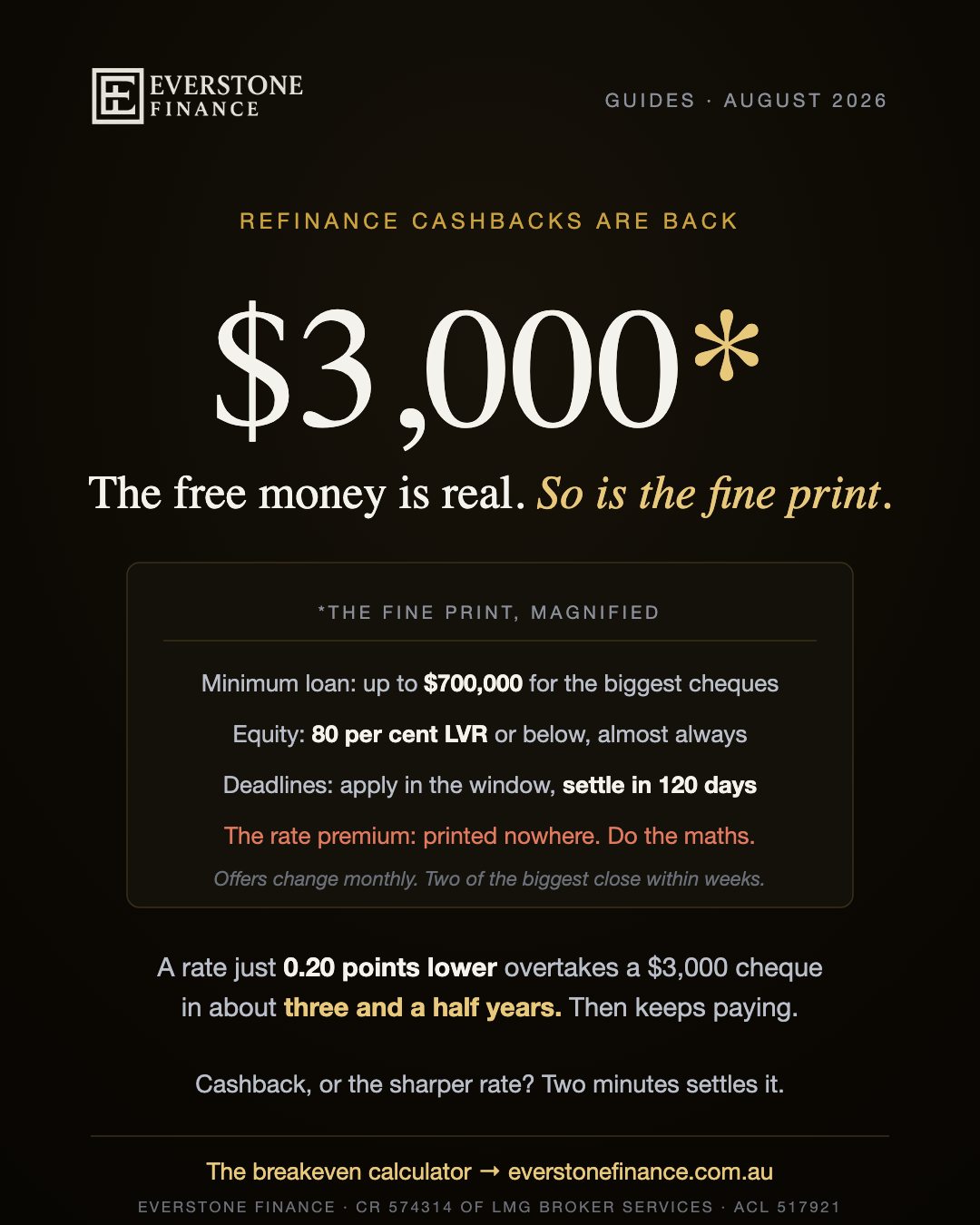
- Refinance cashbacks are back in force: as at August 2026, advertised offers mostly run $2,000 to $4,000, one lender tiers up to $10,000 on very large balances, and one major bank pays frequent flyer points instead of cash.
- The fine print decides everything: minimum loan sizes from $250,000 to $750,000, almost always 80 per cent LVR or below, application windows that close on fixed dates, settle-within-120-days clauses, and repayment-type exclusions.
- The honest maths: a cashback pays once, a sharper rate pays every month. On a typical loan, a rate just 0.20 percentage points lower overtakes a $3,000 cashback in around three to four years, then keeps paying for decades. Sometimes the cashback still wins. The calculator below settles it for your numbers.
- Offers change monthly and the best one for you depends on rate, fees and fine print together. We check the live list across more than 40 lenders when we review a loan, at no cost to you.
What is actually on offer right now
As at August 2026, Australian lenders are advertising refinance cashbacks mostly between $2,000 and $4,000, with one lender tiering offers up to $10,000 for balances above $2 million and one major bank offering frequent flyer points instead of cash. Offers open and close monthly, so any list is a snapshot.
Cashbacks faded from the market for a while; they are firmly back. Right now the going rate for switching your home loan is $2,000 to $4,000 in cash, paid at or shortly after settlement. The size of the cheque usually tiers with the size of the loan: the biggest mainstream offers want $700,000 or more of new lending, mid-range offers sit around $500,000, and entry offers start near $250,000. At the edges of the market it gets more colourful: one lender pays up to $10,000 on balances above $2 million, and one major bank has swapped cash for hundreds of thousands of frequent flyer points on its digital product. Typical qualifying conditions are a minimum loan size between $250,000 and $750,000 depending on the offer and tier, a loan-to-value ratio of 80 per cent or less, an application received inside a fixed offer window, settlement within a deadline such as 120 days, and principal-and-interest repayments for owner-occupiers. Refinancing during a separation has its own rules: covered here.
Offer ranges checked 21 August 2026.
| Offer tier | Typical cashback | Common minimum loan | Common conditions |
|---|---|---|---|
| Entry offers | Lower end of $2,000 to $4,000 | From about $250,000 | LVR 80% or below, application inside the offer window |
| Mid-range to large offers | Upper end of $2,000 to $4,000 | Around $500,000 to $700,000 or more | Settlement within a deadline such as 120 days |
| Tiered top-end offers | Up to $10,000 | Balances above $2 million | Principal-and-interest repayments for owner-occupiers |
You will notice we have not named the lenders. That is deliberate, and not just house discipline: two of the largest offers on the market as we write this close to new applications within weeks, and a named list would be wrong by spring. Treat any cashback article, including this one, as a photograph of a moving object, and check the live offer sheet before you act on it. That check takes us minutes across more than 40 lenders; it takes a Saturday if you do it tab by tab.
The maths that decides it: once versus every month
A cashback is a one-off payment while a rate difference compounds monthly for the life of the loan, so the comparison is a breakeven calculation: divide the cashback by the monthly repayment difference between the cashback loan and the sharpest alternative.
Here is the whole decision in one sentence: the cashback pays once, the rate pays every month, and the question is which one is bigger over the time you will actually hold the loan. On a $600,000 loan with 25 years remaining, a rate just 0.20 percentage points lower saves roughly $70 a month, overtaking a $3,000 cashback in around three and a half years and then continuing to save for the remaining decades. A cashback attached to a genuinely sharp rate is a clean win; a cashback attached to a premium rate is a loan that pays you in year one and quietly charges you from year four onward.
According to Everstone Finance, a cashback pays once while a rate difference pays every month. On a $600,000 loan with 25 years remaining, a rate just 0.20 percentage points lower saves roughly $70 a month, overtakes a $3,000 cashback in around three and a half years, and keeps saving for decades afterwards.
Put rough numbers on it. On a $600,000 loan with 25 years to run, each 0.10 percentage points of rate is worth roughly $35 a month. So if the loan paying a $3,000 cashback carries a rate 0.20 points above the sharpest deal you could otherwise get, you are trading about $70 a month for the cheque, and the cheque runs out in around three and a half years. Hold the loan longer than that, and the “free” money has become the most expensive part of your refinance: over the remaining term the sharper rate is worth north of $20,000 against a $3,000 one-off.
Flip it, though, and the logic flips honestly with it. If the cashback lender’s rate matches or beats the market for your profile, the cashback is a genuine bonus: same loan you would have chosen anyway, plus thousands of dollars that can sit straight in the offset or cover the switching costs several times over. Those deals exist in the current market. The point is never “cashbacks bad”; the point is that the rate comparison comes first and the cheque comes second, and lenders advertise in exactly the opposite order.
Calculator: cashback versus the sharper rate
Enter your loan balance, years remaining, the cashback amount, the rate offered by the cashback lender, and the sharpest alternative rate available to you. The calculator shows the monthly repayment difference, how long the sharper rate takes to overtake the cashback, and the net position over your remaining term, computed on standard principal-and-interest repayments. Numbers are entered by you and processed in your browser: nothing is stored, sent anywhere, or seen by anyone.
Stop guessing which side of the trade you are on. Two rates, one cheque, your actual numbers:
Assumes principal-and-interest repayments over the years entered, rates constant for illustration, and excludes fees, which can change the answer; add annual package fees to your thinking. Your numbers are not stored, not sent anywhere, and not seen by us. General information only, not credit advice.
The fine print, translated
Cashback qualifying conditions follow a consistent pattern across the current market: a minimum loan size, commonly $250,000 at entry tiers and up to $700,000 or more for the largest cheques, with some lenders allowing split loans submitted together to combine toward the minimum; a maximum LVR of 80 per cent, putting the offers off limits above that equity line; a fixed application window and a settlement deadline, often 120 days from application; repayment-type exclusions such as no interest-only owner-occupier loans; refinance-only scope from another institution, excluding internal refinances; and payment at or shortly after settlement, usually into a transaction account with that lender.
Every offer sheet reads differently but the conditions rhyme. Translated into plain English:
- Minimum loan size. The headline cheques want big balances: the largest current mainstream offers require $700,000 or more of new lending, mid-tier offers want $400,000 to $500,000, and entry tiers start around $250,000. Some lenders let split loans submitted together count toward the minimum, which matters if your lending is structured across accounts.
- 80 per cent LVR, almost universally. If your equity position is thinner than 20 per cent, the cashback market is largely closed to you, and refinancing above 80 per cent can trigger lenders mortgage insurance that dwarfs any cheque anyway.
- Deadlines, twice. An application window with a hard close date, then a settlement deadline, commonly 120 days. Miss either and the cashback quietly evaporates while the loan proceeds. Discharge departments at losing lenders are not famous for hurrying, so the settlement clock is a real risk, not boilerplate.
- Repayment-type exclusions. Interest-only owner-occupier lending is commonly excluded, and some offers are one cashback per borrower or per property regardless of how many loans move.
- Where the money lands. Typically at or shortly after settlement, into a transaction account you must open with the new lender. Budget for it as a settlement-time arrival, not an application-time one.
Want the live offer sheet checked against your loan? Minutes, not a Saturday.
A former banker compares your rate against more than 40 lenders, includes every current cashback that your loan size and equity actually qualify for, and gives you the honest verdict: take the cheque, take the sharper rate, or stay put. You pay nothing at any step.
Book a chat with a former bankerThe four ways a cashback costs you money
The four common ways cashback refinances go backwards: a rate premium on the cashback product that overtakes the cheque within a few years; annual package fees on the products that carry many offers, which consume a $2,000 cashback in five to ten years by themselves; switching costs, including discharge fees, government registration fees and any break costs on fixed portions, which net the real cheque down; and serial churning, which racks up credit enquiries, repeated setup costs and time, and which some lenders now screen against. Each is manageable if it is measured before settlement rather than discovered after.
Trap one: the rate premium. Covered above, but it is the big one, so once more: the cashback exists to acquire you, and on some products the acquisition cost is built back into the rate. If the rate is 0.20 points off the pace, the cheque is spent by year four. Run the calculator; it is a two-minute immunisation.
Trap two: the annual fee. Plenty of cashback offers ride on packaged products carrying annual fees in the hundreds of dollars. A $395 annual fee eats a $2,000 cashback in about five years, silently, and it keeps charging after the cashback is a memory. Net the fee out over your realistic holding period before comparing anything.
Trap three: the switching costs. Discharge fees from the outgoing lender, government registration fees, occasionally application or valuation fees, and real break costs if part of your loan is fixed. Usually these total in the hundreds, not thousands, so the cheque survives, but on a fixed-rate break the arithmetic can invert entirely: a fixed break cost can eat the cashback on its own, so get the written break quote before counting the cheque. Our refinance savings calculator is built to hold the full both-sides ledger.
Trap four: the churn habit. If one cashback is good, five must be better, and a small industry of serial switchers now hops loans annually. Honestly: it can work, but each hop is a credit enquiry, a fresh set of switching costs, hours of paperwork, and a bet that your income, valuation and equity all still clear the bar this year. Some lenders have started screening out recent churners, and a knocked-back application is its own cost. Refinancing because the deal is better is housekeeping; refinancing as a hobby is a part-time job, and only the diligent come out ahead. If you are unsure which side of that line you are on, our guide to when to refinance your home loan covers the triggers and the cadence.
How we play it for clients
A broker treats the cashback as one input in the total cost of the loan: current live offers across the panel are filtered to what the borrower’s loan size, equity and repayment type actually qualify for, then compared on rate, fees and cashback together over a realistic holding period. Sometimes the recommendation is the cashback loan, sometimes the sharper rate without one, and sometimes repricing with the current lender beats both. Under the Best Interests Duty the recommendation must serve the borrower, and the service costs the borrower nothing.
When a client asks us about a cashback offer, the process is unglamorous. We pull the live offers across more than 40 lenders, delete the ones your loan size, equity or repayment type do not qualify for, which is usually most of them, and then compare what is left on the only number that matters: total cost over the years you will realistically hold the loan, rate, fees and cheque together. Sometimes the winner is the cashback loan, and the cheque lands in your offset. Sometimes it is a sharper rate with no cashback at all. And more often than the ads would like, the winner is a repricing call to your existing lender, who will quietly match the market to avoid losing you, no paperwork, no switching, no settlement deadline. The same review works if you live overseas: our guide to refinancing an Australian mortgage from overseas covers the fully remote process.
One more honest note, because service quality is part of total cost: some cashback offers come from lenders with slow assessment queues, and in a live purchase or a deadline refinance, weeks of turnaround time can cost more than any cheque pays. That operational knowledge, which lender is actually moving files this month, is not on any comparison site, and it is half the value of asking someone who lodges loans every week.
Frequently asked questions
What is a refinance cashback?
A one-off payment, currently between about $2,000 and $4,000 for most advertised offers, that a lender pays you for moving your home loan to them from another institution. It is an acquisition incentive: lenders pay it because winning a proven borrower is cheap growth, and it is typically paid at or shortly after settlement.
Which lenders are offering cashbacks right now?
The list changes monthly: offers open, close and change tiers on fixed dates, and two of the largest current offers close within weeks of this article’s publication date. Rather than publish a list that will be stale by spring, we check the live offer sheet across more than 40 lenders when we review a loan, filtered to what you actually qualify for.
Do cashback home loans have higher interest rates?
Sometimes, and that is the whole game. Some cashback offers sit on genuinely competitive rates, making the cheque a clean bonus; others carry a rate premium that overtakes the cashback within a few years. The breakeven calculation above, cashback divided by monthly repayment difference, is the two-minute test that separates them.
What loan size do I need to qualify?
Most offers set minimums between $250,000 and $500,000, and the largest current cheques require $700,000 or more of new lending. Offers commonly also require a loan-to-value ratio of 80 per cent or below. Some lenders allow multiple split loans submitted together to combine toward the minimum.
When is the cashback actually paid?
Typically at settlement or within a few weeks after it, usually into a transaction account opened with the new lender. Offers also carry deadlines on both ends: the application must land inside the offer window and the loan must settle within a set period, commonly 120 days, or the cashback lapses.
Is a refinance cashback taxable?
Tax treatment depends on your circumstances, and the answer can differ between owner-occupied and investment lending. Before you count the cheque as clean money, particularly on an investment loan, confirm the treatment with your accountant. We flag it in every review but we are not tax advisers, and this is general information only.
Can I keep refinancing for a new cashback every year?
People do, and with discipline it can pay, but each switch adds a credit enquiry, fresh switching costs, hours of paperwork, and a new assessment of your income and valuation. Some lenders have begun screening applications from recent serial switchers. It is a strategy for the organised, not free money on a loop.
Can I get these offers through a broker, and what does it cost?
Yes, cashback offers are generally available through broker channels, and the review costs you nothing: the lender that wins your loan pays us on settlement, and under the Best Interests Duty our recommendation must serve you, including when the honest answer is that a no-cashback loan, or staying put on a repriced rate, beats every cheque on the market.
The honest summary
The cashback market in August 2026 is real money: thousands of dollars for a switch many borrowers should be making anyway, in a year where the RBA has made clear no cut is coming to do it for you. Take the cheque when it rides on a sharp rate; that deal exists right now. Refuse it when it papers over a premium rate or an annual fee; that deal exists right now too, wearing the same advertising. The breakeven maths above separates one from the other in two minutes, and if you would rather have the whole market checked properly, filtered to what you qualify for, with the fine print read so you do not have to, that is literally what we do all day, and it costs you nothing.
There is a cheque with your name on it, or a rate that beats it. Find out which.
One conversation with a former banker: your loan against the live market, every cashback you qualify for on the table, and the honest total-cost verdict, even when the verdict is stay put. The review is free, and so is the follow-through.
Book a chat with a former bankerAbout the author. Ahmed Lotfi is co-founder of Everstone Finance and a former banker who now works as a mortgage and finance broker in South Yarra, Melbourne, arranging home, investment and commercial lending for clients across Australia and abroad. Everstone Finance operates under the Best Interests Duty as Credit Representative 574314 of LMG Broker Services Pty Ltd, Australian Credit Licence 517921.