

RBA August 2026: Rates on Hold, What It Means for You
On 11 August, the Reserve Bank’s Monetary Policy Board met again, and the lead-up delivered a masterclass in how fast rate expectations move. As recently as mid-July, 55 per cent of surveyed economists expected another rise in 2026, most of them tipping August, and one of the four major banks was forecasting back-to-back hikes that would have taken the cash rate to 4.85 per cent, its highest since 2011. Then the June-quarter inflation numbers landed soft, trimmed mean inflation at 3.6 per cent against forecasts of 3.7 and the RBA’s own 3.8, and within a day traders had scrapped their hike bets. The consensus, which proved right: a hold at 4.35 per cent, one the experts are calling a hawkish hold, with one major bank’s economics team declaring the Board on the sidelines for the rest of 2026 and rate cuts a 2027 story. The whole professional rate-watching industry just repriced its view in twenty-four hours. Here is the question that should prompt: when did you last reprice yours? Because whatever the Board does, your own rate is drifting either way, and checking it is the one move that pays in every branch. Written by former bankers who watched exactly how banks reprice around meetings like this one. And in a calendar coincidence, decision day is also census night: our piece on the mortgage question the whole country answers Tuesday covers the other half of the day.
- The RBA meets on 11 August 2026, and after the June-quarter CPI undershot forecasts, markets now expect a hold: traders scrapped their hike bets within a day of the print.
- A fortnight ago a majority of economists tipped a hike; today they do not. If professional expectations can flip in a day, your assumptions about your own rate deserve a check too. (If a rise ever does land: roughly $95 to $100 a month on a $600,000 loan, as an illustration.)
- For most borrowers, the hike is the smaller number: the gap between what loyal customers pay and what new customers are offered is usually worth several rate rises on its own.
- Whichever way the Board goes, the rational move is the same: know your rate before your lender moves it. If you cannot name your rate right now, that is the tell.
- A rate review with us is free, does not touch your credit file, and works for owner-occupiers, investors and business borrowers alike. Book a chat with a former banker before the meeting does it for you.
What the forecasters actually expect
The picture flipped in late July: June-quarter trimmed mean inflation printed at 3.6 per cent, below the 3.7 forecast and the RBA’s own 3.8, and traders promptly scrapped their August hike bets. Markets now expect the Board to hold on 11 August, and one major bank’s economists see the RBA sidelined for the rest of 2026, with cuts a 2027 story.
Update, 2:30pm, 11 August: the RBA held at 4.35 per cent. As every surveyed economist expected, the cash rate stays put, and the news moves to the Board’s language and the quarterly forecasts. For borrowers the practical meaning is blunt: your rate is not falling on its own, which makes the review yours to start. Our refinance savings calculator shows what the market gap on your loan is worth, and tonight, census night, the whole country writes down what it pays: check the number before you type it.
Rewind a fortnight and the surveys told one story: 55 per cent of economists expected another rise in 2026, 62 per cent of them nominating August, and one of the four majors was forecasting hikes in both August and September, to 4.85 per cent. Then, on 28 July, the June quarter CPI landed: headline inflation rose 0.6 per cent for the quarter with the annual rate easing to 4.0 per cent, and the trimmed mean, the measure the Board watches closest, came in at 3.6 per cent annually, below the 3.7 forecast and the RBA’s own 3.8 projection. Within a day, traders had axed their rate-rise bets, and the market consensus for 11 August swung to a hold at the current 4.35 per cent. One major bank’s economics team now describes the Board as firmly on the sidelines for the remainder of 2026. We name no banks as a matter of policy, but the speed of the reversal is the story. Price yours in sixty seconds of typing with our home loan refinance savings calculator.
Economists had flagged exactly this contingency: Saul Eslake said before the print that his expectation of an August rise “depends on the June quarter inflation figures”, and the figures duly moved the market. A hold is now the expectation, not a certainty; expectations have already flipped once this fortnight, and the Board decides on the data, not the commentary. We make no prediction of our own, and this article works identically whichever way the decision lands, because the useful move for a borrower is the same in both branches.
What a hike does to your repayment
As an illustration, a 0.25 percentage point increase adds roughly $95 to $100 a month to a $600,000 principal and interest loan over 30 years at current rates, about $50 per $300,000 borrowed. Two hikes, as one major bank forecasts, roughly doubles that. Lenders typically pass increases through to variable rates within weeks. The week also brought a reminder that banks themselves move: HSBC is leaving Australian retail banking, and its borrowers face exactly this review question.
The arithmetic of a hike, should this cycle ever deliver another, is modest and worth knowing precisely so headlines never do your thinking for you. On a $600,000 principal and interest loan over 30 years, a 0.25 percentage point increase adds roughly $95 to $100 a month; scale that up or down for your balance, about $50 a month per $300,000 borrowed. If both of the back-to-back rises one bank forecast were to land, call it $190 to $200 a month on that same loan. Real money, not catastrophe.
Two mechanical notes from the inside. First, pass-through is fast on the way up: variable rates typically move within weeks of a cash rate decision, and your lender does not need your permission. Second, fixed-rate borrowers are not exempt, just deferred: if your fixed term ends in the next year or so, the rate environment on the other side of the cliff is being set by exactly these meetings, and our fixed rate expiry guide covers how to land it without the usual damage.
The number bigger than the hike: your loyalty gap
The gap between what existing borrowers drift onto and what the same lender offers new customers is routinely several times the size of one rate hike. If you have not checked your rate in over a year, the meeting on 11 August is not your biggest rate event; your own back-book pricing is. A free review measures the gap in one conversation. And if a review does find you a lower rate, our years-off calculator shows what holding your current repayment at it does to your loan’s length.
Here is the perspective the rate-decision coverage always misses. While everyone argues about 25 basis points, the average borrower who has not reviewed their loan in a couple of years is very often sitting multiple hikes’ worth above what their own lender writes for new customers today. Banks price loyalty and inattention; we watched it from the inside, and it is the entire reason the refinancing market exists. A hold environment sharpens it: when the cash rate sits still, lenders compete for growth the only way left, sharper pricing for new and refinancing customers, while the back book keeps quietly funding the discounts. The plain-English refinancing guide covers the mechanics, and our five-point self-audit shows you how to find your own number.
So ask yourself the only question this meeting really raises: when did you last actually check your rate? Not felt vaguely aware of it. Checked it, against the market, the way you would compare any other bill. If the answer is more than a year ago, then whatever the Board does on 11 August, you are almost certainly donating more to your lender through drift than the hike itself would cost you. And while you have the statement out, run our offset check calculator too; as ASIC just showed, the loan features you already pay for are not always doing their job either.
This logic is not residential-only. Business and commercial facilities drift harder than home loans because they are reviewed even less, and refinancing business debt no longer carries the paperwork ordeal it used to, as our no-tax-returns business refinance piece explains. One review, every facility, same conversation. The full commercial picture, deposits, pricing and reviews, is in our commercial property loans guide.
The expert read: a hawkish hold, not a pivot
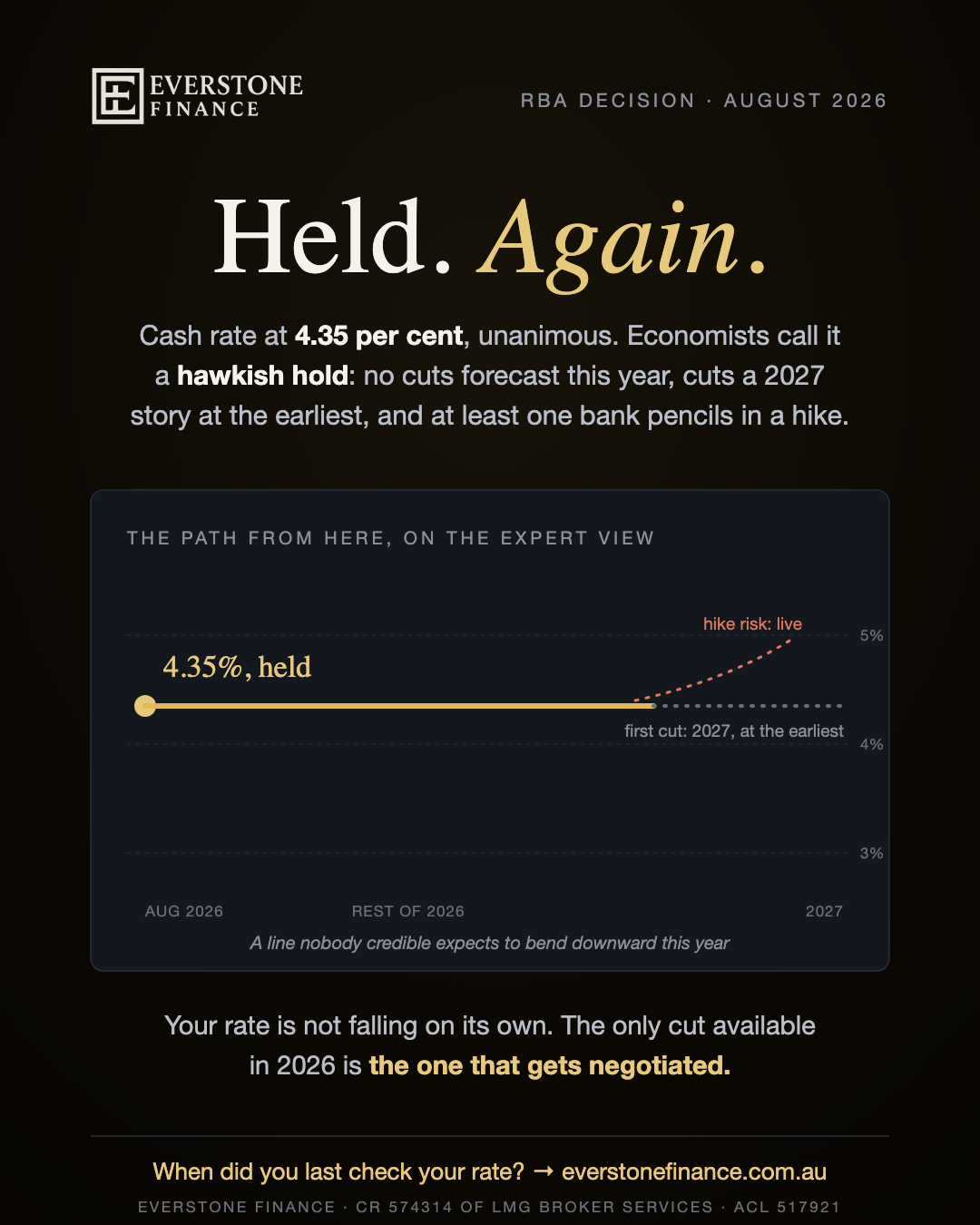
The RBA held the cash rate at 4.35 per cent on 11 August 2026 with the Board unanimous, and Governor Michele Bullock repeated that inflation is still too high and kept a further rise on the table. Economists have labelled it a hawkish hold: the big four banks expect no more hikes this year but see cuts as a 2027 story at the earliest, at least one investment bank has a November hike pencilled in, and market pricing treats a late-year rise as a live chance. The practical meaning for borrowers is that no cut is coming to lower repayments soon, so any rate improvement this year has to be negotiated rather than waited for. The full playbook, including the repricing call and when to move lenders, is in our guide to cutting your rate yourself.
The commentary since the decision has settled on one phrase: a hawkish hold. The vote was unanimous, the statement repeated that inflation is still too high, and Governor Bullock made a point of keeping the door to another rise open rather than soothing anyone. This was a pause with a warning attached, not the first step of a cutting cycle.
The expert split since is worth reading closely. The big four banks have all ruled out further hikes this year, and the more optimistic among them see cuts beginning in 2027 at the earliest, if inflation keeps easing. The hawkish tail is real, though: at least one investment bank’s economics team has a November hike pencilled in, pointing to strong discretionary spending, and market pricing treats a late-year rise as a live chance rather than a tail risk. Nobody credible is forecasting a cut this year.
Sit with what that means if you have been waiting. The plan of “hold on until rates fall” now has an official price tag: a year or more of your current rate, with some risk it rises first. The only rate cut available to you in 2026 is the one negotiated on your own loan, which is exactly what the loyalty-gap numbers above and the next section are about.
What to do now the decision is in, honestly
Do not try to outguess the Board; the professionals just demonstrated how that goes. Position so the decision matters less. Know your current rate, measure it against the market, have your refinance option ready, and decide on fixing based on your circumstances rather than one meeting. A free broker review before the meeting costs nothing and touches nothing on your credit file.
The honest playbook, in order:
- Find your actual rate today. Statement or app, sixty seconds. If it surprises you, that is information.
- Measure the gap, not the headline. A free review compares your rate against what 40+ lenders write today for your exact situation. That number, not the RBA’s, is the one you can act on.
- Decide about fixing on your terms, not the meeting’s. Fixing some or all of a loan is a personal-circumstances decision about certainty, not a bet on one announcement; fixed pricing already has expectations baked in. We walk both sides of it with you rather than selling either.
- If you are buying, get the pre-approval current. Rate moves change borrowing power; a stale pre-approval is the classic August casualty.
- Then let the meeting be interesting instead of stressful. Positioned borrowers watch rate decisions the way people with umbrellas watch clouds.
One reassurance worth stating plainly: a rate review with a broker does not touch your credit file. Nothing is lodged, no enquiry is recorded, and nothing changes unless you decide to move. It is measurement, not commitment, and the lender pays us only if you eventually switch and settle.
The Board held on 11 August. Your rate, you can decide this week.
Bring your current rate, or just your statement, and a former banker will tell you plainly where you sit against the market, what a hike would do to you, and whether moving is worth it. Free, no obligation, no credit-file touch.
Book a free rate reviewFrequently asked questions
When is the next RBA interest rate decision?
The Reserve Bank’s Monetary Policy Board met on 11 August 2026 and held the cash rate at 4.35 per cent. After the June-quarter CPI undershot forecasts, with trimmed mean inflation at 3.6 per cent against the RBA’s 3.8 projection, traders scrapped their hike bets and markets now expect the Board to hold at 4.35 per cent, though expectations have already flipped once this month.
How much would a 0.25 per cent rate rise add to my repayments?
As a rule-of-thumb illustration at current rates, roughly $95 to $100 a month on a $600,000 principal and interest loan over 30 years, or about $50 per $300,000 borrowed. Your exact figure depends on your balance, term and rate; a review calculates it precisely alongside the more useful number, which is your gap to current market pricing.
Should I fix my rate before the August meeting?
Fixing is a personal-circumstances decision about certainty and cash-flow, not a bet on one announcement, and fixed pricing already reflects market expectations of future moves, so there is rarely a free lunch in beating a meeting. The genuine questions are how much rate certainty your budget needs and what flexibility you would give up. This is general information, not advice; we talk through both sides for your situation, free.
Will lenders pass on an RBA increase?
Historically, increases to the cash rate flow through to variable home loan rates quickly, typically within weeks, and lenders do not need borrower consent to reprice a variable loan. That speed on the way up is precisely why knowing your current rate, and your alternatives, before a live meeting is worth an hour of preparation.
Does getting a rate review hurt my credit score?
No. A review conversation with a broker involves no credit enquiry: nothing is lodged and nothing is recorded on your file. An enquiry only occurs later if you choose to proceed with an actual application to a lender. Measuring your position is free in every sense.
Is my lender likely to give me a discount if I just ask?
Sometimes, and it is always worth asking, but retention offers tend to appear only when a lender believes you are genuinely leaving, and they are usually calibrated to be just enough to keep you, not to match the market. Walking in with a written alternative from a competing lender changes that conversation entirely, which is exactly what a broker-run review arms you with.
Does this apply to investment and business loans too?
Yes, and usually more so. Investment loans carry their own pricing tiers, and business and commercial facilities are repriced less often and reviewed less often still, which makes their drift worse. A select major lender will currently refinance business lending on just 12 months of business bank statements and a statement of position, no tax returns, which removes the usual excuse for leaving a business facility unexamined.
Cannot name your current rate without looking? That is the most expensive kind of not-knowing in your budget. Book a free rate review with a former banker before 11 August, and walk into the announcement already positioned.
Sources
Related guides
About the author. Ahmed Lotfi is co-founder of Everstone Finance and a former banker who now works as a mortgage and finance broker in South Yarra, Melbourne, arranging home, investment and commercial lending for clients across Australia. Everstone Finance operates under the Best Interests Duty as Credit Representative 574314 of LMG Broker Services Pty Ltd, Australian Credit Licence 517921.
Umbrella, before the weather.
Whichever way 11 August goes, the borrowers who do well out of rate cycles are the ones who know their number before the market moves it. One free conversation gets you there.
Book a chat with a former banker