

What Does a Mortgage Broker Cost in Australia? Who Pays, and What You Actually Pay (2026)
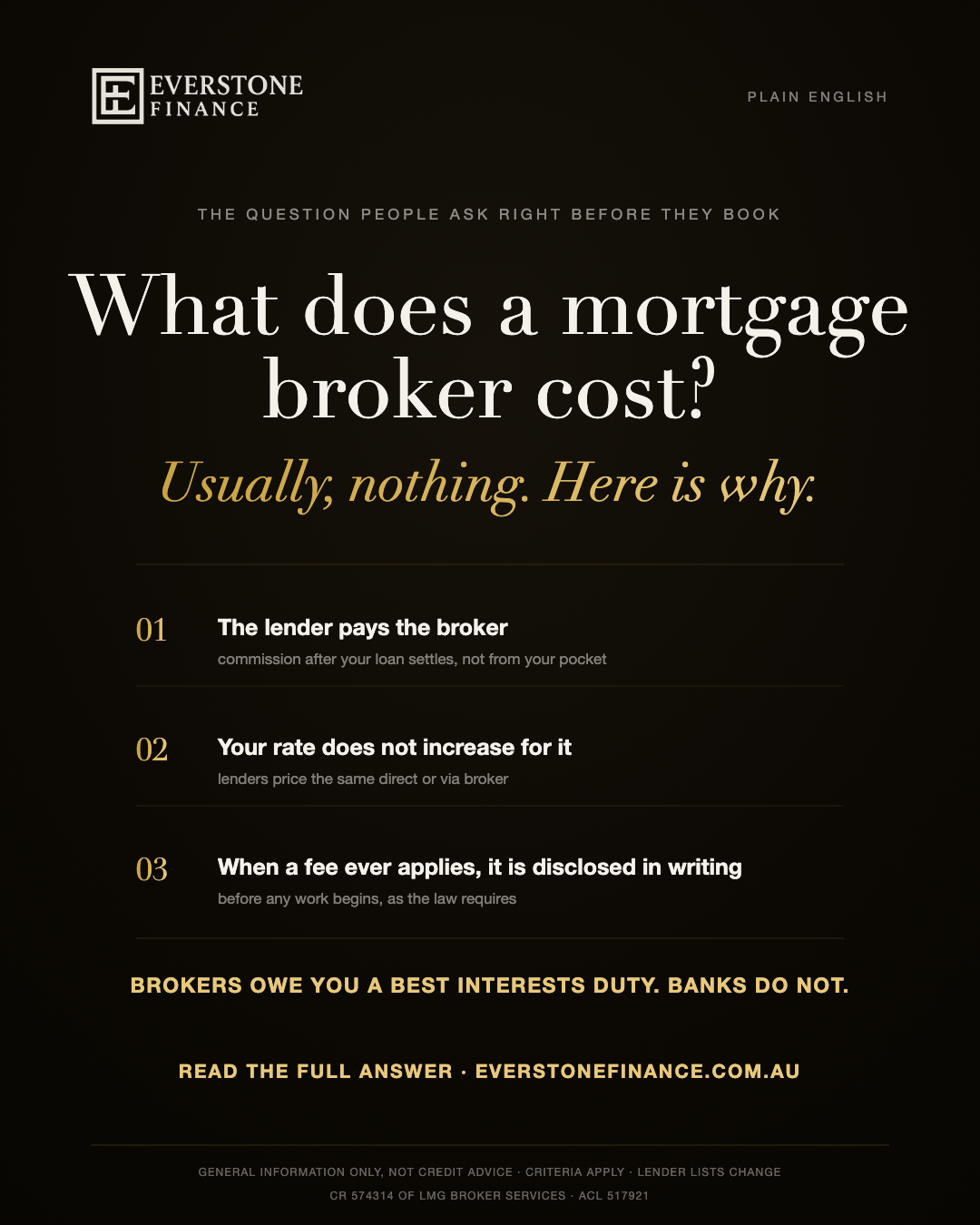
- For almost every residential home loan in Australia, a mortgage broker costs you nothing. The lender pays the broker a commission once the loan settles, out of the lender’s own margin, and your interest rate is not increased to cover it.
- Fees apply only in specialist cases such as commercial or asset finance, specialist lending and bridging, and any fee must be disclosed to you in writing before you apply. If a loan is repaid or refinanced within two years, the lender can take some or all of the upfront commission back from the broker. On a regulated home loan the credit regulations do not allow that cost to be charged to you.
- Next step: ask one question up front, “Will I be charged a fee, and if I refinance within two years, can the clawback be charged to me?” A good broker answers both in one sentence, and on a regulated home loan the second answer is no.
You know who pays the broker. The next question is what the broker finds. Put your loan in front of a former banker, free.
Have your current rate and balance to hand, or the property you plan to buy. You see the lenders we would approach, and how we are paid on your loan is put in writing first.
Book a rate check with a former banker
Is using a mortgage broker free in Australia?
How much does a mortgage broker cost, and who pays the commission? For almost every residential home loan in Australia, a mortgage broker costs you nothing. The lender pays the broker a commission once your loan settles, an upfront commission plus a smaller monthly trail, out of the lender’s own margin. You are not charged a fee, and your interest rate is not increased to cover it. Fees exist only in specialist cases, and they must be disclosed to you in writing before you apply.
This is the question people ask last, usually right before they book, and it is the one most brokers answer with a single word. “Free.” That is true for the large majority of home loans, but it is not the whole picture, and the borrowers who understand the full picture negotiate better.
Here is exactly how a mortgage broker gets paid in Australia, what it costs you, when a fee does apply, and what the law requires you to be shown.
Who actually pays the mortgage broker
The lender does. When your loan settles, the lender pays your broker a commission. There are two parts to it.
| Payment | When it is paid | Who pays it | What you pay |
|---|---|---|---|
| Upfront commission | Once, after settlement | The lender | Nothing |
| Trail commission | Monthly, while the loan runs | The lender | Nothing |
| Broker fee | Only in specialist cases | You, if it applies | Disclosed in writing first |
Both commissions come out of the lender’s own margin. Upfront is calculated on the loan amount drawn down. Trail is a smaller ongoing payment that continues only while your loan stays open, which is the part that quietly matters: your broker is paid to keep your loan suitable for as long as it runs, not only to settle it.
Why lenders are happy to pay it. A loan written through a broker costs a lender less than a loan written through a branch network. No branch, no branch staff, no local overhead. The commission is cheaper than the shopfront it replaces.
Does using a broker make your interest rate higher?
No. This is the most common misunderstanding about broker cost, and it is worth being precise about.
Lenders do not run a separate, more expensive rate card for broker-introduced loans. The commission is paid out of the lender’s margin on a loan they have already priced. You are quoted from the same rate card either way. In practice a broker often lands a better rate than the branch will offer you unprompted, because the broker knows what the other lenders on their panel are currently pricing at and will use it.
Where a rate difference does show up, it is almost never about the broker. It is about the product, the loan to value ratio, whether the loan is owner occupied or investment, and whether the lender is currently buying market share.
When a mortgage broker does charge a fee
Most residential home loans carry no fee to you. There are situations where a broker legitimately charges one, and an honest broker tells you before you have spent any time on it, not after.
- Commercial, business or asset finance. Structures are more complex and commission arrangements differ from residential lending.
- Specialist or non-conforming lending. Cases involving credit impairment, unusual security or complex income often take substantially more work.
- Short-term and bridging finance. Some of these lenders pay little or no commission.
Repaying a home loan early is not on that list. If a loan is repaid or refinanced within two years, the lender can take some or all of the upfront commission back from the broker. On a regulated home loan the credit regulations do not allow that cost to be charged to you (regulation 28VG, National Consumer Credit Protection Regulations 2010).
Ask this early. “Will I be charged a fee, and if I refinance within two years, can the clawback be charged to me?” Any broker should answer both in one sentence, and on a regulated home loan the second answer is no. If the answer is vague, that is your answer.
See the numbers on your own loan, at no cost.
The lender pays us at settlement, so a rate check against 40+ lenders costs you nothing. A former banker shows what your loan should look like, free.
Book a free rate check with a former bankerRather ask a question than book a time? WhatsApp, text or call Ahmed about how a broker is paid, or about your own loan. His own mobile, no call centre, and no cost to ask.
What the law requires you to be shown in writing
Broker pay in Australia is not something you have to guess at or take on trust. Under the National Consumer Credit Protection Act, you must be given written disclosure before you proceed.
- Credit Guide. Given to you early. Sets out who the broker is, their licence details, the lenders they work with, and how they are paid.
- Credit Proposal Disclosure. Given before you apply. Sets out the specific loan being recommended, any fee payable by you, and the commission the broker expects to receive on that loan.
That second document is the one to actually read. It names a number. If a broker has not put one in front of you before you sign an application, ask for it.
Best Interests Duty: the part that actually protects you
Since 1 January 2021, mortgage brokers have been bound by a Best Interests Duty under the National Consumer Credit Protection Act 2009. It requires a broker to act in your best interests and to give priority to your interests when providing credit assistance. Brokers cannot contract out of it; the Act contains a specific anti-avoidance provision.
Banks are not subject to it. The duty applies to brokers, not to credit providers recommending their own products. A branch lender can recommend their own loan without any legal obligation to consider whether a better one exists elsewhere, because from their side there is no elsewhere.
This is the real answer to what a broker costs. The service is free at the point of use and it comes with a legal duty attached that the free alternative does not have.
The market has already voted. Mortgage brokers settled a record 81.6 per cent of all new residential home loans in Australia in the June 2026 quarter, $139.08 billion of new lending, according to MFAA data compiled by Cotality. That is up from 77.6 per cent a year earlier and 53.9 per cent in June 2018. Four in five borrowers now use a broker.
Broker or bank: what each one actually costs you
| Mortgage broker | Bank branch | |
|---|---|---|
| Cost to you | Usually nothing | Nothing |
| Lenders compared | Whole panel, commonly 30 to 60 | One |
| Legal duty to you | Best Interests Duty applies | Does not apply |
| Paid to keep your loan suitable | Yes, via trail | No equivalent |
| Written pay disclosure | Required before you apply | Not required |
| If your rate drifts | Broker can move you | You have to ask |
Frequently asked questions: what a mortgage broker costs
Is using a mortgage broker free in Australia?
For almost all residential home loans, yes. The lender pays your broker a commission after settlement and you pay nothing. Fees apply mainly to commercial, specialist and short-term lending, and any fee must be disclosed to you in writing before you apply.
How do mortgage brokers get paid if I do not pay them?
The lender pays them. There is an upfront commission after your loan settles and a smaller monthly trail commission for as long as the loan stays open. Both come out of the margin the lender earns, not out of your loan or your rate.
Do I get a worse interest rate because the broker gets a commission?
No. Lenders do not price broker-introduced loans higher. You are quoted off the same rate card. A broker will often secure a sharper rate than an unprompted branch offer because they can see what competing lenders are currently pricing at.
Is the commission added to my loan balance?
No. Commission is paid by the lender to the broker. It does not appear in your loan amount, your repayments or your fees, and it is not something you repay.
What is trail commission and does it cost me anything?
Trail is a small monthly payment from the lender to the broker while your loan remains open. It costs you nothing. Its practical effect is that your broker has a reason to keep the loan suitable for you long after settlement.
What is clawback and can it be charged to me?
If a loan is repaid or refinanced within two years, the lender can take some or all of the upfront commission back from the broker. On a regulated home loan the credit regulations do not allow that cost to be charged to you (regulation 28VG, National Consumer Credit Protection Regulations 2010).
Do mortgage brokers have to act in my best interests?
Yes. Since 1 January 2021 brokers have been bound by a Best Interests Duty under the National Consumer Credit Protection Act 2009, and must give priority to your interests. Banks recommending their own products are not subject to this duty.
How do I find out exactly what my broker is being paid?
Read the Credit Proposal Disclosure. Brokers must give it to you before you apply, and it states the specific commission expected on the loan being recommended. You are entitled to ask for it at any point.
Is a broker worth it if I already have a bank I like?
It costs you nothing to find out. A broker can price your existing lender against the rest of the market, so you see where the rate from your bank sits rather than assuming it.
Does a broker charge more for a first home buyer?
No. First home buyer loans are standard residential lending and carry no fee to you. Government schemes such as the Australian Government 5% Deposit Scheme (formerly the Home Guarantee Scheme) are also accessed through participating lenders at no additional broker cost.
The honest summary
A mortgage broker is free to you on virtually every home loan, paid by the lender out of its own margin, with no effect on your rate or your balance. Fees exist at the specialist end of the market and must be disclosed before you apply. The thing worth more than the zero price tag is the Best Interests Duty, which applies to your broker and does not apply to the bank you would otherwise walk into.
If you want to know what your current loan looks like against the rest of the market, that conversation costs nothing either.
Sources and useful references
- MFAA: mortgage brokers support over three quarters of borrowers, a record 81.6 per cent in the June 2026 quarter
- Moneysmart: using a mortgage broker
- ASIC: best interests duty for mortgage brokers
- Federal Register of Legislation: National Consumer Credit Protection Regulations 2010, regulation 28VG, clawback requirements (compilation of 5 September 2026, read 10 October 2026)
Find out what your loan looks like against the market.
A free quick review with a former banker. No fee, no obligation, and you will know plainly whether your current rate is still competitive.
Book a free review