

ATO Tax Debt Loans in Australia (2026): Refinancing Your Home Loan to Clear a Tax Debt, the Lenders That Accept It and What the Tax Office Charges
Yes. A tax debt can be refinanced into a home loan with the lenders that accept it. Everstone Finance, former bankers, arranges these refinances through Liberty, Bluestone and Brighten. Until the debt is cleared, the tax office adds its general interest charge, which compounds daily and can no longer be claimed as an income tax deduction. A first call works the numbers on your own figures.
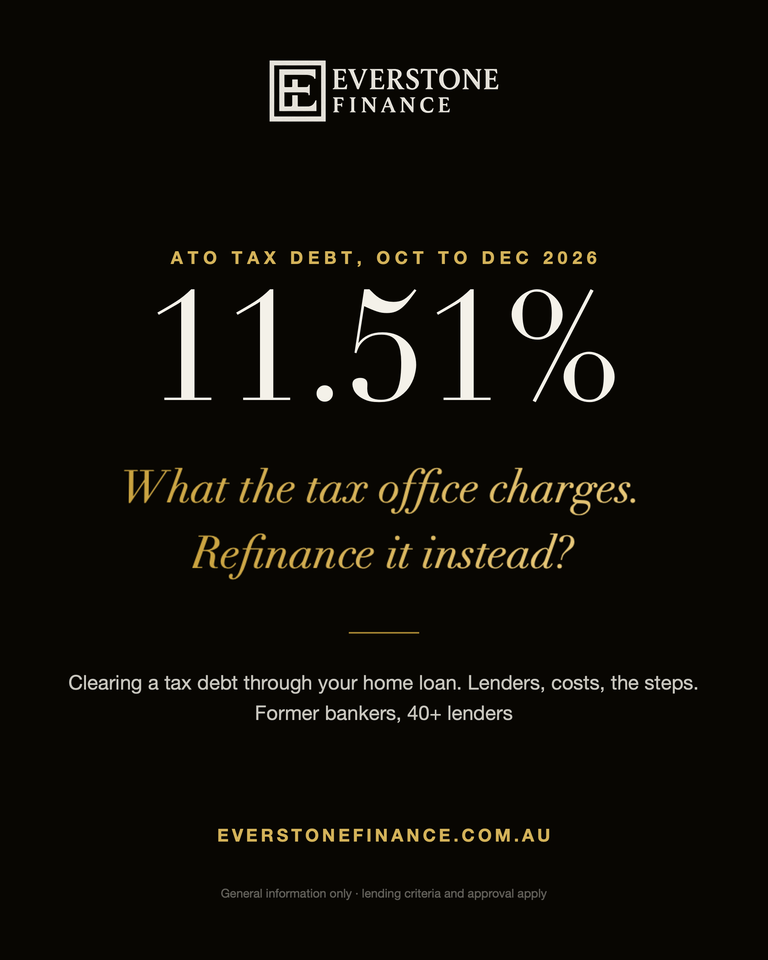
- The charge: the tax office’s general interest charge is 11.51% a year for October to December 2026, reset every quarter and compounded daily.
- No deduction: charges incurred on or after 1 July 2025 cannot be claimed as an income tax deduction.
- Payment plans: interest keeps accruing on a tax office payment plan, and a plan is not automatic.
- Credit cards: the tax office accepts cards until 30 June 2027. After that, a card goes through a third-party payment provider.
- The refinance: the three lenders we use for this each publish that a tax debt can be paid out through a home loan. The lender assesses every file.
Tax office interest adding up every day? Ahmed, a former banker, works out what your home loan can do about it.
Tell him roughly what the tax office is owed and what is left on the home loan. He comes back with the lender that suits the file and the repayment on your own numbers.
Book a call about my tax debtCan you refinance a home loan to pay an ATO tax debt?
Yes. A refinance replaces your home loan with a new one from another lender. Where the home is worth enough more than the loan against it, the new loan can be made larger, and the extra pays the tax office at settlement. The tax debt becomes part of the home loan and, where the lender offers a split, sits in a separate portion with its own repayment.
Not every lender does this, so the choice of lender comes first. Liberty says in an article dated 1 August 2020 that many banks will not refinance tax debt, and that flexible lenders such as Liberty can help. Ahmed Lotfi, the former banker behind Everstone Finance, places these files with Liberty, Bluestone and Brighten. Each still assesses the borrower, the property and the debt before it decides.
Bluestone says in an article on its own site that many Australians, especially self-employed people and small business owners, owe the tax office money.
Borrowing more than you owe today is a cash out, which our cash out refinancing guide explains. The steps of a switch are in our home loan refinancing guide.
One boundary. A registered tax agent advises on the tax; Everstone Finance arranges the loan.
How much interest does the ATO charge on an unpaid tax debt?
The tax office applies the general interest charge, or GIC, when tax or another liability is unpaid after its due date. The rate is set each quarter. The daily rate is the annual rate divided by the days in the year, and the charge compounds daily.
| Quarter | Annual rate | Daily rate |
|---|---|---|
| October to December 2026 | 11.51% | 0.03153425% |
| July to September 2026 | 11.43% | 0.03131507% |
| April to June 2026 | 10.96% | 0.03002740% |
| January to March 2026 | 10.65% | 0.02917808% |
| October to December 2025 | 10.61% | 0.02906849% |
| July to September 2025 | 10.78% | 0.02953425% |
The annual rate fell at the October 2025 reset and has risen at each of the four since, from 10.61 per cent to 11.51 per cent. We make no guess about the next one.
The tax office says that general interest charge and shortfall interest charge incurred on or after 1 July 2025 cannot be claimed as an income tax deduction, even where the debt relates to an earlier year, under the Treasury Laws Amendment (Tax Incentives and Integrity) Act 2025.
Can you pay the ATO with a credit card? Yes, until 30 June 2027
Yes, for now. On 9 October 2026 the tax office announced that it will keep accepting credit card payments for tax obligations until 30 June 2027. ABC News reported the same day that the tax office had planned to stop taking cards from December 2026, after the Reserve Bank’s surcharge ban, and had said that absorbing the card fees would cost about $200 million a year.
The Treasurer’s media release says the government will provide transitional funding for the extension, and that in 2024 to 25 just over two per cent of individuals and around five per cent of small businesses paid the tax office by credit card.
After 30 June 2027 a card is still possible through a third-party payment provider. The tax office tells people to weigh the fees, charges and processing times and to check the provider’s credentials.
A card moves a tax debt. It does not clear it: the balance lands on the card, at the card’s rate and inside its limit. For a debt too large to clear within a statement or two, the home loan is the place to look.
Which lenders offer tax debt loans, and does tax debt affect a home loan?
A tax debt affects a home loan in two ways. It narrows the list of lenders, and with one lender it decides which tier the loan sits in. Here is what each of the three lenders we use says on its own public site, as read on 12 October 2026. Rates and fees are left out: the ones that count are the ones a lender offers on your file.
- Liberty. On its debt consolidation home loans page, Liberty says it can look to refinance different types of debt, and lists credit cards, personal loans, car loans and tax debt.
- Bluestone. The Bluestone refinancing page lists unlimited debt consolidation, including ATO debt and business loans, and says applications with an imperfect credit history are considered. In an article dated 8 July 2025, Bluestone says it may be possible to roll a tax debt into a home loan, which may reduce monthly repayments and leave one repayment.
- Brighten. Brighten publishes two tiers on its full documentation home loans page. Near Prime is described as offering unlimited debt consolidation including payout of ATO debts. Prime states that ATO debts are not accepted.
With that last lender the tax debt itself decides the tier: a file that needs the tax office paid out belongs in Near Prime from the start, however tidy the rest of it is. Read only the Prime terms and the answer looks like no, when the tier that takes a tax debt is Near Prime.
Which lender fits depends on the size of the debt against the value of the home, how your income is shown and your repayment history. Where the tax debt came with missed repayments or a default, our bad credit home loans guide covers how lenders read those.
ATO payment plan or tax debt refinance?
A tax office payment plan spreads the debt into weekly, fortnightly or monthly instalments over the shortest possible fixed period. Extra payments can be made at any time, and refunds and credits are offset against the debt. Income tax and activity statement accounts need separate plans.
| What differs | Tax office payment plan | Home loan refinance |
|---|---|---|
| Interest | The general interest charge, compounded daily. | The rate the lender offers on your file. |
| Who decides | The tax office, which may refuse the terms or the plan. | The lender, on its own assessment. |
| If things slip | A new tax debt lodged or paid late may default the plan, and the full overdue balance becomes payable. | The debt is secured by your home, so a missed repayment is a missed home loan repayment. |
The two are not rivals. A plan can run while a refinance is arranged and, on approval, the new loan pays the balance out at settlement.
A worked example: one tax debt, four ways to repay it
This is our own arithmetic on round numbers. Take a tax debt of $80,000. The tax office side uses the charge for October to December 2026, 11.51 per cent a year, held there throughout, though the tax office resets the rate every quarter and it can move either way. The home loan side uses one illustrative rate of 7.50 per cent a year. It is not the rate of any lender.
At the daily rate, $80,000 attracts $25.23 of interest on the first day. Left untouched for a year at this quarter’s rate, it would grow by $9,757.
| How the $80,000 is repaid | Monthly repayment | Total interest |
|---|---|---|
| Tax office payment plan over two years, at 11.51 per cent | $3,750 | $9,990 |
| Home loan split repaid over two years, at 7.50 per cent | $3,600 | $6,399 |
| Home loan split repaid over five years, at 7.50 per cent | $1,603 | $16,182 |
| Spread over the remaining 25 years of the home loan, at 7.50 per cent | $591 | $97,358 |
The first two rows are like for like: same debt, same two years, and the home loan split costs $3,591 less in interest at the illustrative rate, before switching costs and any rate change on your existing balance.
The last two show the trade a longer term makes. Over five years the repayment is less than half the plan’s, and the interest is higher than the tax office would have charged over two. Over 25 years the interest is more than the debt itself. So we look to put the tax debt in its own split, on the shortest schedule your cash flow can carry.
The method: the tax office side divides 11.51 per cent by 365 for the daily rate, compounds it over one twelfth of a year for an effective monthly rate, and solves for a level instalment over 24 months. The home loan side charges one twelfth of the illustrative 7.50 per cent each month over 24, 60 or 300 months. Total interest is the unrounded repayments less the $80,000. It assumes the tax office accepts a two year plan, which it may not. The tax office has its own online payment plan estimator.
Your tax debt, your home loan, your cash flow. Ahmed runs this table on your figures.
Keep the tax office balance and a recent home loan statement within reach. A former banker sets the split, the term and the repayment beside the payment plan and names the lender he would take the file to.
Run this table on my numbersWhat does a lender look at on an ATO debt consolidation loan?
A lender paying out a tax debt weighs three things: the debt, the home and your income. None of it is needed before the first call, though it helps to have these within reach.
- The tax office balance. What is owed, and whether a payment plan is in place.
- The home loan. The balance, the rate and whether any part is fixed.
- The property. A rough value to start; the lender arranges a valuation of its own.
- Your income. Payslips if employed; if self-employed, tax returns or the alternative documents described below.
Each lender then asks for its own documents as it assesses the file. For a rough sense of what your income supports, our borrowing power calculator gives a band, not a decision.
Can the ATO report a tax debt to credit bureaus?
For a business tax debt, yes, in defined circumstances. The tax office says it may report a business tax debt to credit bureaus where all of these apply.
- The entity has an ABN and is not an excluded entity (a deductible gift recipient, complying super fund, registered charity or government entity).
- At least $100,000 is overdue by more than 90 days.
- The business is not engaging with the tax office to manage the debt.
- There is no active complaint with the Tax Ombudsman about the intent to report.
A business that has a payment plan and is complying with it counts as engaging, and is not reported even at $100,000 or more. The tax office writes first and gives 28 days from receipt of the notice to act.
That page covers business tax debts. It does not address an individual’s own tax debt, so we draw no conclusion about one.
Lenders check with credit bureaus, so those 28 days are the time to engage with the tax office and see whether the home can clear the debt.
Self-employed with a tax debt: a home loan on alternative documents
Bluestone says on its owner occupier home loans page that it accepts alternative documents for income verification and serves self-employed borrowers. Brighten has a separate page for self-employed borrowers, with the same split: Near Prime accepts the payout of ATO debts and Prime does not. That page says self-employed income can be shown by one of three things: an accountant’s letter on the lender’s template, the most recent six months of business activity statements, or the most recent three months of business bank statements.
We match the evidence you already hold to the lender that accepts it. More is in our self-employed home loans guide and, if the business carries borrowing of its own, in our guide to refinancing a business loan without tax returns.
What does a tax debt refinance cost?
The switching costs can include a fee to discharge the loan you have, the incoming lender’s fees to set the new one up, a valuation, settlement and registration costs and, where part of the current loan is fixed, a break cost.
The cost of the loan is its rate, and the new rate applies to everything that moves, not only the tax debt. So we compare the whole position: the tax debt at the tax office against the tax debt in the new loan, any change in the rate on your existing balance, and the switching costs. You see one net figure before you decide.
It also need not be the last loan you hold. Once the tax office is paid and the repayments have a clean record, the loan can be reviewed again.
How Everstone arranges an ATO tax debt loan, step by step
Everstone Finance is a Melbourne brokerage of former bankers. With a tax debt, much depends on how a lender’s credit team reads the debt, so we read the file that way before anything is lodged, and choose the lender first.
- The first conversation. By phone or video call: what the tax office is owed, what is left on the home loan and how your income is shown.
- The numbers in writing. The split, the term and the repayment beside the payment plan.
- The lender. Which of the three fits the file, and the documents it asks for.
- Application. The file is lodged a single time, with the lender chosen for it, and that lender has the property valued.
- Decision and settlement. The decision is the lender’s. On approval, the new loan repays the old one and pays the tax office.
Keep engaging with the tax office while this runs. To start, book a time with Ahmed.
Frequently asked questions
Can you get a home loan with ATO debt?
Yes, with a lender that accepts it. For a homeowner the route is a refinance: the new home loan repays the old one and pays the tax office at settlement. Everstone Finance arranges these loans through Liberty, Bluestone and Brighten. Each lender makes its own decision on the file.
Which lenders offer tax debt loans in Australia?
Everstone Finance places tax debt refinances with three lenders. Liberty lists tax debt among the debts it says it can look to refinance. Bluestone lists ATO debt under debt consolidation on its refinancing page. Brighten publishes that its Near Prime tier accepts the payout of ATO debts and its Prime tier does not.
Does tax debt affect a home loan?
Yes. It narrows the choice of lender. Liberty says on its own site that many banks will not refinance tax debt. Brighten publishes two tiers, and the tax debt decides which one the loan sits in. The lender still assesses the file before it decides.
How much interest does the ATO charge on a tax debt?
The general interest charge is 11.51 per cent a year for October to December 2026, which is 0.03153425 per cent a day. The tax office resets the rate each quarter and the charge compounds daily. Charges incurred on or after 1 July 2025 cannot be claimed as an income tax deduction.
Can you pay the ATO with a credit card?
Yes, until 30 June 2027. The tax office announced on 9 October 2026 that it will keep accepting credit card payments until that date. After it, a taxpayer who wants to pay by card can use a third-party payment provider.
Is an ATO payment plan or a tax debt refinance better?
On a payment plan the debt stays with the tax office, where the general interest charge keeps accruing and compounds daily. A refinance moves it into a home loan at the rate the lender offers, where a longer term lowers the repayment and raises the total interest. Everstone Finance, former bankers, sets the two side by side on your own numbers.
Sources
- Australian Taxation Office, general interest charge rates page, last updated 4 September 2026 (when the charge applies; the rate set each quarter and generally announced two weeks before the quarter starts; the daily rate as the annual rate divided by the days in the year; the annual and daily rates for the six quarters from July to September 2025 to October to December 2026): ato.gov.au, read 12 October 2026
- Australian Taxation Office, payment plans page, last updated 24 February 2026 (weekly, fortnightly or monthly instalments over the shortest possible fixed period; the general interest charge continues to accrue and compounds daily; separate plans for income tax and activity statement accounts; a plan may default where new tax debts are not lodged and paid on time; refunds and credits offset against the debt; extra payments at any time; the tax office may refuse the terms proposed or a plan; the online payment plan estimator): ato.gov.au, read 12 October 2026
- Australian Taxation Office, page on denying deductions for ATO interest charges, last updated 8 June 2026 (general interest charge and shortfall interest charge incurred on or after 1 July 2025 cannot be claimed as an income tax deduction, even where the debt relates to an earlier year; the charge on unpaid income tax is incurred daily; the Treasury Laws Amendment (Tax Incentives and Integrity) Act 2025): ato.gov.au, read 12 October 2026
- Australian Taxation Office, page on disclosure of business tax debts, last updated 15 October 2025 (the four conditions for reporting a business tax debt to credit bureaus, including at least $100,000 overdue by more than 90 days; an excluded entity is a deductible gift recipient, a complying super fund, a registered charity or a government entity; a business complying with a payment plan counts as engaging and is not reported; 28 days from receipt of the notice): ato.gov.au, read 12 October 2026
- Australian Taxation Office, media release published 9 October 2026 (credit card payments for tax obligations accepted until 30 June 2027; third-party payment providers after that date; weigh the fees, charges and processing times and check a provider’s credentials): ato.gov.au, read 12 October 2026
- The Treasurer, the Small Business Minister and the Assistant Treasurer, media release of 9 October 2026 (transitional funding so that credit cards are accepted until the end of the financial year, with costs to be settled in the mid-year budget update; in 2024 to 25 just over two per cent of individuals and around five per cent of small businesses paid the tax office by credit card; free and low-fee methods such as debit card and bank transfer; the link to the Reserve Bank’s surcharging reforms): ministers.treasury.gov.au, read 12 October 2026
- ABC News, 9 October 2026 (the tax office had planned to stop taking credit cards from December 2026 after the Reserve Bank’s surcharge ban, and had said that absorbing the card fees would cost about $200 million a year): abc.net.au, read 12 October 2026
- Worked example: our own arithmetic on a tax debt of $80,000. The tax office side uses the general interest charge for October to December 2026, 11.51 per cent a year, divided by 365 for the daily rate, compounded over one twelfth of a year for an effective monthly rate, with a level monthly instalment over 24 months. The home loan side uses an illustrative 7.50 per cent a year, one twelfth of it each month, with a level monthly repayment over 24, 60 or 300 months. Total interest is the repayments less the debt, and figures are rounded to the nearest dollar. The tax office rate is held at the current quarter only to do the arithmetic, since it is reset every quarter. The illustrative rate is ours alone and is not a quote. Every loan is priced by its lender on that lender’s own assessment of the file when an application is made, and switching costs are left out of the example.
- Liberty, debt consolidation home loans page (in its questions and answers: it can look to refinance different types of debt, listing credit cards, personal loans, car loans and tax debt): liberty.com.au; article on tackling a tax debt, dated 1 August 2020 (a homeowner may be able to refinance and consolidate a tax debt into the home loan; many banks will not refinance tax debt and flexible lenders can help; interest may keep accruing on a payment plan): liberty.com.au, both read 12 October 2026. No rate, fee, loan size or loan to value figure from these pages is used.
- Bluestone, refinancing page (unlimited debt consolidation including ATO debt and business loans; applications with an imperfect credit history considered): bluestone.com.au; owner occupier home loans page (unlimited cash out and debt consolidation, footnoted as subject to eligibility; alternative documents accepted for income verification; self-employed borrowers): bluestone.com.au; article on managing tax debt and a home loan, dated 8 July 2025 (borrowers in complex situations including ATO debt; in the right circumstances it may be possible to roll a tax debt into a home loan; interest usually continues on a payment plan and terms can be strict; many Australians, especially self-employed people and small business owners, owe the tax office money): bluestone.com.au, all read 12 October 2026. No rate, fee, loan size or loan to value figure from these pages is used.
- Brighten, full documentation home loans page (two tiers: Near Prime with unlimited debt consolidation including payout of ATO debts, Prime with ATO debts not accepted; refinance and equity release, owner occupied or investment): brighten.com.au; alternative documentation page for self-employed borrowers (the same split between the tiers; the three ways of showing self-employed income): brighten.com.au, both read 12 October 2026. No rate, fee, loan size or loan to value figure from these pages is used.
Lender names on this page identify whose published pages we read. Everstone Finance is not affiliated with, endorsed by or acting on behalf of any lender named here.