

Refinance Your Business Loan With No Tax Returns (2026): One Year of Statements Can Be Enough
Ask a room of business owners why they have never refinanced the loan quietly bleeding their margins and you will hear the same answer in different accents: the paperwork. Two years of tax returns, accountant-prepared financials, interim statements, and by the time the pile is assembled the motivation is gone and another year of the old rate is paid.
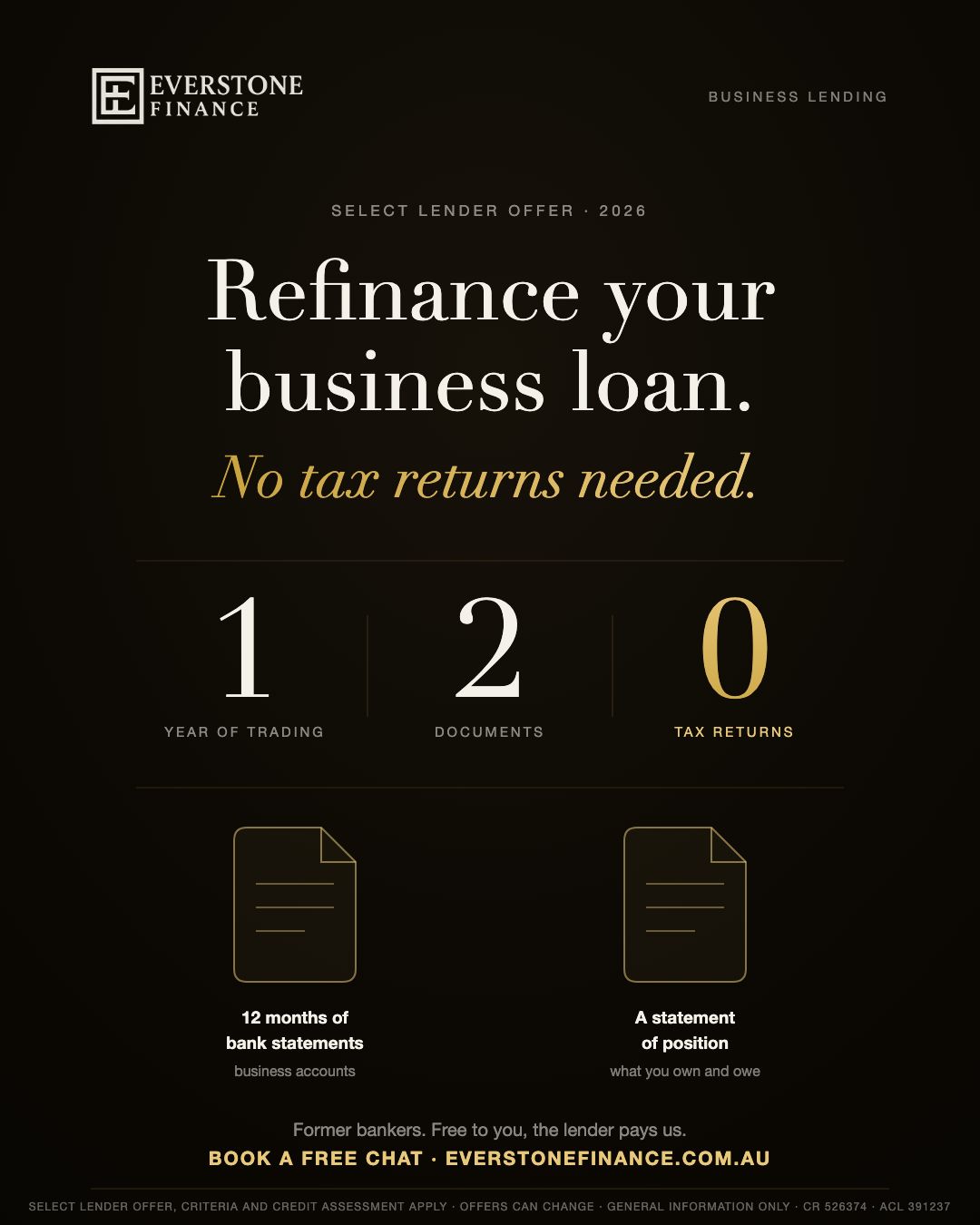
Here is the update that changes that arithmetic: at a select major lender, a business that has been operating for one year or more can currently refinance its business lending with exactly two documents: 12 months of business bank statements, and a statement of position. No tax returns. No accountant-prepared financials for the application. Your statements tell the lender what your business actually does, in real time, instead of what a tax return said about a year that ended long ago.
This guide explains how the offer works, who it genuinely suits, what a statement of position actually is, and how to move on it while it exists, written by former bankers who arrange business and commercial lending every week. To see what the switch is worth in dollars first, run our refinance savings calculator: monthly difference, and the totals over 1, 10, 20 and 30 years. And if the strong dollar has fattened your margins this year, our piece on making the currency windfall permanent explains why now is the moment lenders read you best.
- At a select major lender, businesses trading for 1 year or more can refinance business lending with no tax returns.
- The application runs on two documents: 12 months of business bank statements and a statement of position.
- It suits owners who are behind on lodgment, growing faster than their last return shows, or simply time-poor.
- Standard credit assessment and criteria still apply, and lender offers like this change, so timing matters.
- Book a chat with a former banker, we know exactly which lender runs this and whether your business fits.
- What is the no tax returns business loan refinance offer, in plain terms?
- Why are tax returns the wall for business refinancing?
- Does the two-document refinance suit your business?
- What are the two documents, exactly?
- Beyond the paperwork: is the refinance itself worth it?
- Why do business owners run this through Everstone?
- Frequently asked questions
If the business has traded for less than a year, or the lending is a new purchase rather than a refinance, the statement path is not open yet and the answer moves to the low doc and no doc lenders. Our low doc and no doc commercial loans guide compares what La Trobe Financial, Liberty, RedZed, Pepper Money, Thinktank, Prime Capital and the short-term private lenders publish: which documents replace the tax returns, the 65 to 80 per cent loan-to-value caps, and the 12-month facilities built around an exit rather than around financials.
What is the no tax returns business loan refinance offer, in plain terms?
A select major lender is currently refinancing existing business lending for businesses that have operated for at least one year, using 12 months of business bank statements and a statement of position instead of tax returns. Standard credit assessment still applies; the change is what evidences your income, not whether it is assessed.
Strip the banking language away and the offer is this simple. If your business has been trading for a year or more and carries business debt written somewhere else, a select major lender will currently assess a refinance of that lending on:
- Twelve months of business bank statements, the account your trading actually runs through, showing revenue arriving and expenses leaving in real time, and
- A statement of position, a one-page summary of what the business and its owners own and owe.
That is the application. No tax returns. No waiting on your accountant to finalise last year’s financials, no explaining why the return from a lean year does not reflect the business you run today. The lender reads your last twelve months of actual banking, applies its normal credit assessment, and decides on the business as it currently trades.
Two honest framing notes before anything else. First, this is a documentation change, not a free pass: serviceability, conduct and credit history are assessed as rigorously as ever, just from fresher evidence. Second, it is one lender’s current offer, and lender offers change without notice, which is half the reason to have a broker who tracks them. We name no lenders in public content as a matter of policy; knowing which doors are open this quarter is precisely the value we bring to the conversation.
Why are tax returns the wall for business refinancing?
Because tax returns are slow, backward-looking and expensive to produce. Many strong businesses lodge late, many returns describe a year that no longer resembles current trading, and legitimate tax planning deliberately minimises the profit a return shows. Bank statements solve all three: they show the business as it is, not as it was.
The traditional business refinance file asks for up to two years of tax returns and financials, and that requirement quietly disqualifies or discourages an enormous share of good businesses, for three very ordinary reasons:
- Returns run behind reality. A refinance assessed today on your last lodged return can be reading a year that ended long ago. If your business has grown since, the paperwork literally cannot see it, and the loan you qualify for is sized to a smaller business than the one you run.
- Lodgment lags are normal. Plenty of profitable, well-run businesses lodge late, extensions through an accountant are routine, and a refinance that demands the missing return goes straight to the bottom of the to-do list, where it dies.
- Good tax planning works against you. Your accountant’s job is legitimately minimising taxable profit. A return engineered to show less profit then becomes the very document a lender uses to size your borrowing. Statements sidestep the contradiction: they show cashflow, not accounting outcomes.
Bank statements invert all three problems. They are current to the month, they exist without anyone preparing them, and they show the raw truth of trading: money in, money out, every week. For a lender, twelve months of clean statements is arguably better evidence of a business’s health than a polished return about the distant past, which is exactly why this style of assessment exists.
Does the two-document refinance suit your business?
Best fit: businesses past their first birthday with solid trading visible in their statements, owners behind on lodgment or whose growth outpaces their last return, and time-poor operators who will never assemble the full-doc pile. Weaker fit: businesses whose statements show struggling cashflow, where the traditional file may actually present better.
An offer like this is not a universal answer, and pretending otherwise would waste your time. Here is the honest sorting:
It suits you well if. Tick what applies to your business:
0 of 5 fit signals ticked
Think harder, and talk to us first, if your statements show a rough patch, seasonal troughs or irregular deposits that need context, because raw statements carry no footnotes. Sometimes the traditional file, where an accountant’s financials can explain a one-off, actually presents your business better, and sometimes a different lender’s policy fits your shape entirely. Reading which presentation wins for your specific business is former banker work, and it is exactly the assessment we run before anything is lodged. The same thinking applies across our self-employed lending guide on the home side: the file you present determines the answer you get.
Not sure which column you sit in?
A former banker reads your last twelve months of statements the way the credit team will and tells you plainly whether they make your case or complicate it, before anything is lodged. No cost, no obligation.
Check whether my statements make the case, freeRather message than book? WhatsApp or text Ahmed about refinancing your business loan without tax returns. His own mobile, no call centre, and no obligation.
What are the two documents, exactly?
Twelve months of statements for the account your business trades through, downloadable from internet banking in minutes, and a statement of position: a structured summary of assets and liabilities for the business and its owners. Most clients assemble both in under a day, and we prepare the statement of position with you.
Since the whole offer is the paperwork, here is precisely what the paperwork is:
| Document | What it is | Where it comes from |
|---|---|---|
| 12 months of business bank statements | The full statement history of the account your trading runs through, showing turnover, expenses and conduct | Downloaded from your internet banking in minutes |
| Statement of position | A structured one-page summary of what the business and its owners own and owe: assets, debts, limits and repayments | We prepare it with you from information you already know |
General information only, not credit advice. Exact requirements are set by the lender at application and can include standard identity, entity and security checks alongside the two core documents.
What the assessor actually reads in your statements. A few practical notes from the files we run:
- Conduct matters. The statements show every dishonour and every month the account went backwards, so the twelve months you present are the twelve months you have. If a rough patch sits in the window, it is worth a conversation before applying rather than after.
- The statement of position is not an accounting document. It is a disciplined list, and preparing it with a broker takes an hour, not a bookkeeping engagement.
- Separation helps. Businesses that run trading through one clean account present dramatically better than those with revenue scattered across personal and business accounts. We see the scattered version every week, and it is worth fixing this month even if you refinance next quarter.
Beyond the paperwork: is the refinance itself worth it?
Removing the documentation wall only matters if the refinance pays. The test is the same as ever: current rate and fees against the market, break costs if any, and what freed-up repayment room does for the business. Our business loan refinancing guide runs that maths; this offer simply removes the excuse for not running it.
We should be clear about what this offer does and does not change. It removes the barrier to applying. Whether refinancing is worth doing is the same commercial question it always was, and we hold it to the same standard: the new lending must beat the old on the numbers that matter, rate, fees, structure and flexibility, by enough to justify the switch. Our full guide to business loan refinancing walks that arithmetic properly, and it pairs with this piece: that article answers “should I”, this one answers “how, without the paperwork ordeal”.
What we can say from the files we see is that business lending drifts worse than home lending, because busy owners review it less. Facilities written years ago at different market rates, overdrafts that crept up and never came down, equipment finance stacked at whatever rate applied that month: the neglect compounds quietly. If the paperwork was the reason the review never happened, that reason just got much smaller, and the same review can extend to your commercial property loan while the file is open, and our commercial refinance calculator shows what a rate change on that facility saves each month and when switching pays back.
In short: the two-document route removes the excuse for not reviewing the loan; whether the refinance pays is still decided by rate, fees, structure and break costs against what you hold today.
Why do business owners run this through Everstone?
Because knowing which lender runs which offer, this quarter, is literally the job. Everstone Finance are former bankers arranging business, commercial and home lending under one roof: we confirm your fit before anything is lodged, prepare the statement of position with you, and present your statements the way credit teams read them.
An offer like this rewards speed and presentation, and both are our home ground. We know the lender running it and the criteria around it, we can tell you in one conversation whether your last twelve months of statements make your case or complicate it, and we prepare the statement of position with you so it lands the way a credit assessor expects. If your statements need context, we know which other lenders read a business’s shape more generously, because matching the file to the policy is what former bankers do all day.
There is also the whole-picture advantage. Business owners rarely hold one debt: there is the business loan, often a commercial premises loan, sometimes equipment finance, and a home loan carrying the family. We arrange all of it, which means the refinance conversation can weigh the entire balance sheet, the way we describe in our practice purchase guide for professionals, rather than optimising one facility while another leaks. And if owning your premises through super has crossed your mind, our step-by-step guide to buying property with your super shows what that takes.
On cost: for home lending the lender pays us on settlement at no cost to you. Commercial and business lending commissions are also generally lender-paid, and where any engagement terms apply to a complex transaction, they are agreed with you in writing before work begins. No surprises, either side.
One year of statements. One conversation.
Tell us how long you have been trading and roughly what your business owes, and we will tell you plainly whether the two-document refinance fits, and what it could change. No cost, no obligation.
Book a chat with a former bankerFrequently asked questions
Can I refinance a business loan without tax returns?
Currently, yes, at a select major lender: businesses that have operated for a year or more can refinance existing business lending using 12 months of business bank statements and a statement of position, with no tax returns required. Standard credit assessment and criteria still apply, and lender offers change, which is why we confirm current policy before anything is lodged.
How long does my business need to have operated?
One year or more under this offer. The twelve months of business bank statements effectively are the track record: they show turnover, expenses and account conduct across a full trading year, which is what the lender assesses in place of tax returns and accountant-prepared financials.
What is a statement of position?
A structured summary, usually a page or two, of what the business and its owners own and owe: assets like property, vehicles and equipment on one side, and debts, limits and repayments on the other. It is not an accounting document and does not need accountant preparation; we put it together with you from information you already have.
What if I am behind on my tax lodgment?
This is exactly the situation the offer helps, because the application does not ask for returns. Being behind on lodgment stops being a refinancing roadblock, though it remains something to resolve with your accountant in its own right, and any tax debts visible in your statements or statement of position still form part of the credit assessment.
Is a bank-statement refinance more expensive?
The documentation route does not change how we hold the deal to account: the refinance has to beat your current lending on rate, fees and structure or we will tell you it is not worth doing. Pricing is assessed case by case as with any business facility, and comparing the offer against the wider market is part of what we do before recommending it.
What kinds of business debt can be refinanced this way?
The offer targets existing business lending. Exactly which facilities fit, and how things like overdrafts or attached property security are treated, depends on the lender’s criteria at application, so we map your actual facilities against current policy in the first conversation. Commercial property loans have their own refinance path, which we also arrange and often review at the same time.
What does a broker cost for a business refinance?
Commissions on business and commercial lending are generally paid by the lender, as with home loans, and where any engagement terms ever apply to a complex transaction they are agreed with you in writing before work begins. The fit-check conversation costs nothing, and if the honest answer is that your current lending stands up, that is the answer you will get.
Reading this between jobs, invoices or shifts? That is the point of a two-document refinance. Book a time with a former banker, and bring nothing but how long you have been trading.
Sources
Related guides
About the author. Ahmed Lotfi is co-founder of Everstone Finance and a former banker who now works as a mortgage and finance broker in South Yarra, Melbourne, arranging home, investment and commercial lending for clients across Australia. Everstone Finance operates under the Best Interests Duty.
The paperwork excuse just retired
Twelve months of statements you can download tonight, a statement of position we build with you, and a refinance conversation your margins have been waiting for.
Book a chat with a former banker