

Self-Employed Home Loans in Australia (2026): How to Get Approved When the System Thinks You Earn Less
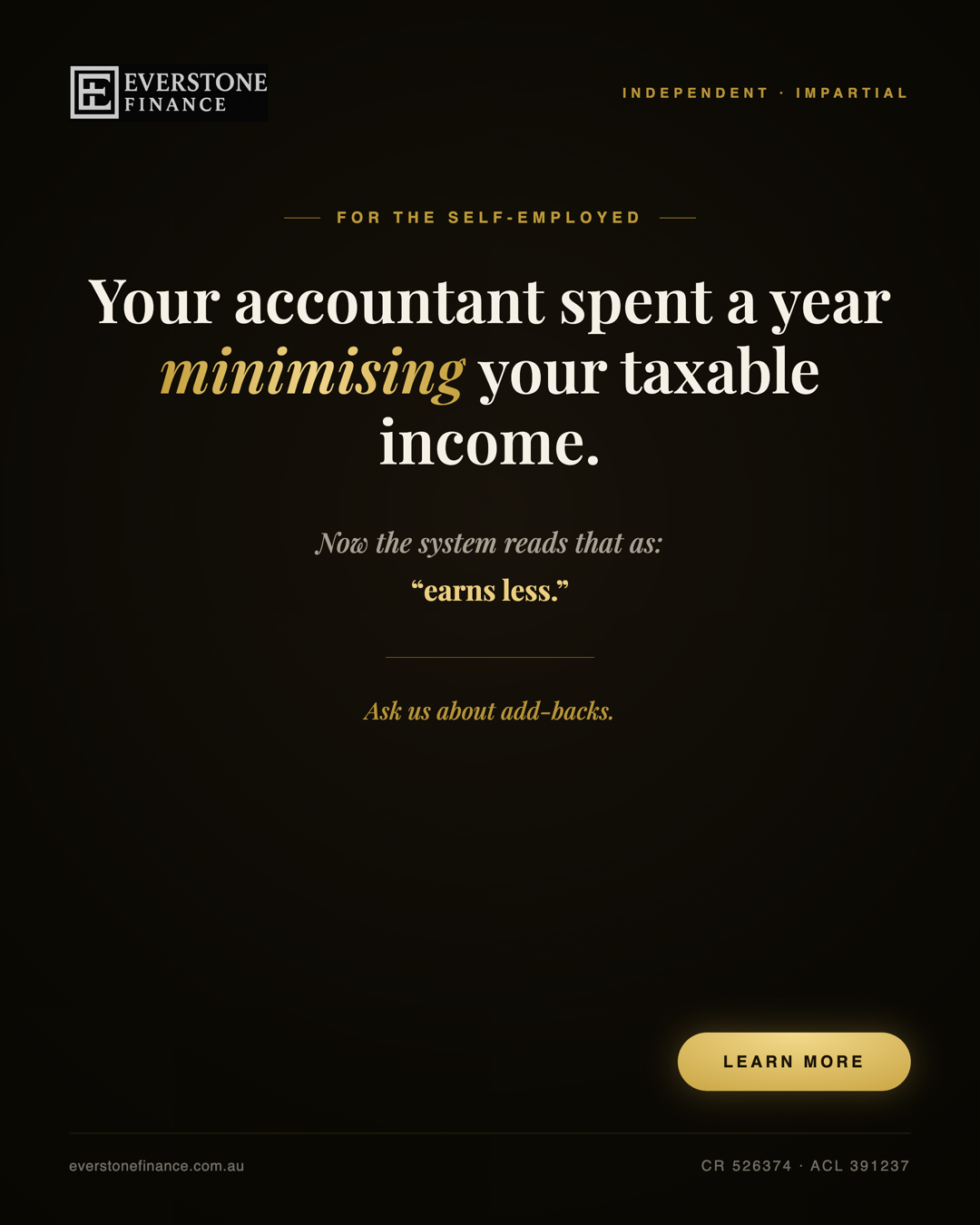
The thing that saves you tax is the same thing that shrinks your borrowing power. A good broker knows how to fix that.
- Banks lend against your taxable income, not your turnover. Your accountant works all year to make that taxable figure small. So the better your tax return looks for the ATO, the worse it often looks to a lender. That is the whole problem, and it is fixable.
- Add-backs are the fix. Lenders will add several deductions back to your income, depreciation, extra super, one-off costs, company profit you left in the business, so your assessable income climbs back toward what you actually earn. Different lenders add back different things.
- You do not always need two years of tax returns. Some lenders accept one year of financials, and a few will look at you with one year of ABN history if the rest of the file is strong.
- Low-doc is not a dirty word. If your income has grown faster than your tax returns show, a lender can assess you on your BAS, an accountant’s letter or business bank statements instead. The trade-off is usually a slightly higher rate or a larger deposit.
- The lender you pick decides the outcome. The same business, with the same numbers, can be a flat no at one bank and a comfortable yes at the next. Matching your situation to the right lender is exactly what we do.
Here is the quiet unfairness at the heart of self-employed lending. You take the risk, carry the staff, ride the quiet months and build something real. Then you go to buy a home, and a bank looks at one number on your tax return and decides you earn less than the PAYG employee down the road who has never made a payroll in their life.
It is not personal, and it is not a conspiracy. It is just that the system was built around payslips, and a payslip is easy to read. Your income is not on a payslip. It is spread across a business tax return, a personal return, a profit and loss statement, a BAS, and a set of decisions your accountant made to legally keep your tax bill down. Read the wrong way, all of that says “earns less.” Read properly, it often says the opposite.
At Everstone Finance we write these loans every week. Sole traders, company directors, tradies, consultants, e-commerce operators, medical professionals running their own practice. This is the plain-English guide we wish more of them had read before a bank knocked them back: how lenders actually assess self-employed income in 2026, what add-backs are and how they rescue your borrowing power, the difference between full-doc and low-doc, what to do if you have only been trading a year, and the handful of mistakes that get good businesses declined.
- Why the bank thinks you earn less
- How lenders actually read your income
- Add-backs: the money you get back
- Full-doc vs low-doc
- If you have only traded a year
- How much you can borrow
- Deposit, LMI and the 5% question
- Your document checklist
- Five mistakes that get you declined
- How we get self-employed approved
- Glossary
- FAQ
Why the bank thinks you earn less than you do
Lenders assess a self-employed applicant on taxable income, the profit left after every deduction your accountant has claimed. Because good tax planning is designed to make that figure as low as legally possible, your assessable income for a home loan often sits well below the cash your business actually generates. Add-backs and the right lender choice close most of that gap.
Picture a business turning over $420,000 a year. After wages, rent, vehicles, equipment, depreciation, super contributions and the rest, the accountant lands your personal taxable income at $95,000. For tax, that is a job well done. For a bank reading the return at face value, you are a $95,000 earner, full stop.
The employee comparison stings because it is so stark. A salaried worker on $130,000 hands over two payslips and a contract and the assessment is basically finished. You hand over two years of business returns, two years of personal returns, notices of assessment, a profit and loss, sometimes a BAS, and then wait while someone decides how much of your own income they are willing to believe. Same dollars in the bank. Very different experience. Tech contractors weighing a permanent offer should also see our tech employee home loans guide, since named-employer waivers require direct employment.
None of this means you cannot borrow well. It means the raw tax figure is the starting point, not the finish line, and that the lender who reads it generously is worth far more to you than a headline rate.
How lenders actually read self-employed income
There is no single rule, which is the first thing to understand. Each lender has its own credit policy, and the differences between them are where deals are won or lost. That said, a few patterns hold across most of the market.
They usually want two years, and they often take the lower one. The common approach is to look at your two most recent financial years and either average them or, more conservatively, use the lower of the two. If your income is climbing, that conservative habit hurts, because it anchors you to your weaker year. The good news is that some lenders will use your most recent year only when the trend is clearly up, which can lift your assessable income substantially.
Your structure changes the maths. How your income is read depends on whether you are a sole trader, a partnership, a company or a trust.
- Sole trader or partnership: the lender works from your personal tax return and the net profit of the business. Simple to follow, and your taxable income is front and centre.
- Company director: this is where many people undersell themselves. If you pay yourself a modest $90,000 wage but leave $80,000 of profit sitting in the company, a lender that only counts your wage sees $90,000. A lender that adds back your share of retained company profit sees $170,000. You did not earn a cent more or less. The policy did the talking.
- Trust: distributions, retained profit and who controls the trust all matter. It needs a lender comfortable reading trust financials, and not all of them are.
Some lenders skip the tax return entirely. A growing number will assess your income from your BAS (your GST turnover) or from your business bank statements, rather than from a finished tax return. For a business that has grown quickly, or whose returns are not yet lodged, this alt-doc route often shows a far healthier income than last year’s paperwork.
Add-backs: the deductions the lender gives back to you
An add-back is a business expense a lender adds back onto your taxable income because it is not a true ongoing cash cost to you. Depreciation, additional superannuation, one-off purchases and retained company profit are common add-backs. They can lift your assessable income by tens of thousands of dollars, and they are the single biggest lever in a self-employed application.
This is the part the image at the top of this guide is about. Your accountant spent the year minimising your taxable income. Add-backs are how a good lender, and a good broker, put the realistic version of your income back together. Here are the ones that matter most.
| Add-back | What it is | How lenders treat it |
|---|---|---|
| Depreciation | A paper deduction for the ageing of assets you have already paid for. No cash leaves your pocket each year. | Very commonly added back, often in full. Usually the largest single add-back. |
| Additional superannuation | Voluntary super you contribute above what is compulsory. | Many lenders add it back, since it is a choice, not a fixed cost. |
| Net profit retained in your company | Profit your company earned but did not pay out to you as wages. | Added back by lenders that assess company directors properly. Often huge. |
| One-off or non-recurring expenses | A genuine once-only cost, a new fit-out, equipment, a legal bill. | Case by case, with evidence and usually an accountant’s confirmation. |
| Interest on debt being cleared | Interest on a loan that is about to be refinanced or paid off. | Some lenders add it back, since the cost is going away. |
| Amortisation | A paper write-down of intangible assets like goodwill. | Frequently added back, similar logic to depreciation. |
Put together, add-backs are rarely trivial. Run the earlier example again. The business shows $95,000 taxable income. A lender that allows your $18,000 of depreciation, $12,000 of extra super and a $6,000 one-off cost now assesses you on $131,000. At a rough five-times-income guide, that is the difference between borrowing in the region of $475,000 and roughly $655,000. Same business, same year, same person. The only variable that moved was the lender’s policy on add-backs.
The lesson: never accept a borrowing figure from a single bank as your ceiling. If a lender ignored your add-backs, it did not assess your income. It assessed your tax planning.
Full-doc vs low-doc: which one fits you
Self-employed borrowers fall into two broad lanes. Most can go full-doc, which is the cheaper, mainstream route. Some are better served by low-doc, also called alt-doc, where income is proven a different way. Neither is better in the abstract. The right one is the one that matches your paperwork to your reality.
| Feature | Full-doc | Low-doc / alt-doc |
|---|---|---|
| Income evidence | Two years of tax returns and notices of assessment (one year with some lenders) | BAS statements, an accountant’s letter, or six to twelve months of business bank statements |
| Trading history | Usually two years, sometimes one | Often one year of ABN, occasionally six months with a strong file |
| Maximum LVR | Up to 95%, and higher again where an LMI waiver applies | Generally 60% to 80% |
| Interest rate | Standard market rates | A little higher, reflecting the lighter income proof |
| Best suited to | Established businesses with clean, lodged financials | Newer businesses, fast growth not yet in the returns, or income that is hard to show on paper |
A quick reality check on low-doc, because the name scares people off. It does not mean no documents and it does not mean anything goes. It means the lender accepts a different, legitimate proof of income, your GST turnover or your accountant’s declaration, when a finished tax return either does not exist yet or understates what you now earn. It is a tool for honest businesses, and it is regulated like any other loan.
What if you have only been trading a year?
You still have options. Several lenders will consider self-employed applicants with one year of financials, and a smaller group will look at you with as little as one year of ABN history. They will usually want a clean credit file, a steady income, and often a larger deposit. Two full years simply opens more doors at sharper rates. The same logic has reached business lending too: see the no-tax-returns business loan refinance.
The myth that you must wait two years before you can buy has cost a lot of people the home they wanted. It is often not true. If your business has been running for twelve months, your ABN and GST registration are in order, and your income shows up consistently in your business banking, there are lenders who will work with that. One of the majors will use a single year of financials at or below 80% LVR. Several non-bank lenders go further again for the right file.
The honest caveat is this. Under twelve months of trading is genuinely hard, and you may need to wait a little, lean on a specialist lender, or come in with a stronger deposit to balance the thinner history. We will tell you plainly where you sit rather than letting you find out through a knockback that leaves a mark on your credit file.
How much can you actually borrow?
The mechanics are the same as for anyone else. A lender takes your assessable income, subtracts your living costs and existing commitments, applies an interest rate buffer, and works out what you can comfortably repay. The buffer matters, because lenders test you at a rate two to three percent above the actual rate to make sure you can handle a rise.
Where self-employed borrowing power is won or lost is upstream of all that, in how your income is calculated in the first place. The same file, run through two lenders, can produce borrowing limits hundreds of thousands of dollars apart, purely because one counted your retained profit and add-backs and the other did not. So the real question is not only “how much can I borrow,” it is “which lender reads my income most generously, and is that lender still competitive on rate and policy.” That is a matching problem, and it is the part of the job we actually enjoy.
Worth knowing: paying down a credit card limit, clearing a car loan, or restructuring how you draw income from your company can each lift your borrowing power more than chasing a slightly lower rate. We look at the whole picture before you apply, not after.
Deposit, LMI and the 5% question
Being self-employed does not lock you out of a small deposit. On a full-doc application with solid financials, you can borrow up to 95% of a property’s value just like a salaried buyer, with lenders mortgage insurance covering the gap above 80%. The self-employed label changes how your income is proven, not the deposit tiers available to you.
Two routes can reduce or remove LMI even with a smaller deposit. If you work in an eligible profession, many lenders waive LMI up to 85% or 90% regardless of how you are paid, so a self-employed doctor, accountant or lawyer can often still access a waiver. And the federal First Home Guarantee can let an eligible first home buyer purchase with as little as 5% and no LMI, self-employed included, subject to the scheme’s caps. We cover both in our guides to LMI waivers for professionals and the first home buyer schemes by state.
Your self-employed document checklist
Walking in organised does two things. It speeds the whole process up, and it signals to a lender that the business is run properly. For a standard full-doc application, expect to provide most of the following.
- Two years of personal tax returns and ATO notices of assessment (one year for some lenders)
- Two years of business tax returns and financial statements, the profit and loss and the balance sheet
- Your ABN and GST registration details
- Recent business bank statements, usually three to six months
- Recent BAS statements, if you are assessed on turnover or going low-doc
- An accountant’s letter, for many low-doc applications
- Personal living-expense detail and statements for any existing debts
- Identification and, if relevant, details of the property you are buying
If some of that is missing or out of date, do not let it stop you reaching out. Half of our job early on is telling you the shortest path to a complete file, and which lender needs the least of it.
Five mistakes that get self-employed buyers declined
Most self-employed knockbacks are avoidable. These are the ones we see again and again.
- Applying to your own bank first. Your everyday bank is one policy out of dozens, and rarely the most generous on add-backs or trading history. People treat the first no as the final word. It almost never is.
- Letting a knockback hit your credit file. Every formal application can leave an enquiry. A string of declines makes the next lender nervous. Far better to match the right lender before you apply, not after.
- Aggressive last-minute tax minimisation. Slashing your taxable income the year before you buy saves a little tax and can cost you a lot of borrowing power. Talk to your broker and accountant together before lodging, not after.
- Messy business banking. Personal spending run through the business account, or income that does not reconcile to the returns, makes a lender cautious. Clean, readable accounts get read generously.
- Assuming low-doc is the only option. Plenty of self-employed buyers who think they need low-doc actually qualify full-doc once their add-backs are counted, at a sharper rate. The reverse happens too. The point is to check, not assume.
How Everstone gets self-employed buyers approved
We were bankers before we were brokers, so we have sat on the other side of the desk and read these files for a living. We know which lenders add back retained company profit, which will use your stronger recent year, which assess on BAS, and which will look at one year of ABN. More usefully, we know which of them is also competitive once your loan settles, so you are not trading a yes for a punishing rate.
The process is simple. You tell us how your business is set up and roughly what it earns. We work out your real assessable income with the add-backs applied, tell you plainly what you can borrow and with whom, and handle the paperwork and the lender conversations from there. If the timing is better in three months, we will say so. We are paid by the lender when the loan settles, so the advice up front costs you nothing.
“Great service and full transparency. Ahmed and Zappelin went above and beyond to secure me a great rate on my mortgage and business loans. If you are unsure whether to engage, I would recommend proceeding.” Al, Google review
Self-employed and ready to buy or refinance?
Tell us how your business is structured and what it earns. We will calculate your real borrowing power with add-backs applied, match you to the lender that reads your income best, and take care of the rest. No cost, no obligation.
Talk to an ex-bankerSelf-employed lending glossary
- Add-back
- A business deduction a lender adds back to your taxable income because it is not a true ongoing cash cost, such as depreciation or extra super. Add-backs lift your assessable income.
- Taxable income
- The profit left after every deduction your accountant has claimed. The figure the ATO taxes, and the figure most lenders start from.
- Assessable income
- The income a lender actually uses to work out your borrowing power, after add-backs and policy adjustments are applied to your taxable income.
- Full-doc
- An application backed by full financial evidence, typically two years of tax returns and notices of assessment. Usually the cheapest route.
- Low-doc (alt-doc)
- An application where income is proven by BAS, an accountant’s letter or business bank statements rather than full tax returns. Useful for newer or fast-growing businesses.
- BAS
- Business Activity Statement. Reports your GST and turnover to the ATO, and can be used as proof of income on alt-doc loans.
- Notice of Assessment
- The ATO’s confirmation of your taxable income for a year, after your return is processed. Lenders use it to verify income.
- Retained profit
- Profit a company earns but keeps in the business rather than paying out as wages. The right lender can add a director’s share back to income.
Self-employed home loan FAQ
Can I get a home loan if I am self-employed?
Yes. Self-employed Australians get home loans every day. The difference is in how your income is proven, not whether you qualify. With the right lender and your add-backs counted, many self-employed borrowers can access the same rates and the same deposit tiers as salaried buyers.
Do I need two years of tax returns?
Not always. Two years is the smoothest path and opens the most lenders, but several will accept one year of financials, and some will assess you on your BAS or business bank statements instead. A few will consider one year of ABN history for a strong file.
What is an add-back and why does it matter?
An add-back is a deduction the lender adds back to your taxable income because it is not a real cash cost, such as depreciation or voluntary super. Add-backs can lift your assessable income by tens of thousands of dollars, which is often the difference between an approval and a decline.
How much can a self-employed person borrow?
It depends on your assessable income after add-backs, your deposit, your existing debts and the lender’s policy. Because lenders calculate self-employed income so differently, two of them can land hundreds of thousands of dollars apart on the same business. That is why matching the lender to your situation matters so much.
Can I use my BAS instead of tax returns?
With some lenders, yes. Alt-doc loans let you prove income through your BAS, an accountant’s letter or business bank statements. This often suits businesses whose recent growth is not yet reflected in a lodged tax return.
How long does my ABN need to be registered?
Most lenders prefer at least two years, but many will accept twelve months, and a few will look at six months of ABN and GST registration for the right applicant. You usually need to be registered for GST once your turnover passes $75,000.
Do low-doc loans cost more?
Usually a little. Low-doc rates tend to sit modestly above standard rates and often cap the loan at 60% to 80% of the property value. For many borrowers the slightly higher cost is well worth being able to buy now rather than waiting two years.
Can I get a low deposit home loan if I am self-employed?
Yes. On a full-doc application you can borrow up to 95% with lenders mortgage insurance, the same as a salaried buyer. If you work in an eligible profession you may also access an LMI waiver, and eligible first home buyers can use the First Home Guarantee with as little as 5% deposit.
Will minimising my tax hurt my home loan?
It can. The deductions that lower your tax also lower the taxable income a lender starts from. Add-backs recover a lot of that, but if you are planning to buy, it is worth speaking to your broker and accountant together before you lodge, so tax planning and borrowing power are weighed against each other.
I was knocked back by my bank. Does that mean I cannot buy?
No, and it is one of the most common things we hear. Your own bank is a single policy. A decline there often just means its rules did not fit your structure, not that you are unfinanceable. A different lender frequently says yes to the same file.
Does it cost anything to talk to Everstone?
No. We are paid by the lender when your loan settles, so working out your real borrowing power, the right lender and the cleanest path to approval costs you nothing and carries no obligation.
Do I need to be in Melbourne to work with you?
No. We are based in South Yarra and meet locally in person, but we arrange self-employed home loans for clients across Melbourne and Australia-wide by phone and Zoom.
Related guides
Sources and useful references
- Australian Taxation Office, GST registration threshold and Business Activity Statements, ato.gov.au
- Australian Securities and Investments Commission, MoneySmart guidance on home loans, moneysmart.gov.au
- Housing Australia, First Home Guarantee eligibility and place caps, housingaustralia.gov.au