

Australian Expats in Thailand: Home Loans Back Home When the Baht Is Not on the List
Yes. An Australian citizen or permanent resident living in Thailand can borrow from Australian lenders to buy or refinance property at home, with no FIRB approval and the whole process run by video. Thailand adds three things no other country in this cluster adds at once: the baht sits on no lender’s published preferred-currency list, so a Bangkok salary is usually counted at 70 per cent rather than 80; foreign income remitted into Thailand has been taxable there since 1 January 2024, so a deposit parked in a Thai account is a Thai tax event; and a transfer of USD 200,000 or more out of Thailand needs supporting documents at a licensed bank. Everstone Finance, a Melbourne mortgage broker across 40+ lenders, plans the deposit route before the property search for exactly those reasons.
Can you get an Australian home loan while living in Thailand?
Yes. Australian citizens are never foreign persons under Australia’s foreign investment rules, so no FIRB approval applies however long you have lived in Thailand, and permanent residents keep the same position while ordinarily resident in Australia. Lenders assess a Thai salary the same way they assess any foreign income: converted to Australian dollars, shaded, then run through Australian tax rates and living costs. The difference with Thailand is how hard the shading is and how much paperwork the deposit needs, not whether the loan is possible.
Thailand draws a large and varied Australian population: the Department of Foreign Affairs and Trade puts Australian visits at 700,000 to 800,000 a year, and the people who stay are teachers, engineers on regional contracts, hospitality and dive operators in Phuket, technology staff in Bangkok and retirees on long-stay visas. They share one financial feature that matters to a lender: most of them are paid in baht, and the ones who are not are usually paid in USD by an employer with no Australian presence. Both cases are workable. Both need a lender chosen for the currency, not the brand.
Why the baht is not on any published currency list
Australian lenders sort foreign currencies into tiers. One major-bank-backed lender publishes a preferred list of thirteen currencies, GBP, EUR, HKD, NZD, SGD, CAD, USD, INR, IDR, VND, JPY, AED and SAR, counted at 80 per cent of gross income, with other currencies at 70 per cent case by case. The baht is not on it. Brighten’s Elevate product names more than 20 accepted income currencies and lists VND and CNY among the notable ones; it does not name the baht. La Trobe Financial names no currencies at all. So a Thai salary is generally assessed as an “other” currency: accepted by fewer lenders, shaded to about 70 per cent, sometimes with a lower loan-to-value cap.
Deposit and LVR on a baht salary. In one major bank’s published broker policy an unlisted currency such as the baht is taken case by case with at least 30 per cent deducted from the gross salary, and the 95 per cent tier, reserved for an Australian citizen paid in Australian dollars or one of seven listed currencies, does not apply. A 20 per cent deposit plus costs is the planning number from Bangkok, a US dollar package is read on the listed tier at 80 per cent of gross, and a permanent resident living overseas stops at 80 per cent whatever the currency.
That gap is worth money. An Australian earning the baht equivalent of A$150,000 net in Bangkok is assessed at A$105,000 by a lender applying 70 per cent, and A$120,000 by a lender that treats the baht generously, before Australian tax rates and living costs are layered on top. The Singapore neighbour on the same package gets 80 per cent by default. Over a 30-year loan the difference decides whether the property is a two-bedroom apartment or a house, which is why the lender is chosen first and the suburb second. We do not publish which lenders read the baht best because the position changes with each policy update; we check it on the day the file is priced.
Two mitigations exist. If part of your package is paid in USD, or you hold Australian rental income, some lenders assess the mix rather than the weakest currency. And if your employer is a multinational paying through a Singapore or Hong Kong payroll, the currency on the payslip, not the country you sit in, is what the lender reads.
Taxed on the way in: the 2024 remittance rule
Since 1 January 2024, a Thai tax resident who brings foreign-sourced income into Thailand is taxed on it in the year it is remitted, regardless of the year it was earned, under Revenue Department Instructions 161/2566 and 162/2566, with income earned before 2024 excluded. A proposal to exempt income remitted in the year it is earned or the following year was still a draft, not law, as at 5 September 2026. Thailand’s personal income tax runs from 5 per cent above 150,000 baht to 35 per cent above 5,000,000 baht.
The practical consequence for a deposit is simple and easy to get wrong. Salary earned and kept in Thailand is Thai income and has been taxed at source or at filing. Savings held offshore and later brought into Thailand to be pooled with a deposit can become a Thai tax event on arrival. Money that never enters Thailand, an Australian salary component paid straight into an Australian account, or an offshore balance transferred directly to your Australian lender at settlement, does not trigger the remittance rule at all, because it was never remitted to Thailand. The order of transfers is therefore a tax decision before it is a banking one, and it belongs with a tax agent who knows both systems. Our job is narrower: we tell the lender where the deposit will come from and evidence its source before it moves.
One trap in the paperwork: the Revenue Department’s English tax page was last updated on 21 March 2024 and still shows an old top bracket. Use a current professional summary for the rates, and the Instructions themselves for the remittance rule.
Papered on the way out: Bank of Thailand rules
The Bank of Thailand’s exchange control regulation allows transfers for payment of obligations to non-residents generally, caps gifts abroad at USD 50,000 per person per calendar year, and requires authorised banks to obtain supporting documents from the customer for any transaction of USD 200,000 or more. A deposit for an Australian property is not a gift, but at deposit scale it crosses the documentation threshold, so the purchase contract, the loan approval and the source of the funds need to be in hand before the transfer is requested.
Do not rely on the number you read on a forum. The claim that the gift limit was raised to USD 200,000 circulates widely and is not what the regulation says: USD 50,000 is the gift cap, and USD 200,000 is the point at which any transfer needs paperwork. The distinction matters because a bank teller will ask which one you are relying on. The cleanest answer is a settlement statement from your Australian conveyancer, a copy of the contract of sale, your lender’s formal approval and bank statements showing how the money accumulated. Ask your Thai bank in writing what it will require, and allow a fortnight, because the request lands on a settlement date that does not move.
Living in Thailand and earning in baht? WhatsApp Ahmed from where you are about a home loan back in Australia. His own mobile, no call centre, and the first chat is free.
180 days, not 183: Thai tax residency and the 1989 treaty
Section 41 of the Thai Revenue Code deems anyone present in Thailand for 180 days or more in a tax year to be a Thai tax resident; it is 180 days, not the 183 you will read elsewhere. Australia and Thailand have had a double tax agreement in force since 27 December 1989, which is what prevents the same income being fully taxed twice, and the ATO defers to Treasury’s treaty list for the current text. Whether you are also an Australian tax resident is a separate question with its own tests, and the answer changes how Australian rental income and any future sale are taxed.
For the loan itself, residency changes evidence rather than eligibility. A Thai tax resident produces Thai filings; someone who commutes in and out on a regional contract may have no Thai return at all and evidences income through payslips and bank credits instead. Both are acceptable to lenders that read foreign income. The residency question bites afterwards, on the rent and the eventual sale, which is why the tax agent belongs in the first conversation, not the last.
LTR, DTV, retirement and the visa a lender wants to see
Thailand’s Long-Term Resident visa, run by the Board of Investment, is a ten-year renewable visa for wealthy global citizens, wealthy pensioners, work-from-Thailand professionals and highly skilled professionals, with a 17 per cent flat personal income tax for highly skilled professionals and an exemption for overseas income. The Destination Thailand Visa allows a five-year stay with multiple entries of up to 180 days each, extendable once, on evidence of at least 500,000 baht. The Non-Immigrant O-A retirement visa is for people aged 50 and over, with an 800,000 baht deposit or 65,000 baht a month. From 15 September 2026, Australians entering visa-free get 30 days rather than 60.
A lender does not underwrite your visa, but it reads it. A ten-year LTR with a professional employer says stable income in a way a rolling tourist stay cannot, and a lender assessing serviceability wants to see that the income producing the repayments has a legal basis to continue. The DTV suits people whose income is earned elsewhere and merely spent in Thailand, which is a strong position for an Australian loan because the salary is often in a listed currency. Retirees on the O-A visa are usually assessed on Australian assets and superannuation income rather than Thai earnings, which is a different file again and one we run regularly.
FIRB, if you are a citizen or permanent resident
Australian citizens living in Thailand do not need Foreign Investment Review Board approval to buy residential property in Australia, established or new, and do not pay the foreign purchaser surcharge duty in New South Wales, where Revenue NSW treats citizens as never being foreign persons. Permanent residents keep that position while ordinarily resident in Australia; a permanent resident who has lived in Thailand for an extended period can be treated as a foreign person and should confirm the position before signing. A Thai partner who is not a citizen or permanent resident is a foreign person, with FIRB approval and, until 30 June 2029, no established dwellings.
Mixed couples are common in Thailand and the title question should be settled before the search. A citizen buying alone can bid on anything; a couple buying together with a Thai spouse on the title is limited to what a foreign person can buy during the ban, plus approval fees and state surcharges on the foreign share. Our guide to buying property in Australia from overseas sets out the rules by status, and the non-resident guide covers the partner who is not Australian.
The Thailand file, and what lenders ask for
A Thailand file needs the standard expat set, three to six months of payslips, an employment contract, bank statements showing the salary landing, and certified identification, plus three things the country adds: NAATI-accredited translations of any Thai-language document, evidence of the deposit’s source that will satisfy both the Australian lender and the Thai bank releasing the funds, and a clear statement of which currency and which account the repayments will come from.
Certification is the step that slows a Bangkok file. Identity documents are typically certified at the Australian Embassy in Bangkok or the Consulate-General in Phuket, or by a notary, and appointments are not same-day. Do it in the same week as the pre-approval, not the week of the contract. Payslips in Thai need a NAATI translation; an employer letter in English from a multinational usually does not. And if part of your income is a Thai housing or education allowance, ask the lender early whether it counts, because policies differ and the answer changes the budget.
Thailand files are won on the lender, not the postcode.
A former banker prices your baht or USD income across the lenders that actually read it, maps the deposit route through the Bank of Thailand rules, and tells you what you can borrow before you look at a listing. No credit enquiry until you decide to apply.
Book a free Thailand expat call with a former bankerBangkok, Phuket, Chiang Mai and Pattaya
Bangkok is three hours behind Melbourne in the Australian winter and four in summer, which puts a 7 am Bangkok call at a comfortable 10 or 11 am for a Melbourne broker and makes video appointments easy in both directions. Smartraveller names the Australian Embassy in Bangkok and the Consulate-General in Phuket as the two posts, and Bangkok, Phuket and Pattaya as the cities Australians most use. Chiang Mai has no post, so certification means a trip or a notary.
The cities differ in the files they produce more than in the rules. Bangkok files are corporate: multinational payslips, often in USD or SGD, with a Thai housing allowance on top. Phuket files are hospitality and marine: baht income, sometimes seasonal, sometimes partly cash, which is the profile that needs the most careful lender choice. Chiang Mai files are increasingly remote workers on the DTV, paid in a listed currency by an employer with no Thai presence, which lenders read well once the contract and the account are clear. Pattaya files skew to retirees on the O-A visa, assessed on Australian assets. All four are placed by video; none of them requires a flight.
Sequence the deposit before the search
The Thailand order of operations is: decide where the deposit will physically sit at settlement, confirm with a tax agent whether moving it creates a Thai tax event, obtain pre-approval on the shaded income, then search. Doing it in the usual order, search first and money second, is how a Bangkok buyer discovers on exchange day that a USD 200,000 transfer needs documents they do not have and that the savings they pooled in Thailand in March are now taxable there.
- Map the money. Which account, which currency, which country, and whether it has ever been remitted into Thailand since 1 January 2024.
- Get the tax answer in writing. A Thai-aware tax agent confirms whether the planned transfer is a remittance event and how the 1989 treaty applies.
- Price the loan on the real income. Baht at 70 per cent, USD at 80 with the right lender, allowances only if the lender counts them.
- Pre-approve before the listing. Certified identification and translations done in the same week.
- Book the transfer with the documents ready. Contract, approval, settlement statement and source-of-funds evidence, with a fortnight to spare.
Refinancing an Australian loan from Thailand
An Australian loan you already hold can be refinanced from Thailand without flying home, on the same shaded-income rules as a purchase and with the same certification steps. The rate you were given years ago is the usual reason; the current expat lender panel is the usual answer. Because the loan and the property are both in Australia, the Thai remittance rule is irrelevant to a refinance unless you plan to bring equity into Thailand, which is a separate decision to make with a tax agent first.
The process is covered in our guide to refinancing an Australian mortgage from overseas, and the lender rules by currency in the Australian expat home loans and expat lending guide. If your Australian loan is with HSBC, the exit adds a timetable of its own, set out in our HSBC refinance guide.
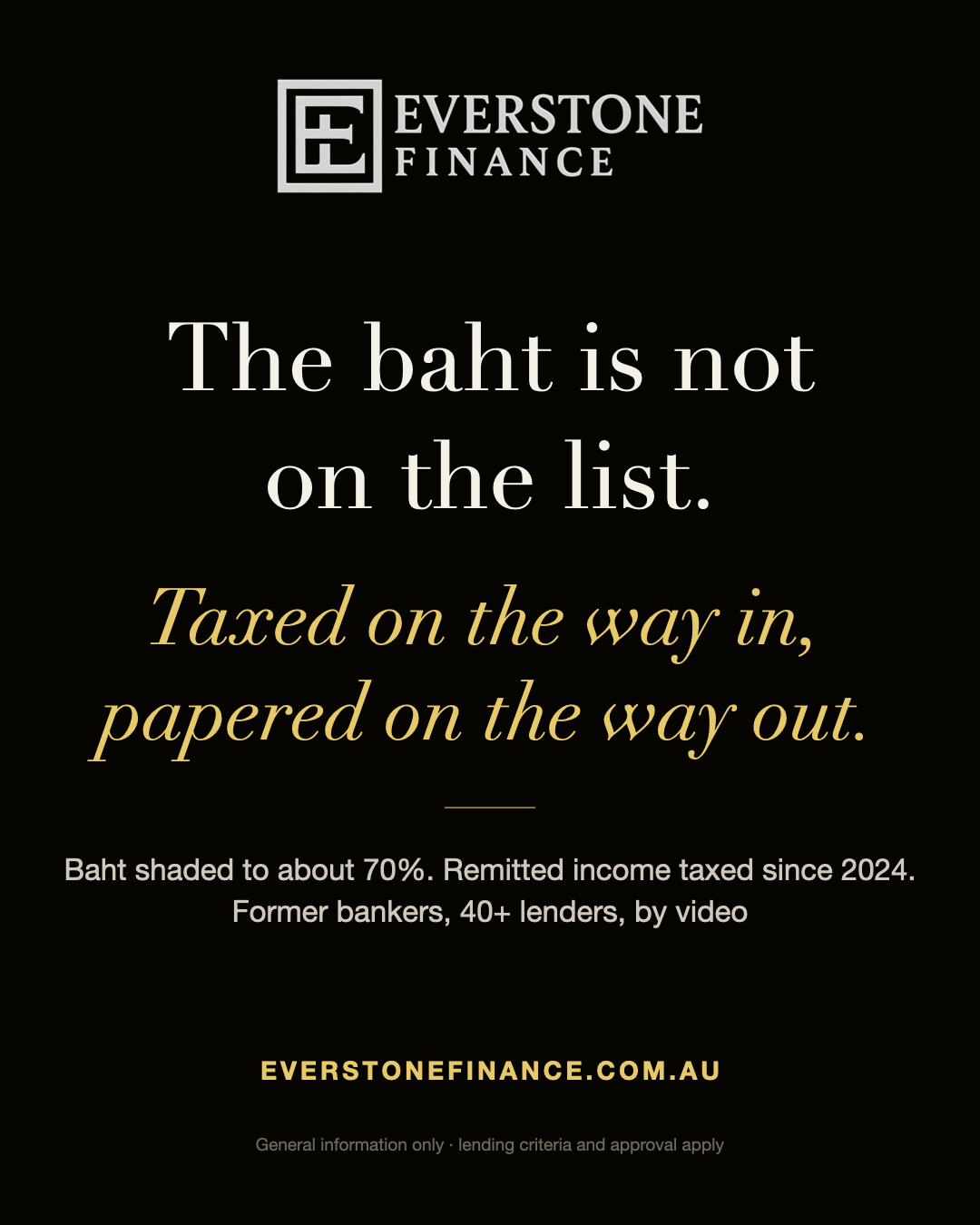
Taxed on the way in, papered on the way out. Plan it once, properly.
Tell a former banker where you live, what you earn and which currency it lands in. You get the borrowing figure across 40+ lenders, the deposit route, and the honest answer if the timing is wrong.
Book a chat with a former bankerBuying a home in Australia from Thailand: money first, certification second, search third
Buying a home in Australia from Thailand runs in a fixed order because Thailand taxes the money on the way in and papers it on the way out. The deposit is planned first: where it sits, whether remitting it into Thailand creates a Thai tax event, and what the Bank of Thailand route out of the country requires. The baht itself counts at around 70 per cent of gross because it is on no published list. Certification at the Embassy in Bangkok or the Consulate-General in Phuket is booked in the pre-approval week, Thai language payslips are translated, and the contract, electronic signing and PEXA settlement run from Thailand, three hours behind Melbourne and four in the Australian summer.
Whether the search is buying a home in Australia from Thailand, buying a house in Australia from Thailand, buying property in Australia from Bangkok or can I buy a house in Australia from Thailand, a citizen or permanent resident can from Bangkok, Phuket, Chiang Mai or Pattaya, provided the money is sequenced before the search.
Frequently asked questions
Can an Australian living in Thailand get an Australian home loan?
Yes. Australian citizens and permanent residents living in Thailand can buy and refinance Australian residential property, with no FIRB approval for citizens and the whole process run by video. Lenders convert and shade Thai baht income before assessing it, and because the baht sits on no published preferred-currency list it is usually counted at about 70 per cent of gross income, so the lender choice decides the borrowing figure.
How do Australian lenders treat Thai baht income?
As an other currency. One major-bank-backed lender publishes a preferred list of thirteen currencies counted at 80 per cent of gross income, with others at 70 per cent case by case, and the baht is not on it; Brighten names more than 20 accepted currencies without naming the baht, and La Trobe Financial names none. Expect roughly 70 per cent shading, fewer willing lenders and sometimes a lower loan-to-value cap, and expect a USD-paid package to be read more generously.
Is money I bring into Thailand taxed?
Since 1 January 2024, a Thai tax resident who remits foreign-sourced income into Thailand is taxed on it in the year of remittance regardless of when it was earned, under Revenue Department Instructions 161/2566 and 162/2566, with pre-2024 income excluded. A proposed exemption for income remitted in the year earned or the next was still a draft as at 5 September 2026. Money that never enters Thailand is not remitted, which is why the deposit route is planned with a tax agent before it moves.
How much can I transfer out of Thailand for an Australian deposit?
Transfers to pay obligations to non-residents are generally allowed under the Bank of Thailand exchange control regulation, gifts abroad are capped at USD 50,000 per person per calendar year, and any transaction of USD 200,000 or more requires the authorised bank to obtain supporting documents from you. A property deposit is an obligation, not a gift, so at deposit scale you need the contract, the loan approval and evidence of the source of funds ready before the transfer.
Am I a Thai tax resident?
If you are present in Thailand for 180 days or more in a tax year, Section 41 of the Revenue Code deems you a Thai tax resident. It is 180 days, not 183. Australia and Thailand have had a double tax agreement in force since 27 December 1989, and whether you are also an Australian tax resident is a separate test that decides how rent and any future sale are taxed.
Do I need FIRB approval to buy in Australia while living in Thailand?
Not if you are an Australian citizen, however long you have been in Thailand. Permanent residents keep the same position while ordinarily resident in Australia, and a permanent resident who has lived in Thailand for an extended period should confirm their status before signing. A Thai partner who is not a citizen or permanent resident is a foreign person, which means FIRB approval and, until 30 June 2029, no established dwellings.
How do I buy a home in Australia from Thailand, step by step?
Plan the deposit first: keep it outside Thailand if it can stay there, or map the Thai tax and Bank of Thailand paperwork if it must move through a Thai account. Get a pre-approval on the baht salary at around 70 per cent of gross, or on a listed currency if the package pays one. Order NAATI translations of Thai language payslips and book certification at the Embassy in Bangkok or the Consulate-General in Phuket; neither is same day. Search with a buyers agent or family in Australia, have an Australian conveyancer review the contract, sign electronically, and settle through PEXA. A 7 am Bangkok call is late morning in Melbourne.
Sources
- PwC Tax Summaries, Thailand, taxes on personal income, last reviewed 24 August 2026: taxsummaries.pwc.com
- KPMG Flash Alert 2023-238 on Revenue Department Instructions 161/2566 and 162/2566, 11 December 2023: kpmg.com
- ThaiLawOnline, remittance tax exemption status, 5 September 2026: thailawonline.com
- Thai Revenue Code, Section 41 (residency): rd.go.th
- Australian Treasury, income tax treaties list (Thailand, in force 27 December 1989): treasury.gov.au
- Bank of Thailand, exchange control regulation: bot.or.th
- Board of Investment, Long-Term Resident visa: ltr.boi.go.th
- Tourism Authority of Thailand Newsroom, Destination Thailand Visa (16 July 2024) and visa exemption changes from 15 September 2026 (1 September 2026): tatnews.org
- Ministry of Foreign Affairs of Thailand, Non-Immigrant O-A long stay visa: mfa.go.th
- Department of Foreign Affairs and Trade, Thailand country brief; Smartraveller, Thailand (updated 3 June 2026): smartraveller.gov.au
- Australian Government foreign investment rules: foreigninvestment.gov.au
About the author. Ahmed Lotfi is co-founder of Everstone Finance and a former banker who now works as a mortgage and finance broker in South Yarra, Melbourne, arranging home, investment and commercial lending for Australians at home and abroad. Everstone Finance operates under the Best Interests Duty as Credit Representative 574314 of LMG Broker Services Pty Ltd, Australian Credit Licence 517921.