
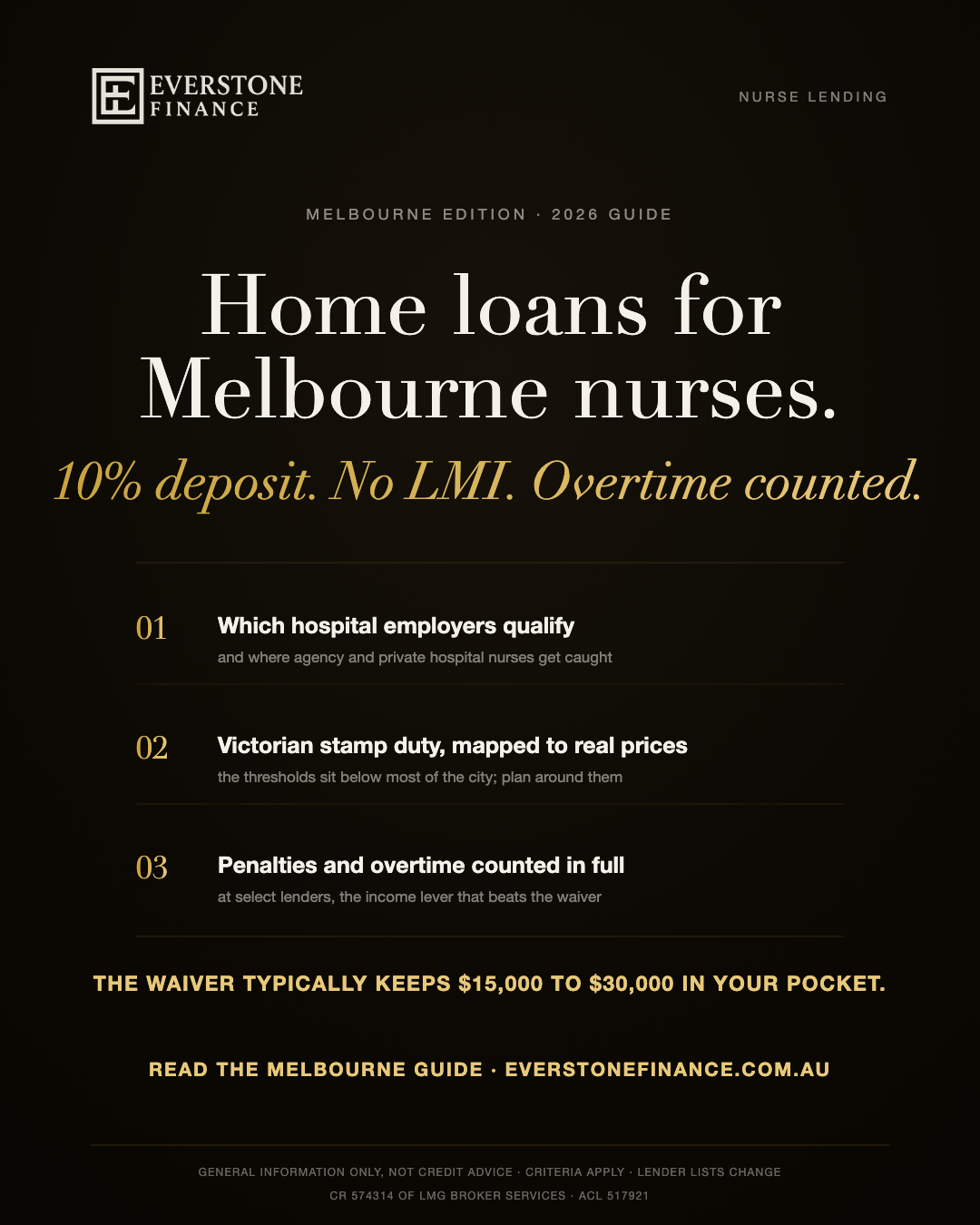

Home Loans for Nurses in Melbourne (2026): 10% Deposit, No LMI, and the Victorian Stamp Duty Trap
- Registered Nurses and Midwives in Melbourne earning $90,000 or more can borrow up to 90 per cent of a property’s value with no LMI through select lenders. The harder Melbourne problem is Victorian stamp duty thresholds that sit below what much of the city costs.
- The typical saving is roughly $22,000 on a $700,000 Melbourne purchase with a 10 per cent deposit, cash you keep at settlement rather than hand to an insurer.
- Next step: confirm your role counts before you apply. Most waivers are written around front-line, hospital-employed clinical nursing, and agency, ABN or non-hospital roles usually need another route such as the First Home Guarantee.
The short answer: Registered Nurses and Midwives in Melbourne earning $90,000 or more can borrow up to 90 per cent of a property’s value with no Lenders Mortgage Insurance through select lenders. On a $700,000 purchase with a 10 per cent deposit that is roughly $22,000 you keep. The harder part in Melbourne is not the waiver, it is Victorian stamp duty thresholds that sit well below what most of the city actually costs.
Melbourne is one of the best cities in Australia to be a nurse buying a home, and one of the most frustrating. The lender policy is genuinely good. The state concessions were written for a cheaper city than the one you are shopping in.
This guide covers what applies specifically if you work in Melbourne: which employers count, how Victorian stamp duty interacts with the waiver, and where agency and private hospital nurses get caught. And if leaving the profession is on your mind at all, our piece on the leaving question and the home loan maths explains why sequence matters.
The no-LMI policy, and what it saves a Melbourne buyer
Any borrower with less than a 20 per cent deposit is normally charged Lenders Mortgage Insurance, a one-off premium that protects the lender rather than you. It typically runs $15,000 to $30,000 depending on loan size and loan to value ratio.
For Registered Nurses and Midwives earning $90,000 or more a year, select lenders waive it outright up to 90 per cent LVR. At least one major lender publishes this openly. Others run the same or very similar policy without marketing it.
Policies and lender lists change, which is why we confirm current policy before you apply rather than working from last year’s rules.
Which Melbourne employers count as hospital-employed
This is where Melbourne nurses either sail through or hit a wall. Most of the strong waivers are written around front-line, hospital-employed clinical nursing. In practice that covers the people working at Victoria’s major public and private hospital groups.
- Public. The Royal Melbourne, The Alfred, Austin Health, Monash Health, Western Health, Northern Health, St Vincent’s, Peter MacCallum, the Royal Children’s, the Royal Women’s, Eastern Health.
- Private. Epworth, Cabrini, St Vincent’s Private, Knox Private, Mercy, Healthscope and Ramsay sites across the metro area.
Public or private is generally not the deciding factor. Whether the role is clinical, front-line and directly employed usually is.
Where Melbourne nurses get caught. A number of lenders exclude agency nurses, self-employed and ABN contractors, and nursing roles outside a hospital setting. Melbourne has a large agency and community nursing workforce, so this catches people regularly. If you have moved from a ward to a clinic, an agency or your own ABN, the medical waiver may not fit. Other routes such as the First Home Guarantee, a guarantor structure or standard high-LVR lending usually still get you there.
How your Melbourne shifts get counted
This is the part that changes what you can actually buy, and it matters more in Melbourne than the waiver does.
Run your file through ordinary lending policy and the bank discounts your variable income. Overtime, shift allowances, weekend penalties and on-call, often only 60 to 80 per cent of it survives into the borrowing calculation. For an office worker with an occasional bonus, that caution is reasonable. For a Melbourne hospital RN whose penalty rates are a structural, predictable part of the pay packet, it is not.
For front-line hospital-employed nurses, several major lenders now count 100 per cent of overtime and shift allowances. On a typical Melbourne nursing income that difference moves borrowing capacity by tens of thousands of dollars, which in this market is the difference between a two bedroom in the suburb you want and a one bedroom in the one you settled for.
Victorian nurses have also seen substantial pay movement recently. We covered what that does to borrowing power in our analysis of the 2026 nursing pay rises.
Victorian stamp duty: the Melbourne-specific problem
Here is where Melbourne differs sharply from the national picture. Victoria’s first home buyer stamp duty concessions are generous, and they stop at a price point much of Melbourne has moved past.
| Purchase price | Victorian first home buyer duty |
|---|---|
| Up to $600,000 | No stamp duty |
| $600,001 to $750,000 | Concession, tapering as price rises |
| Above $750,000 | Full stamp duty applies |
For a nurse buying a house within reasonable commuting distance of a major Melbourne hospital, $600,000 is a tight ceiling and $750,000 is not a generous one. Two things follow.
- Apartments and townhouses do far better here than houses. The concession is often fully available on well-located units in the inner and middle ring while being unreachable on a house in the same postcode.
- The cliff at $750,000 is worth planning around. Moving a purchase price from just above the threshold to just below it can be worth more than the negotiation itself.
The concession applies to both new builds and established homes, and there is no income test on the Victorian First Home Owner Grant, though that grant is limited to new homes.
Stacking the waiver with the First Home Guarantee
If you are a first home buyer in Melbourne, the federal First Home Guarantee is the other route past LMI. Since October 2025 it has run without income caps or annual place limits, and the property price cap for Melbourne and Geelong is $950,000.
That higher cap is the important number. It is meaningfully above the Victorian stamp duty thresholds, which means a Melbourne nurse often has two separate levers pulling in different directions: the Guarantee lets you go to $950,000 with a 5 per cent deposit and no LMI, while the duty concession rewards you for staying under $750,000.
Which combination wins depends on your deposit, your borrowing capacity and what you are buying. It is a genuinely worthwhile calculation to run properly rather than guess at, because the two schemes are not additive in an obvious way.
Salary packaging, and why Melbourne public health nurses should mention it
If you work for a Victorian public health service or a not for profit hospital, you likely have access to salary packaging. Many nurses treat it as a payroll detail. Lenders that understand health sector packaging will gross it up into assessable income, which lifts borrowing capacity.
Not every lender treats it the same way, and it is routinely left off applications entirely because the borrower did not think to mention it. Bring your packaging statement.
Frequently asked questions: home loans for nurses in Melbourne
Do Melbourne nurses get an LMI waiver?
Yes. Registered Nurses and Midwives in Melbourne earning $90,000 or more can access up to 90 per cent LVR with no Lenders Mortgage Insurance through select lenders. The policy is national, and Melbourne’s major public and private hospital employers generally satisfy the hospital-employed requirement.
Does it matter whether I work at a public or private Melbourne hospital?
Generally no. Lenders are usually concerned with whether the role is clinical, front-line and directly employed rather than whether the employer is Monash Health or Epworth. Agency placement and ABN contracting are the arrangements that cause problems.
I am an agency nurse in Melbourne. Can I still get in?
Often not through the medical waiver, since many lenders exclude agency and contract arrangements. The First Home Guarantee, a family guarantor structure or standard high-LVR lending will usually still work. It is worth a proper policy check rather than assuming you are excluded.
Do I pay stamp duty as a first home buyer nurse in Melbourne?
Not on a purchase up to $600,000. Between $600,001 and $750,000 a tapering concession applies. Above $750,000 full Victorian stamp duty applies. This is separate from the LMI waiver and the two do not affect each other.
Can I use the LMI waiver and the First Home Guarantee together?
They are alternative routes past LMI rather than a stack. The Guarantee allows a 5 per cent deposit up to a $950,000 Melbourne price cap; the professional waiver allows 10 per cent with no cap of that kind. Which is better depends on your deposit size and what you are buying.
Will a lender count my penalty rates and overtime?
Several major lenders count 100 per cent of overtime and shift allowances for front-line hospital-employed nurses, against the 60 to 80 per cent that ordinary policy applies. Evidencing it cleanly across recent payslips is what makes the difference.
I am an Enrolled Nurse. Am I excluded?
Not necessarily. Some waivers are written around Registered Nurses specifically, others are broader. The income threshold is often the binding constraint rather than the registration category, so it is worth checking current policy for your circumstances.
How much can a Melbourne nurse borrow?
It depends on base wage, how much overtime and allowance income is counted, salary packaging, existing debts and dependants. The variable that moves it most for nurses is whether your shift income is assessed at 100 per cent or discounted, which is exactly what lender selection controls.
The honest summary
The lending policy for Melbourne nurses is strong: 90 per cent LVR with no LMI, and shift income counted properly by lenders that understand health sector pay. The constraint in Melbourne is not the loan, it is the gap between Victorian stamp duty thresholds and Melbourne prices, and the choice between the duty concession and the First Home Guarantee’s higher cap.
That choice is worth getting right before you start looking, not after you have found something.
Sources and useful references
Borrow smarter as a Melbourne nurse.
A free quick review with a former banker. We will tell you plainly which lenders count your shift income in full, and whether the duty concession or the First Home Guarantee suits your purchase.
Book a free reviewThis guide is part of our home loans for professionals series covering every occupation that can buy with no LMI.