
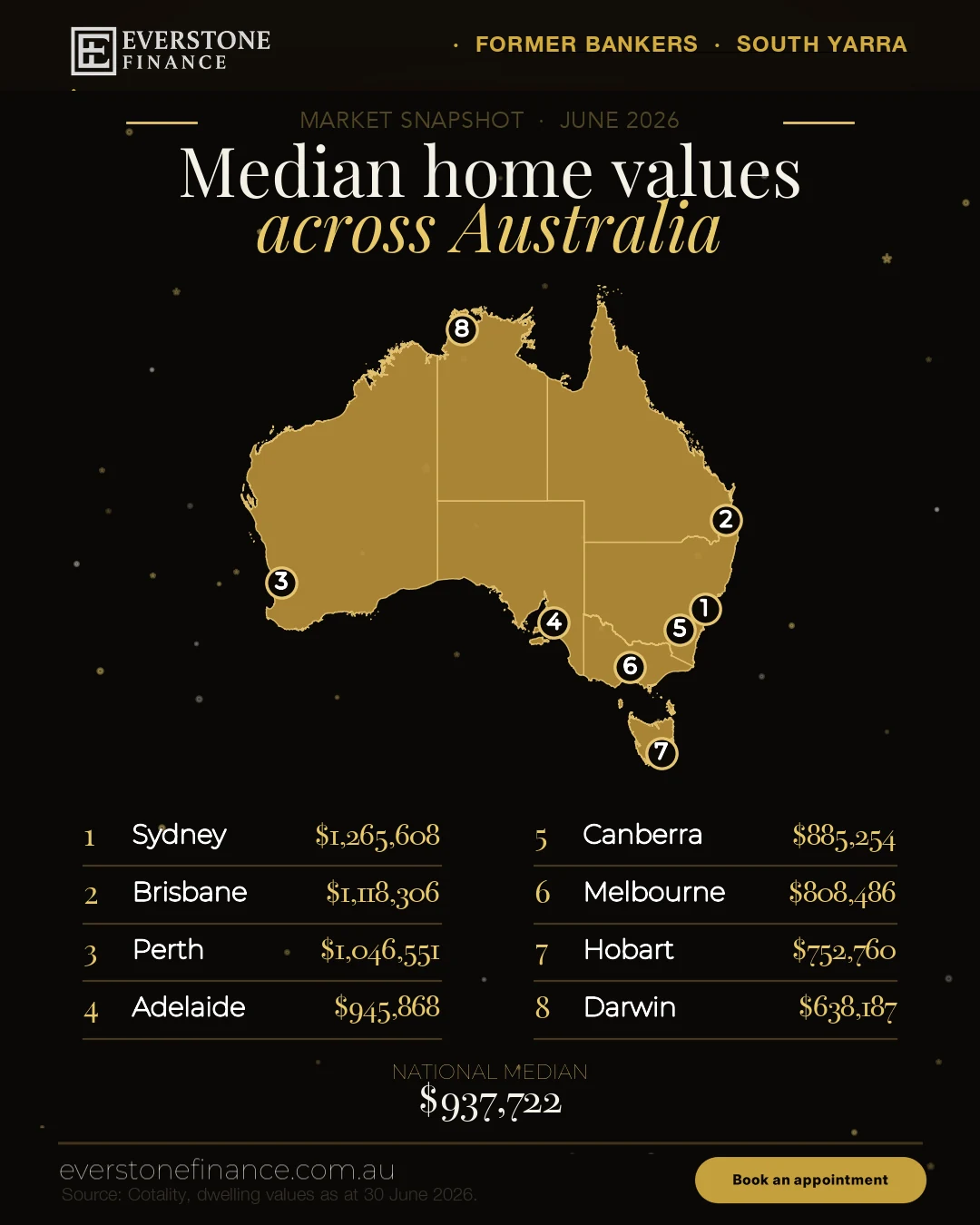

Median House Prices in Australia (2026): Every Capital City Ranked
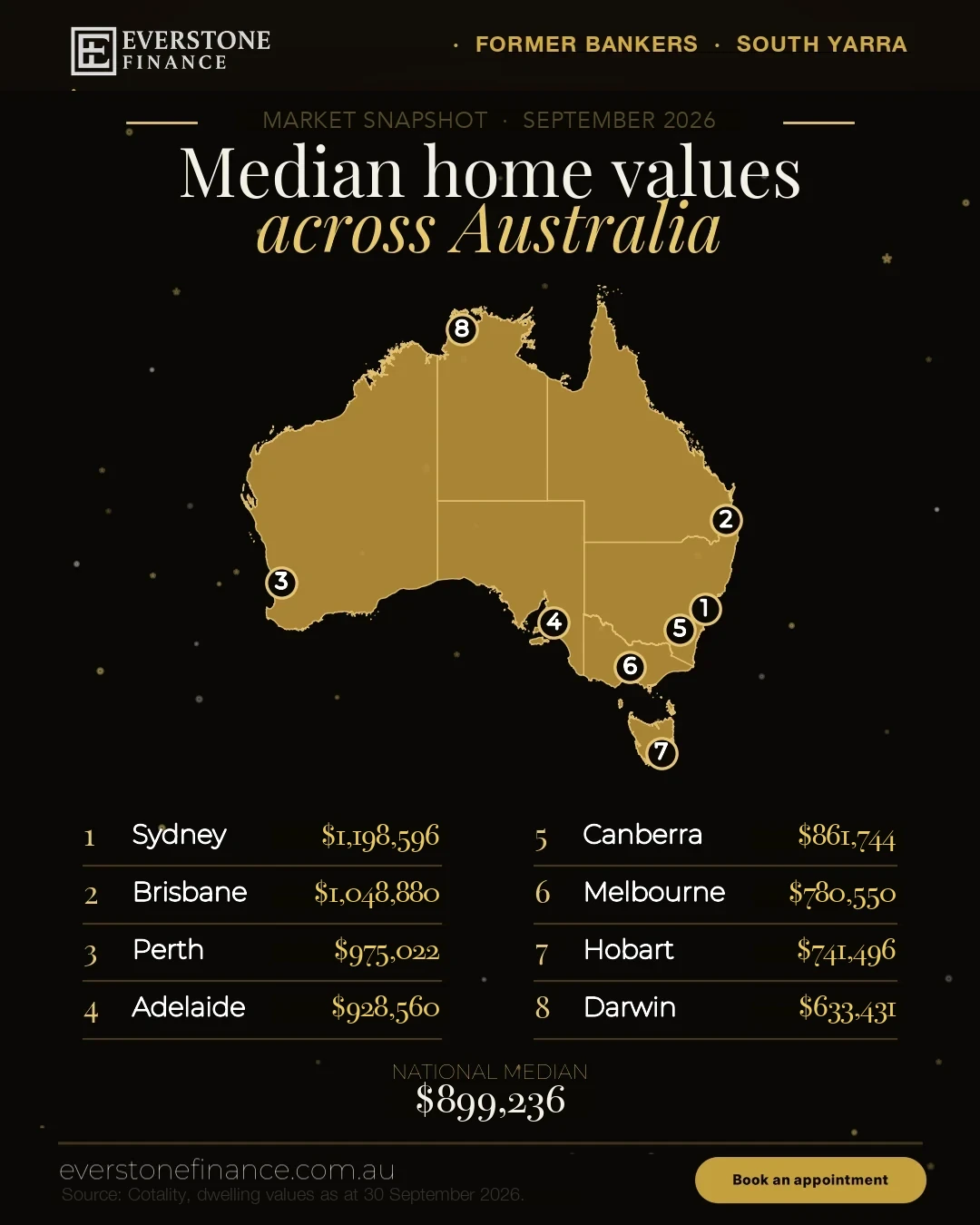
Australia’s eight capital cities ranked by Cotality median dwelling value, as at 30 September 2026.
- The national median is $899,236, down 1.1% in September, a sixth straight monthly fall, and 5.2% below the March 2026 peak (Cotality median dwelling value, houses and units combined, as at 30 September 2026).
- Sydney is the most expensive capital at $1,198,596. Darwin is the most affordable at $633,431, and the only capital that rose in September.
- Darwin is now the fastest-growing capital over the year, up 11.9%, ahead of Perth (+10.1%), which has slipped back under the million-dollar mark to $975,022. Hobart (+7.0%), Adelaide (+6.5%) and Brisbane (+5.9%) are also higher than a year ago.
- Sydney (-7.0%) and Melbourne (-6.2%) both went backwards over the year, and 97% of capital city suburbs recorded falls over the three months to September, so the “Australian market” is really eight different markets.
- Combined capital cities sit at $973,525; combined regional Australia at $758,931.
Want to know what these prices mean for your deposit and borrowing power? Book a free borrowing power check with a former banker. Reading from overseas? The check runs by Zoom or phone, and our guide to Australian expat home loans shows how lenders count a foreign salary.
Buying at these prices, or already holding a loan against them? A former banker works yours through, free.
For a purchase, we work out your borrowing range and put it beside the median in the city you are looking at. For a home you own, we check your loan against other lenders.
Check my borrowing or my loan with a former bankerIf you’re trying to make sense of median house prices in Australia in 2026, the single national number hides the real story. As at 30 September 2026, the national median dwelling value is $899,236, but that average stretches from a $1.2 million Sydney down to a $633,000 Darwin, and the national index has now fallen for six straight months. This guide ranks every capital city by median value, shows the annual growth behind each number, breaks down what it means for your deposit and borrowing power, and explains how to actually buy well in a market moving at eight different speeds. All figures are Cotality median dwelling values as at 30 September 2026, the way we’d walk a client through them at Everstone Finance. For where the jobs are moving against these price levels, see our fastest-growing cities analysis. And with the expensive end falling fastest, our piece on why upgraders win the changeover maths shows what the tier split is worth in dollars.
Australia’s national median dwelling value is $899,236 as at 30 September 2026, down 1.1% over the month and unchanged over the year (Cotality). Sydney leads capitals at $1,198,596, followed by Brisbane ($1,048,880) and Perth ($975,022). Melbourne sits lowest among the larger capitals at $780,550, and every capital except Darwin fell over the September quarter.
Are Australian house prices falling in September 2026?
Yes. The national median dwelling value fell 1.1 per cent in September 2026, a sixth consecutive monthly decline, leaving values 5.2 per cent below the March 2026 peak. 97 per cent of capital city suburbs recorded falls over the three months to 30 September, and every capital except Darwin declined over the same period. Source: Cotality Home Value Index, as at 30 September 2026.
Every median on this page is the 30 September 2026 index, so the levels and the direction now describe the same market. This section sets out how fast each capital is moving, because the annual column in the ranking below mixes growth earned early in the cycle with the falls of the past six months.
| Market | Month | 3 months | 12 months |
|---|---|---|---|
| Sydney | -1.4% | -4.9% | -7.0% |
| Melbourne | -0.7% | -3.4% | -6.2% |
| Brisbane | -1.5% | -4.7% | +5.9% |
| Adelaide | -1.3% | -2.7% | +6.5% |
| Perth | -1.2% | -4.7% | +10.1% |
| Hobart | -0.5% | -1.2% | +7.0% |
| Darwin | +0.4% | +0.5% | +11.9% |
| Canberra | -1.1% | -3.2% | -1.6% |
| Combined capitals | -1.2% | -4.3% | -1.8% |
| Combined regional | -0.7% | -1.9% | +5.6% |
| Australia | -1.1% | -3.7% | 0.0% |
The quarter almost inverts the annual picture. Sydney and Melbourne are down over the year as well as the quarter, while Darwin and Perth still carry double digit annual growth that was earned earlier in the cycle rather than recently. Over the most recent three months only Darwin gained ground, and Sydney is the weakest market in the country.
Cotality reports that the proportion of capital city suburbs recording a fall in values more than doubled from 45.8 per cent in autumn to 93 per cent over winter, and reached 97 per cent over the three months to September. Sydney is leading the downturn: values fell 1.4 per cent in September and now sit 8.6 per cent below the February 2026 peak, a decline Cotality describes as marginally deeper than the equivalent stage of the 2022 to 2023 downturn. Melbourne remains 7.5 per cent below its March 2022 peak.
Demand is doing the work. Cotality’s estimate of home sales over the past three months is 19.1 per cent lower than at the same time last year, while rents rose 5.5 per cent over the year and the national gross rental yield, at 3.85 per cent, is the highest since August 2019.
For a buyer that is a different market from the one the annual medians describe. Softer values strengthen your negotiating position, while elevated rates work against your borrowing capacity, so the two pull in opposite directions. What decides your outcome is what you can borrow and comfortably hold today rather than what the market did last year, and that is the calculation worth doing before you commit to anything. You can book a free borrowing power check and have it run on your own income and deposit.
Median house prices in Australia: the 30 September 2026 snapshot
The 30 September 2026 index puts the national median dwelling value in Australia at $899,236, unchanged over the year (0.0%) and down 3.7% over the quarter (Cotality). Capital city values range from $1,198,596 in Sydney, the most expensive, to $633,431 in Darwin, the most affordable. The combined capital cities median is $973,525 and combined regional Australia is $758,931.
The headline is now flat over the year (0.0%): six straight monthly falls have cancelled the growth earned earlier in the cycle. The annual gains still sit with the smaller and mid-sized capitals, Darwin, Perth, Hobart, Adelaide and Brisbane, while Sydney (-7.0%) and Melbourne (-6.2%) have gone backwards over the year and every capital except Darwin fell over the September quarter. In practical terms, “the Australian property market” is now eight distinct markets, each with its own price point, growth rate and momentum. Treating them as one number is how buyers either talk themselves out of a city that’s still affordable, or overpay in one that’s already run hard. Our ninth-downturn analysis covers the turn and its 30-year context.
What is the average house price in Australia?
Most searches for the average house price in Australia are really asking for the median. As at 30 September 2026, the national median dwelling value is $899,236 (Cotality, houses and units combined). A mean average sits higher than a median, because a small number of very expensive sales pull the mean upward.
The distinction matters when you compare one headline with another. A median splits the market in half, so half of all homes sit above it and half below, which is why property indexes report medians rather than averages. Before you treat two numbers as comparable, check three things: whether the figure is a median or a mean, whether it covers houses only or houses and units together, and the date it was measured. Unless it is labelled houses or units, every median in this guide is a Cotality median dwelling value as at 30 September 2026, covering houses and units combined, which is why the houses-only median for the same city sits higher; the table under the ranking shows both. For the number behind each capital, see the full capital city ranking.
The official average: the ABS mean dwelling price, June quarter 2026
The Australian Bureau of Statistics publishes the only official average. Its Total Value of Dwellings release for the June quarter 2026, published on 8 September 2026, puts the mean price of a residential dwelling in Australia at $1,100,400, down $8,200 on the March quarter. The same release counts 11,531,100 residential dwellings worth $12,688.9 billion in total, $34.1 billion less than three months earlier. The ABS figure is a mean of the value of every dwelling in the country, houses and units together, at the end of June; the Cotality figure used through this guide is a median value at 30 September. That is why the official average sits about $201,000 above the $899,236 median: the average is pulled up by the most expensive homes, the median is not.
| State or territory | Mean dwelling price, June quarter 2026 | March quarter 2026 |
|---|---|---|
| New South Wales | $1,304,900 | $1,337,600 |
| Queensland | $1,130,600 | $1,114,800 |
| Western Australia | $1,123,700 | $1,099,200 |
| Australian Capital Territory | $981,700 | $995,000 |
| South Australia | $979,600 | $966,300 |
| Victoria | $918,400 | $938,000 |
| Tasmania | $733,200 | $717,700 |
| Northern Territory | $614,400 | $588,300 |
| Australia | $1,100,400 | $1,108,600 |
Source: ABS, Total Value of Dwellings, June Quarter 2026 (released 8 September 2026; next release 1 December 2026). New South Wales, Victoria and the Australian Capital Territory fell over the quarter; every other state and territory rose. Use the ABS mean when you want the official national average, and the Cotality medians below when you want to know what a typical home in each capital city actually costs.
How do Australia’s capital cities rank by median house price in 2026?
Ranked from most to least expensive by median dwelling value (Cotality, 30 September 2026): 1. Sydney $1,198,596 · 2. Brisbane $1,048,880 · 3. Perth $975,022 · 4. Adelaide $928,560 · 5. Canberra $861,744 · 6. Melbourne $780,550 · 7. Hobart $741,496 · 8. Darwin $633,431. The national median is $899,236.
The most striking change is at the top. Brisbane, Perth and Adelaide have all overtaken Melbourne, an order that would have looked unthinkable a few years ago. Melbourne, long Australia’s second city by price, is now the sixth most expensive capital.
| Rank | City | Median value | Annual change |
|---|---|---|---|
| 1 | Sydney | $1,198,596 | -7.0% |
| 2 | Brisbane | $1,048,880 | +5.9% |
| 3 | Perth | $975,022 | +10.1% |
| 4 | Adelaide | $928,560 | +6.5% |
| 5 | Canberra | $861,744 | -1.6% |
| 6 | Melbourne | $780,550 | -6.2% |
| 7 | Hobart | $741,496 | +7.0% |
| 8 | Darwin | $633,431 | +11.9% |
| Combined capitals | $973,525 | -1.8% | |
| Combined regional | $758,931 | +5.6% | |
| National | $899,236 | 0.0% |
Median house and unit values, separately
The ranking above combines houses and units. Cotality also publishes each on its own, and the house figure is the one to use if a house is what you are buying. At 30 September 2026 the median house value was $1,466,060 in Sydney and $979,193 nationally, against $867,597 and $727,818 for units. On houses alone, four capitals sit above $1 million (Sydney, Brisbane, Perth and Canberra), and Canberra moves ahead of Adelaide.
| City | Houses | Units | All dwellings |
|---|---|---|---|
| Sydney | $1,466,060 | $867,597 | $1,198,596 |
| Brisbane | $1,146,078 | $834,627 | $1,048,880 |
| Perth | $1,017,734 | $714,265 | $975,022 |
| Adelaide | $990,531 | $674,188 | $928,560 |
| Canberra | $1,006,269 | $582,245 | $861,744 |
| Melbourne | $915,119 | $624,740 | $780,550 |
| Hobart | $790,406 | $591,795 | $741,496 |
| Darwin | $747,252 | $480,748 | $633,431 |
| Combined capitals | $1,103,201 | $738,778 | $973,525 |
| Combined regional | $775,024 | $669,770 | $758,931 |
| National | $979,193 | $727,818 | $899,236 |
These are the market’s numbers. What’s yours?
Medians tell you what everyone else paid. A former banker turns them into your number: what you can actually borrow, what it costs monthly, and which of more than 40 lenders writes it best. One short call, nothing to prepare.
Get my numbers checked, freeWould rather message than book? WhatsApp or text Ahmed about what the medians mean for your own deposit and borrowing. His own mobile, no call centre, and nothing touches your credit file until you choose a lender.
What is the median house price in each Australian capital city?
City by city, the Cotality median dwelling values at 30 September 2026 are: Sydney $1,198,596 (down 7.0% over the year), Brisbane $1,048,880 (up 5.9%), Perth $975,022 (up 10.1%), Adelaide $928,560 (up 6.5%), Canberra $861,744 (down 1.6%), Melbourne $780,550 (down 6.2%), Hobart $741,496 (up 7.0%) and Darwin $633,431 (up 11.9%).
Here’s what each capital’s number is telling buyers in 2026. Each heading below shows the combined dwelling value, houses and units together; the house and unit medians for each city are in the table above.
Sydney median house price: $1,198,596 (-7.0% year)
Sydney remains comfortably the most expensive capital, and it is now leading the downturn: values fell 1.4% in September, 4.9% over the quarter, and sit 8.6% below the February 2026 peak, a decline Cotality describes as marginally deeper than the equivalent stage of the 2022 to 2023 downturn. For buyers, a falling Sydney can mean less frantic competition than the city’s reputation suggests, the affordability hurdle is the deposit and borrowing power, not a runaway price. Measured against incomes rather than raw prices, Sydney also sits among the least affordable cities in Australia and the world.
Brisbane median house price: $1,048,880 (+5.9% year)
Brisbane is the story of the cycle. Still up 5.9% over the year on the back of strong interstate migration and tight supply, it has leapfrogged Melbourne and Canberra to become the second most expensive capital in the country. The turn has now reached it too: values fell 1.5% in September, the largest monthly fall of the capitals, and sit 5.4% below the May 2026 peak.
Perth median house price: $975,022 (+10.1% year)
Perth is the second fastest-growing capital in Australia over the year, up 10.1% and behind only Darwin, but the falls since its April 2026 peak have pushed it back under the million-dollar mark, with values down 6.0% from that peak. Perth houses alone still sit above it, at $1,017,734. After a decade of underperformance, Perth ran hard on the back of a strong local economy and limited listings. It’s a reminder that yesterday’s cheapest capital can become this year’s headline.
Adelaide median house price: $928,560 (+6.5% year)
Adelaide’s quiet, consistent growth, still 6.5% over the year, has kept it above Canberra and Melbourne, and it is holding up better than most, down 2.9% from its May 2026 peak, the shallowest fall among the five largest capitals. Long seen as an affordable alternative, Adelaide now sits about $29,000 above the national median.
Canberra median house price: $861,744 (-1.6% year)
The capital’s capital sits mid-table at $861,744, with values down 1.6% over the year and 6.2% below their May 2022 peak. Canberra tends to move with public-sector confidence and remains less volatile than the mining-state capitals.
Melbourne median house price: $780,550 (-6.2% year)
Melbourne is now the sixth most expensive capital, cheaper than Brisbane, Perth and Adelaide, after values fell 6.2% over the year to sit 7.5% below their March 2022 peak. For buyers, Australia’s second-largest city is arguably its most interesting value story in 2026: a global city priced below several smaller capitals. Melbourne is also our home market, and we cover it suburb by suburb in the areas we serve. Where Melbourne heads from here is in our Melbourne 2027 forecast.
Hobart median house price: $741,496 (+7.0% year)
After a sharp run-up and then a cooling, Hobart is the steadiest capital in the downturn, up 7.0% over the year and down 0.5% over the month and 1.2% over the quarter, the smallest falls among the seven capitals that declined. It remains one of the more affordable capitals while offering lifestyle appeal that keeps demand resilient.
Darwin median house price: $633,431 (+11.9% year)
Darwin is the most affordable capital in Australia, the only one that rose in September, up 0.4%, and now the fastest-growing over the year, up 11.9%. Values sit 0.2% below their July 2026 peak. For buyers and investors chasing entry price and yield, Darwin’s combination of the lowest median and strong growth stands out, with the usual caveat that smaller markets can be more volatile.
How do capital city and regional median prices compare?
As at 30 September 2026, the combined capital cities median dwelling value is $973,525, while combined regional Australia is $758,931, a gap of roughly $215,000. Regional markets are also falling more gently, down 1.9% over the September quarter against 4.3% for the capitals, and remain well above pre-pandemic levels.
The capital, regional gap matters if you’re weighing a lifestyle move or a regional investment. A smaller regional median doesn’t automatically mean better value, rental demand, vacancy rates, lender appetite and resale depth all vary enormously between towns. The number is a starting point, not a verdict.
Why have median house prices moved like this in 2026?
Three forces explain the 2026 spread: interest rates (the RBA has lifted the cash rate four times this year, from 3.60% to 4.60%, most recently on 29 September 2026, which cools the most expensive markets fastest), interstate migration (flowing into Brisbane, Perth, Adelaide and Darwin), and tight supply (not enough new listings or construction to meet demand). Together they explain why the mid-sized capitals still hold annual gains while Sydney and Melbourne are falling, and why the downturn has now spread to seven of the eight capitals.
Higher borrowing costs bite hardest where prices, and therefore loan sizes, are largest, which is part of why Sydney and Melbourne turned first while the more affordable capitals kept running longer. If you want the full picture on rates and what they do to your borrowing power, read our companion guide on interest rates and your borrowing power, written at the August 2026 decision when the cash rate was 4.35%, and our guide to the September 2026 rise to 4.60% and whether to refinance. And if you already have a home loan, refinancing your home loan, explained end to end, is worth checking, along with what falling values do to your loan to value ratio when you refinance.
How much deposit do you need at each city’s median?
A 20% deposit avoids Lenders Mortgage Insurance (LMI). On the 30 September 2026 national median of $899,236 that’s about $179,847. On Sydney’s $1,198,596 median it’s about $239,719; on Darwin’s $633,431 median, about $126,686. You can buy with less, often 5 to 10%, but below 20% you generally pay LMI (or use a guarantor or eligible scheme).
| City | Median value | 20% deposit | 10% deposit |
|---|---|---|---|
| Sydney | $1,198,596 | $239,719 | $119,860 |
| Brisbane | $1,048,880 | $209,776 | $104,888 |
| Perth | $975,022 | $195,004 | $97,502 |
| Adelaide | $928,560 | $185,712 | $92,856 |
| Canberra | $861,744 | $172,349 | $86,174 |
| Melbourne | $780,550 | $156,110 | $78,055 |
| Hobart | $741,496 | $148,299 | $74,150 |
| Darwin | $633,431 | $126,686 | $63,343 |
| National | $899,236 | $179,847 | $89,924 |
Worth knowing: a smaller deposit isn’t a dead end. Depending on your situation you may be able to buy with 5 to 10% down using LMI, a family guarantee, or an eligible government scheme, and some professions can access reduced or waived LMI. A broker can tell you which path fits before you start house-hunting. Registered nurses and midwives, for example, can buy with a 10% deposit and no LMI through select lenders. And for business owners, the same buy-or-keep-renting question applies to premises, covered in our commercial property loans guide. And for what each city’s median home costs you per month, see our monthly repayments by city companion.
Deposit worked out at the median? Now check what a lender will actually give you.
The deposit is the entry ticket; serviceability sets the loan. A former banker runs your income and commitments across 40 plus lenders and tells you, in writing, the price bracket you can buy in and in which capital. Free, no obligation, and no credit enquiry until you choose a lender.
Check my borrowing power at the median, freeWhat do median house prices mean for you as a buyer?
A median is the midpoint of a market, not the price you’ll pay. What actually decides what you can buy is your borrowing power and deposit, and both vary by lender. Two lenders can differ by tens of thousands on the same income, so the median is a guide to the market, not a limit on you.
It’s easy to read a million-dollar median and assume a city is off the table. But medians lump houses and units together and span every suburb, the right unit, townhouse or outer-suburb house can sit well below the figure. The more useful question isn’t “what’s the median?” but “what can I borrow, across the whole market, and where does that put me?” For the full path from pre-approval to settlement, see our step-by-step guide to buying property in Australia. To see which of these medians local incomes can actually carry, our affordability league table tests every city against the five-times-income benchmark.
How to buy smart in a multi-speed market
In a market moving at eight different speeds, the buyers who do well know their borrowing power across 40+ lenders, get pre-approved before they shop, and stay open to the cities and property types where value still exists, rather than chasing last cycle’s winner.
Three moves matter more than picking the “right” city: first, get your real borrowing power mapped across the market, not just one bank’s guess; second, lock in pre-approval so you can act when the right property appears; third, match the city and property type to your goals and budget rather than the headlines. A broker does the comparison work for you, and it costs you nothing. For how to choose one, see our guide to the questions to ask a mortgage broker before you commit.
Sources and useful references
- ABS: lending indicators
- ABS: Total Value of Dwellings, June Quarter 2026 (mean dwelling prices, released 8 September 2026)
- ASIC Moneysmart: home loans
- Cotality Home Value Index, released 1 October 2026 (results as at 30 September 2026)
- Cotality: Australian housing market downturn widens (Home Value Index, August 2026)
- Reserve Bank of Australia: cash rate decisions
See exactly what you can buy, free
Book a no-obligation chat and we’ll map your borrowing power across 40+ lenders and show you where you stand against the median in any capital, in plain English.
Book an appointmentMedian house price glossary
- Median house price
- The middle value of all sales in a market, half sold for more, half for less. It’s less skewed by extreme sales than an average, which is why it’s the standard property benchmark.
- Median dwelling value
- Cotality’s measure of the midpoint value of all dwellings (houses and units combined) in an area. The figures in this guide are median dwelling values.
- Combined capital cities
- An aggregate index of the eight greater capital city markets, used to track the “capitals” as a whole. It sits at $973,525 as at 30 September 2026.
- Combined regional
- An aggregate of dwelling values outside the greater capital cities. It sits at $758,931 as at 30 September 2026.
- Capital growth
- The increase in a property’s value over time, usually shown as an annual percentage. Reported here as the change over the year to 30 September 2026.
- Cotality
- The property data and analytics provider (formerly CoreLogic) whose home value indices are widely used to track Australian dwelling values.
- Borrowing power
- The maximum a lender will lend you, based on income, expenses, debts and the rate they assess you at. It varies between lenders and sets what you can actually buy.
- Lenders Mortgage Insurance (LMI)
- A one-off insurance cost lenders usually require when you borrow more than 80% of a property’s value (a deposit under 20%). Some buyers can reduce, waive or avoid it.
Median house price FAQ
What is the median house price in Australia in 2026?
As at 30 September 2026, the national median dwelling value in Australia is $899,236, unchanged over the year (0.0%) and down 1.1% in the month, a sixth consecutive monthly fall (Cotality, houses and units combined). Combined capital cities sit at $973,525 and combined regional Australia at $758,931.
What is the most expensive city to buy a house in Australia?
Sydney is the most expensive capital, with a median dwelling value of $1,198,596 as at 30 September 2026. It is also leading the downturn, with values falling 7.0% over the year.
What is the cheapest capital city in Australia?
Darwin is the most affordable capital, with a median dwelling value of $633,431. It was also the only capital to rise in September 2026, up 0.4% in the month and 11.9% over the year.
Which capital city has the fastest-growing house prices?
Darwin is the fastest-growing capital over the year, up 11.9% to 30 September 2026, with a median of $633,431. Perth is second, up 10.1% with a median of $975,022, although Perth values have fallen 6.0% from the April 2026 peak. Hobart (+7.0%), Adelaide (+6.5%) and Brisbane (+5.9%) also rose over the year.
What is the median house price in Sydney?
Sydney’s median dwelling value is $1,198,596 as at 30 September 2026, down 7.0% over the year and 8.6% below its February 2026 peak. It remains the most expensive capital in Australia.
What is the median house price in Melbourne?
Melbourne’s median dwelling value is $780,550 as at 30 September 2026, down 6.2% over the year. Melbourne is now the sixth most expensive capital, cheaper than Brisbane, Perth and Adelaide.
What is the median house price in Brisbane?
Brisbane’s median dwelling value is $1,048,880 as at 30 September 2026, up 5.9% over the year. It is now the second most expensive capital city in Australia, ahead of Melbourne.
Is Brisbane more expensive than Melbourne now?
Yes. As at 30 September 2026, Brisbane’s median ($1,048,880) is well above Melbourne’s ($780,550). Perth and Adelaide have also overtaken Melbourne, which now ranks sixth among the capitals by median value.
What is the difference between a median house price and a median dwelling value?
A median house price usually refers to houses only, while a median dwelling value (the measure used here, from Cotality) covers all dwellings, houses and units combined. Because units are generally cheaper, a combined dwelling figure sits below the houses-only median for the same area. At 30 September 2026 the national median house value was $979,193 and the national median dwelling value was $899,236.
What is the average house price in Australia?
In everyday use, average house price and median house price mean the same thing. The benchmark reported by property indexes is the median. As at 30 September 2026, the national median dwelling value in Australia is $899,236 (Cotality, houses and units combined), with combined capital cities at $973,525 and combined regional Australia at $758,931.
How much deposit do I need to buy a median-priced home in Australia?
A 20% deposit avoids Lenders Mortgage Insurance, about $179,847 on the national median of $899,236 at 30 September 2026. You can often buy with 5 to 10% down, but below 20% you generally pay LMI, unless you use a guarantor, an eligible scheme, or a profession-based LMI waiver. A broker can tell you which applies to you.
Are Australian house prices going up or down in 2026?
Mostly down. The national index fell 1.1% in September 2026, a sixth consecutive monthly decline, and every capital except Darwin fell over the September quarter. Nationally, values are level with a year ago (0.0%): Darwin, Perth, Hobart, Adelaide and Brisbane are still higher than a year ago, while Sydney, Melbourne and Canberra are lower.
Where does this median house price data come from?
The figures in this guide are Cotality median dwelling values as at 30 September 2026. Property data is updated regularly, so confirm the latest figures before making any decision, and speak to a professional about your own circumstances.
Do I need to be in Melbourne or South Yarra to work with Everstone Finance?
No. Everstone Finance is based in South Yarra and meets locally in person, but works with clients across Melbourne and Australia-wide by phone and Zoom.
The bottom line: there is no single “Australian house price” in 2026, there are eight capital markets moving at different speeds, from a $1.2M Sydney to a $633k Darwin. The median tells you where a market sits; your borrowing power and deposit decide where you can buy. Know both before you start, and you turn a confusing market into a short list.
Map your borrowing power across 40+ lenders, free
No cost, no obligation. We’ll show you exactly what you can buy at today’s rates and where it puts you against the median in any capital, clearly and in writing.
Book an appointment