

The Deposit You Need for an Investment Property in Australia, City by City (2026)
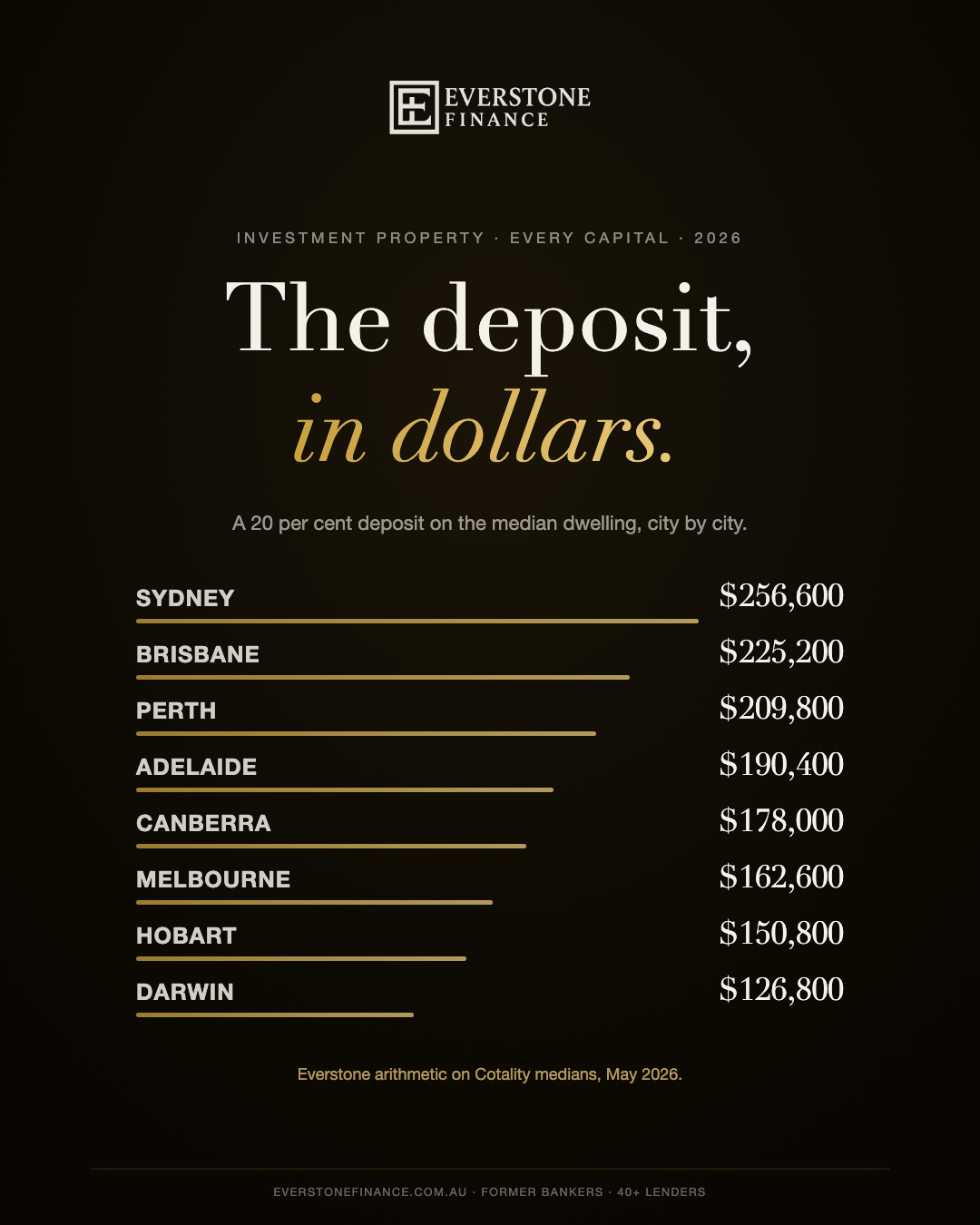
The same 20 per cent means a very different dollar figure depending on the capital. Computed on the Cotality May 2026 medians from our rental yields guide.
Lenders generally want a larger deposit for an investment property than for an owner occupied home. A 20 per cent deposit usually avoids lenders mortgage insurance, and smaller deposits are commonly possible with LMI, a guarantor, or usable equity in an existing property. On capital city medians, 20 per cent runs from roughly $126,800 in Darwin to $256,600 in Sydney.
Buying a home to live in instead? See our owner-occupier deposit guide, city by city.
- A larger deposit is the investment norm. Lenders generally fund a smaller share of an investment purchase than an owner occupied one, and profession based LMI waivers often do not extend to investment loans.
- 20 per cent is the line that avoids LMI. Above 80 per cent LVR, lenders generally require lenders mortgage insurance. Below it, they generally do not.
- In dollars, the spread is enormous. On the Cotality May 2026 medians from our rental yields guide, a 20 per cent deposit runs from $126,800 in Darwin to $256,600 in Sydney. The medians are as published; the arithmetic is ours.
- The deposit does not have to be cash. Usable equity in a property you already own, and in some cases a guarantor, can stand in for saved dollars.
Ask how large an investment property deposit needs to be and you will collect the same two answers everywhere: 20 per cent to avoid lenders mortgage insurance, less if you are willing to pay it. Both are true, and neither is useful on its own, because nobody saves in percentages. You save in dollars, and the dollars depend entirely on which city you are buying in.
So this guide does the conversion. Below are the deposit norms for investment purchases, why they run more conservative than owner occupied lending, and the table the generic guides never give you: 10 and 20 per cent of the current median dwelling value in every Australian capital, in dollars, computed on the same Cotality May 2026 medians we publish in our rental yields guide.
Why investment deposits run larger
When a bank lends against the home you live in, it is lending against the roof over your head, and history says owner occupiers protect that roof with everything they have. An investment property is a business asset. When life goes wrong, landlords sell the investment long before they sell the family home, and lenders write their rules with that ordering in mind.
That caution reaches the deposit in three common ways. The maximum share of the purchase price a lender will fund, the loan to value ratio, or LVR, commonly sits lower for investment purchases than for owner occupied ones. Deposit advantages that soften the rules for some owner occupiers, such as LMI waivers tied to certain professions, do not always extend to investment lending. And where a lender will accept a smaller deposit, the pricing and the assessment generally tighten as the deposit shrinks.
Rental income complicates the picture in an interesting way. The rent your property is expected to earn does help the application, but it helps the servicing side, the test of whether your income covers the repayments, and lenders generally count only a portion of it to allow for vacancies and costs. What rent does not do is reduce the deposit. The deposit has to exist before the first tenant does.
None of this makes investing unreasonably hard. It simply means the deposit conversation for an investment purchase starts from a more conservative baseline, and that the gap between a 10 per cent and a 20 per cent deposit carries more consequence than it does for a home you live in.
What a deposit looks like in dollars, city by city
Percentages are abstract until they meet a price. The medians below are the Cotality May 2026 median dwelling values for each capital, exactly as published in our rental yields guide, and the 10 and 20 per cent columns are our arithmetic on those published medians, nothing more. No forecasts, no modelling, just multiplication.
| City | Median dwelling value | 10% deposit | 20% deposit |
|---|---|---|---|
| Sydney | $1,283,000 | $128,300 | $256,600 |
| Brisbane | $1,126,000 | $112,600 | $225,200 |
| Perth | $1,049,000 | $104,900 | $209,800 |
| Adelaide | $952,000 | $95,200 | $190,400 |
| Canberra | $890,000 | $89,000 | $178,000 |
| Melbourne | $813,000 | $81,300 | $162,600 |
| Hobart | $754,000 | $75,400 | $150,800 |
| Darwin | $634,000 | $63,400 | $126,800 |
Source medians: Cotality, May 2026, as published in our rental yields guide. Deposit columns are arithmetic on those medians, not quotes, offers or indications of what any lender will approve. A 10 per cent deposit generally sits above the 80 per cent LVR line, so LMI or additional security usually applies, and every figure excludes stamp duty and settlement costs.
According to Everstone Finance arithmetic on the Cotality May 2026 medians, a 20 per cent deposit on the median dwelling runs from $126,800 in Darwin to $256,600 in Sydney, a gap of $129,800, and a full 20 per cent deposit in Darwin costs less than a 10 per cent deposit in Sydney.
Sit with that contrast for a moment: the entire 20 per cent deposit for the median Darwin dwelling, $126,800, is smaller than the 10 per cent deposit for the median Sydney dwelling, $128,300. Same country, same month, same data source. The table also quietly records how the national map has shifted: on these medians a Perth deposit now runs $47,200 deeper than a Melbourne one at the 20 per cent tier.
Which city deserves those dollars is a different question, and it is the one our rental yields guide answers: the same medians, paired with what each city returns in rent against what it costs to hold.
The LMI threshold: where 80 per cent changes the rules
The loan to value ratio is the loan as a share of the property value, and 80 per cent is the line most deposit decisions are really about. Once the loan rises above 80 per cent of the value, lenders generally require lenders mortgage insurance, LMI. It is insurance that protects the lender, not you, and the borrower pays for it.
How much it costs is deliberately not a number in this guide, because the premium depends on the lender, the insurer, the loan size and the LVR band, and any figure we printed would be wrong for most readers. The mechanics, though, are consistent: the premium scales with the size of the loan and rises steeply as the LVR climbs, so a deposit just under 20 per cent and a 10 per cent deposit sit in very different LMI territory. The premium can often be capitalised, added to the loan rather than paid upfront, which spreads the cost but slightly raises the LVR and the interest paid over time. Our plain English guide to what LMI is covers the detail.
For investment purchases the threshold matters more than usual, because the waivers that let some owner occupiers borrow past 80 per cent without LMI, medical and other professional programs among them, are commonly restricted or unavailable on investment loans. Treat 80 per cent as the point where the sums change, and price both sides of it before you settle on a deposit size.
Deposits that are not cash: equity and guarantors
The largest investment deposits in Australia are rarely saved in cash. They are drawn from walls. If a property you already own has grown in value, a lender may let you borrow against part of that growth, your usable equity, and use it as the deposit on an investment purchase. The general shape mirrors the LMI line above: lenders will typically lend against the part of your property value that sits below 80 per cent, minus what you still owe. The result can fund a deposit without a dollar leaving your savings account.
Done well, this is how one property becomes two. Done carelessly, it stacks two loans on one income, so structure matters more than enthusiasm. Our guide to using equity to buy an investment property walks through the mechanics, the maths and the traps.
Guarantor arrangements are the other non cash path. A family member, usually a parent, offers part of their own property as additional security, which can reduce or remove the cash deposit a lender requires. The guarantee is generally limited to a set slice of the loan rather than the whole of it, and it is a serious commitment for the guarantor, who should take their own advice before signing anything. It appears more often in first home purchases than investment ones, but some lenders will consider it for investment lending.
What else you need on settlement day
The deposit is the headline number, not the whole bill. Stamp duty is the largest extra in most states, it varies significantly between states and territories, and the concessions that soften it for some first home buyers generally do not apply to investment purchases. Around it sit government registration fees, legal and conveyancing costs, inspections, lender fees and settlement adjustments for costs the seller has already paid.
We have deliberately kept dollar figures out of this section, because duty scales with the price and the jurisdiction, and a single national number would mislead more than it informs. The practical rule: budget a meaningful buffer beyond the deposit itself, and price the full stack for your actual state before you commit. Our step by step guide to buying an investment property walks the whole sequence, from borrowing power to settlement day.
Frequently asked questions
Do you need a bigger deposit for an investment property than for a home?
Generally, yes. Lenders treat investment lending as higher risk, so the maximum share of the price they will fund commonly sits lower than for a home you live in, and deposit advantages tied to certain professions often apply only to owner occupied purchases. A larger deposit also strengthens how the whole application services.
Can you buy an investment property with a 10 per cent deposit?
Commonly, yes, subject to the lender and your overall position. Below a 20 per cent deposit most lenders require lenders mortgage insurance, which adds a cost that scales with the loan size and the loan to value band. The table in this guide shows what 10 per cent of each capital city median looks like in dollars.
Does rental income count toward the deposit?
No. Expected rent helps the servicing side of the application, the test of whether you can afford the repayments, and lenders generally count only part of it to allow for vacancies and costs. The deposit itself has to come from savings, usable equity in another property, a guarantee arrangement, or a combination of these.
Can equity replace a cash deposit for an investment purchase?
Yes, and it is one of the most common ways Australians fund an investment deposit. If a property you already own has grown in value, a lender may let you borrow against part of that growth and use it as the deposit on the next purchase. Our guide to using equity to buy an investment property walks through the mechanics.
Do the deposit figures in the table include stamp duty and other costs?
No. The table is deposit arithmetic only. Stamp duty, government fees, legal and inspection costs sit on top of the deposit and vary significantly by state and territory, so they need their own line in the budget. Our step by step guide to buying an investment property covers the full cost stack.
Why is the deposit gap between capitals so large?
Because the medians differ so much. On the Cotality May 2026 medians published in our rental yields guide, the median Sydney dwelling is $1,283,000 while Darwin is $634,000, so the same 20 per cent deposit is $256,600 in Sydney and $126,800 in Darwin. A full 20 per cent deposit in Darwin costs less than a 10 per cent deposit in Sydney.
Know your number before you browse listings. To the dollar.
A former banker will price your deposit position across a wide panel of lenders, show you where the 80 per cent line sits for you, and map the equity path if your deposit is already in your home.
Book a free chat with a former banker