

How Much Deposit Do You Need in Each Australian Capital City? (2026)
Median dwelling values by capital city, the basis for every deposit figure below (Cotality, 31 May 2026).
Ask what deposit you need to buy a home in Australia and you will get eight different answers, because there are eight capital city markets, each with its own median. In this guide we take the Cotality medians from our median house prices companion, current as at 31 May 2026, and turn them into the number that actually matters when you are saving: the deposit. We show the standard 20 per cent figure for every capital, plus the 10 per cent and 5 per cent tiers that eligible professionals and scheme participants can use, and the realistic ways to get there sooner. This is how we would walk a client through it at Everstone, as former bankers who have seen what lenders approve rather than what the brochures say. And if rent is what makes the deposit feel impossible, our rents analysis runs the arithmetic on what your weekly payment already proves. Deposit is half the equation; our affordability league table shows how far each city sits from what local incomes support. First Nations buyers should also know the IBA pathway, where deposits start from $1,500: see our First Nations home loans guide.
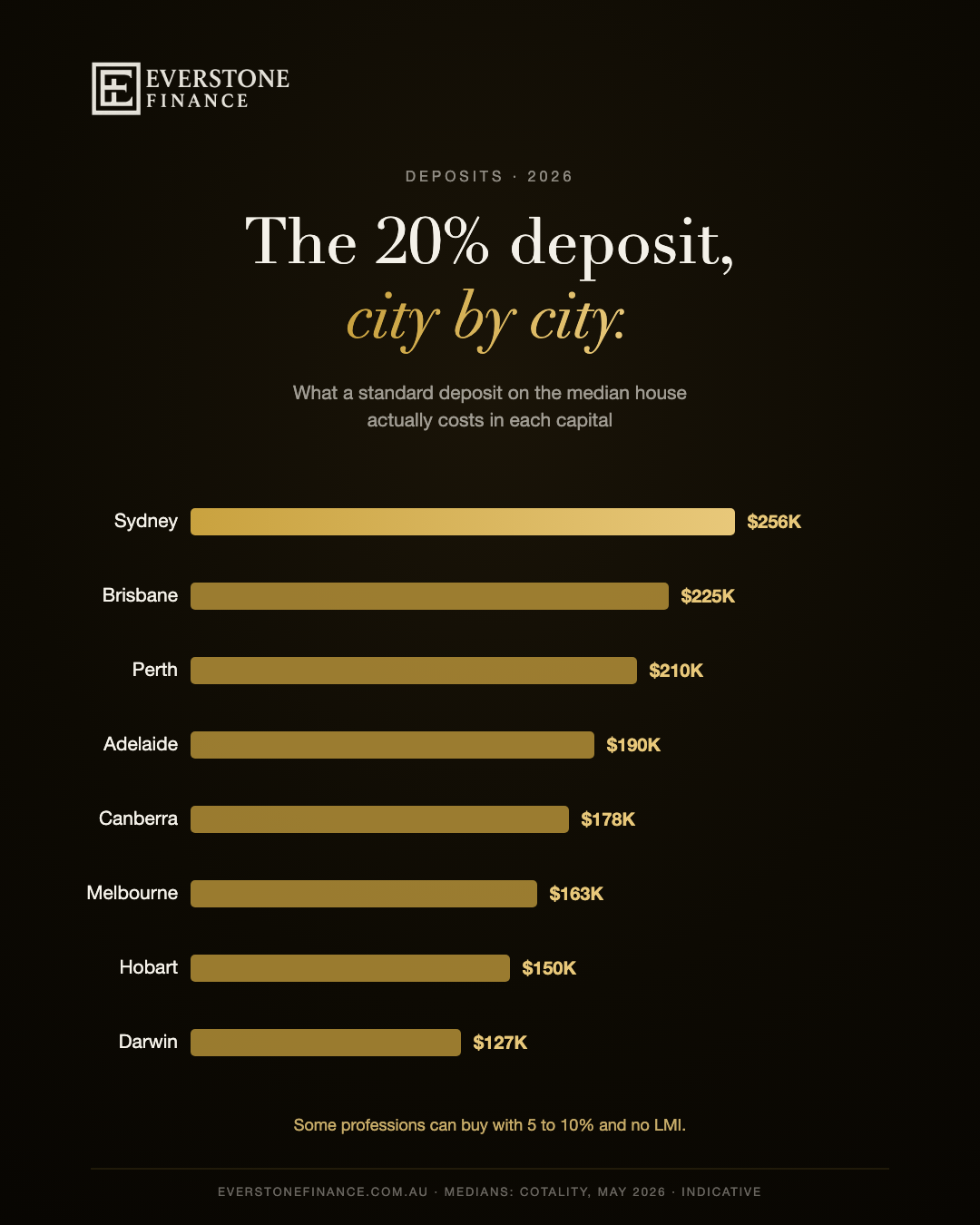
A 20 per cent deposit on the median house ranges from roughly $127,000 in Darwin to $256,000 in Sydney. Most buyers put down less than that and either pay lenders mortgage insurance or qualify for a waiver. If you want to know which path fits you, book a free chat with us.
How much deposit do you need in each capital city?
On current medians, a 20 per cent deposit ranges from about $127,000 in Darwin to about $256,000 in Sydney. At the 10 per cent tier available to many eligible professionals the range is roughly $63,000 to $128,000, and at 5 per cent it is roughly $32,000 to $64,000, before stamp duty and purchase costs.
The medians below are Cotality median dwelling values as at 31 May 2026, exactly as published in our median house prices guide. The deposit columns are simple arithmetic on those medians, rounded to the nearest $1,000. The 20% column is the standard no-LMI benchmark; the 10% and 5% columns are the tiers that eligible professionals and government-scheme participants can buy at without paying LMI.
| City | Median house price | 20% deposit | 10% deposit | 5% deposit |
|---|---|---|---|---|
| Sydney | $1,282,020 | $256,000 | $128,000 | $64,000 |
| Brisbane | $1,126,149 | $225,000 | $113,000 | $56,000 |
| Perth | $1,050,354 | $210,000 | $105,000 | $53,000 |
| Adelaide | $950,703 | $190,000 | $95,000 | $48,000 |
| Canberra | $890,555 | $178,000 | $89,000 | $45,000 |
| Melbourne | $812,621 | $163,000 | $81,000 | $41,000 |
| Hobart | $752,398 | $150,000 | $75,000 | $38,000 |
| Darwin | $634,368 | $127,000 | $63,000 | $32,000 |
| National | $941,864 | $188,000 | $94,000 | $47,000 |
Later print: Cotality’s Home Value Index results as at 31 August 2026 put the medians at Sydney $1,222,718, Melbourne $786,718, Brisbane $1,080,142, Adelaide $937,207, Perth $999,987, Hobart $752,397, Darwin $647,259 and Canberra $864,998. The table keeps the 31 May 2026 values the deposit figures were computed on, so the two months are not mixed; a 20 per cent deposit on an August median is one fifth of that figure.
Two things stand out. First, the spread: the gap between a Sydney deposit and a Darwin deposit at 20 per cent is about $129,000, which is more than an entire 20 per cent Darwin deposit. Second, the tiers change everything. A buyer who qualifies for a 5 per cent pathway in Sydney needs about $64,000, less than half what a standard buyer needs in Darwin at 20 per cent. Where you buy matters, but how you qualify matters just as much.
Why is 20% the magic deposit number, and when is it not?
Lenders treat 80 per cent of a property’s value as the standard risk line. Borrow at or below it, with a 20 per cent deposit, and you avoid lenders mortgage insurance and generally see the sharpest lending policy. Borrow above it and LMI usually applies, unless a waiver, guarantor or government scheme steps in.
The 20 per cent figure is not a law, it is a risk setting. When your loan is 80 per cent of the property’s value or less, the lender has a comfortable buffer if prices fall, so it does not require insurance on the loan. Cross that line and the lender usually insists on lenders mortgage insurance to protect itself, at your cost. That is the whole magic of 20 per cent: it is the point where a significant one-off cost disappears and lender appetite opens up.
When is it not the magic number? In two directions. For eligible professionals, banks quietly move the line to 90 or even 95 per cent, so the real target is 10 or 5 per cent. And at the other end, waiting years to reach 20 per cent has a cost of its own: in the cities where prices are rising, the target keeps moving while you save. A quarter of a million dollars is a long wait in Sydney, and the table above is exactly why so many buyers use one of the lower tiers deliberately rather than as a compromise.
Want to know which deposit tier you actually need?
Have a former banker check whether your job, savings and target city put you at 5%, 10% or 20%, and what each costs, free.
Check my deposit options, freeWould rather message than book? WhatsApp or text Ahmed with your job, your deposit so far and the city you have in mind. His own mobile, no call centre, and no cost to ask.
What happens if you put down less than 20%?
You can still buy, often with as little as 5 to 10 per cent down, but the lender will usually charge lenders mortgage insurance, a one-off premium that protects the lender rather than you. The cost rises with the loan size and how far above 80 per cent you borrow, and on a large purchase it can run well into the tens of thousands.
Lenders mortgage insurance is the toll for crossing the 80 per cent line. On smaller loans just over the threshold it can be a few thousand dollars; on a big loan at a 90 or 95 per cent lending ratio it climbs steeply, and on Sydney-sized purchases it can be a five-figure cost that many buyers capitalise into the loan and then pay interest on for decades. It is not automatically a bad deal, paying LMI to buy years earlier has worked out well for plenty of buyers in rising markets, but it should be a decision, not a surprise.
The other thing to know is that LMI is priced and applied differently from lender to lender, and some occupations can have it waived entirely. Before you accept a quote, it is worth checking whether you are one of them. We cover who qualifies and how much it saves in our guide to the 90 per cent LMI waiver for professionals.
Which professions can skip the 20% deposit entirely?
Doctors, dentists and a range of other eligible professionals can borrow up to 90 per cent, and in some cases 95 per cent, of a property’s value with no LMI. That turns the deposit hurdle into the 10% or 5% column of the table above: roughly $128,000 or $64,000 in Sydney rather than $256,000.
Lenders keep professional lists, occupations with strong, stable incomes and very low default rates, and they compete for those borrowers by waiving LMI at high lending ratios. Medical professionals sit at the top of the tree: doctors can reach 95 per cent with no LMI at select lenders, and dentists commonly access 90 per cent, and higher with some lenders. Lawyers, accountants and select other professions are frequently accepted at the 90 per cent tier, and nurses and other health workers have their own strong policies with particular lenders.
The catch is that no two lenders draw the list the same way. One lender waives LMI for an occupation that another declines, income floors differ, and how your income is structured changes which policy you fit. That is the gap we work in: we know which of the 40-plus lenders on our panel waives LMI for your occupation and income type before you apply. The full picture, profession by profession, is in our guide to home loans for professionals in Australia.
How long does it take to save each deposit?
As a simple illustration, a household saving $2,000 a month would take about 10.7 years to save Sydney’s $256,000 standard deposit, and about 5.3 years for Darwin’s $127,000. At the 5 per cent tier, every capital comes in under three years on the same savings rate.
The table below is illustrative only. It assumes a flat $2,000 saved every month and ignores interest earned on savings, wage growth, and any movement in property prices while you save. Real timelines can be shorter or longer, and in rising markets the target itself moves. What the illustration shows clearly is the difference the tiers make: qualifying for a 5 or 10 per cent pathway does not shave months off the wait, it removes years.
| City | Time to save 20% | Time to save 5% |
|---|---|---|
| Sydney | about 10.7 years | about 2.7 years |
| Brisbane | about 9.4 years | about 2.3 years |
| Perth | about 8.8 years | about 2.2 years |
| Adelaide | about 7.9 years | about 2.0 years |
| Canberra | about 7.4 years | about 1.9 years |
| Melbourne | about 6.8 years | about 1.7 years |
| Hobart | about 6.3 years | about 1.6 years |
| Darwin | about 5.3 years | about 1.3 years |
Run your own numbers with your actual savings rate and the arithmetic is the same: deposit divided by monthly savings gives months to target. If the answer at 20 per cent is longer than you are prepared to wait, the sections above and below are the levers that change it.
How does stamp duty add to the deposit you need?
Stamp duty is the second big upfront cost, and it sits on top of your deposit. It varies significantly by state and territory and rises with the purchase price, and on a median-priced capital city home it is commonly a five-figure sum. First home buyers often pay much less, or nothing, depending on where they buy.
Buyers who plan meticulously for the deposit are regularly blindsided by transfer duty, because it is calculated differently in every state and territory and the concessions differ just as much. As a rule of thumb, the more expensive the property and the state, the heavier the duty, and it must generally be paid at settlement rather than added to the loan. Lenders also look for a buffer beyond the deposit to cover duty, legal work and inspections, so the real savings target is deposit plus costs.
The good news is that most states and territories give first home buyers meaningful concessions or full exemptions below certain price thresholds, which in some cases wipes out the duty entirely. The rules, caps and grants change often and differ by state, so check the current settings for your state in our state-by-state guide to first home buyer grants and stamp duty savings before you set your savings target.
How can you reach a home deposit faster?
Four levers shorten the deposit timeline: a guarantor loan secured against family property, a professional LMI waiver at 90 to 95 per cent, the federal Help to Buy shared equity scheme, and the First Home Guarantee, which lets eligible first home buyers purchase with 5 per cent and no LMI.
A guarantor. If a family member offers part of their own property as additional security, some lenders will finance the full purchase with little or no cash deposit and no LMI. The guarantee can usually be released once you have built enough equity. It is the fastest route in, but it puts the guarantor’s property partly on the line, so it needs to be structured carefully and everyone needs to understand the risk.
A professional waiver. If your occupation qualifies, the 90 to 95 per cent no-LMI policies above are the cleanest shortcut: no scheme caps, no place limits, just a lender whose policy matches your profession and income.
Help to Buy. Under the federal government’s shared equity scheme, the government contributes a share of the purchase price alongside your deposit, shrinking the loan you need to service. Eligibility, income caps and property price caps apply, and the government holds an equity share in the home. We break down how it works and who it suits in our Help to Buy scheme guide.
The First Home Guarantee. Housing Australia’s guarantee lets eligible first home buyers purchase with a 5 per cent deposit and no LMI, with the government guaranteeing the gap to the lender. Places and property price caps apply and they differ by city, so availability is not guaranteed at any given time, but for eligible buyers it converts the 20% column of our table into the 5% column at a stroke.
None of these paths is automatically better than patiently saving 20 per cent. Each trades something, risk to a guarantor, an equity share, scheme caps, for time. The right choice depends on your income, your city and your timeline, and that is a conversation, not a formula.
Want your exact deposit number?
Tell us your city, income and timeline. We will show you which tier you can actually buy at, across more than 40 lenders, and what it means in dollars. No cost, no obligation.
Talk to a former bankerDeposit FAQs
Can I buy with a 5% deposit in Australia?
Yes. Many lenders will lend up to 95 per cent of a property’s value, which means a 5 per cent deposit, though at that level you will usually pay lenders mortgage insurance. Eligible professionals can borrow with a 5 to 10 per cent deposit and no LMI, and the First Home Guarantee lets eligible first home buyers purchase with 5 per cent and no LMI, subject to places and price caps.
How much deposit do I need for a $1 million home?
On a $1 million purchase, a 20 per cent deposit is $200,000, a 10 per cent deposit is $100,000 and a 5 per cent deposit is $50,000. Stamp duty and purchase costs sit on top. Below 20 per cent you will usually pay lenders mortgage insurance unless you qualify for a professional waiver, a guarantor arrangement or an eligible government scheme.
Do investors need a bigger deposit?
Often, yes. Lenders tend to be more conservative on investment lending, so maximum LVRs can sit lower than for owner occupiers and professional waivers do not always extend to investment purchases. Many investors also choose a larger deposit deliberately because it strengthens serviceability and the overall structure. The right answer depends on your position, which is exactly what we map across lenders before you apply.
Which capital city needs the smallest deposit?
Darwin. On its median of $634,368, a 20 per cent deposit is about $127,000 and a 5 per cent deposit is about $32,000, the lowest of any Australian capital. Hobart and Melbourne need the next smallest deposits among the capitals on current medians. And medians move: see what just happened in our analysis of Melbourne’s premium suburb price falls.
Does my deposit include stamp duty and other costs?
No. Your deposit and your purchase costs are separate, and lenders want to see you can cover both. Stamp duty, legal and conveyancing fees and inspections all sit on top of the deposit. First home buyers may pay reduced or no stamp duty depending on their state or territory, which can shrink the total cash needed considerably.
How much deposit do I need in Sydney?
On the 31 May 2026 Cotality median of $1,282,020 used in the table, a 20 per cent deposit in Sydney is about $256,000, a 10 per cent deposit about $128,000 and a 5 per cent deposit about $64,000, before stamp duty and purchase costs. The 31 August 2026 median is $1,222,718, and a 20 per cent deposit on that figure is one fifth of it.
How much deposit do I need in Melbourne?
On the 31 May 2026 median of $812,621, a 20 per cent deposit in Melbourne is about $163,000, a 10 per cent deposit about $81,000 and a 5 per cent deposit about $41,000, before stamp duty and costs. Melbourne needs one of the smallest deposits of the mainland capitals, and its 31 August 2026 median is $786,718.
How long does it take to save a 20 per cent deposit?
On a flat $2,000 a month, about 10.7 years in Sydney, 9.4 years in Brisbane, 8.8 years in Perth, 7.9 years in Adelaide, 7.4 years in Canberra, 6.8 years in Melbourne, 6.3 years in Hobart and 5.3 years in Darwin, ignoring interest, wage growth and price movement. At the 5 per cent tier every capital comes in under three years on the same savings rate.