

Private Sale or Auction: How to Buy in 2026
- Australian homes sell two main ways: private sale, a negotiation where conditions and cooling-off can protect you, and auction, where the winning bid is unconditional on the spot.
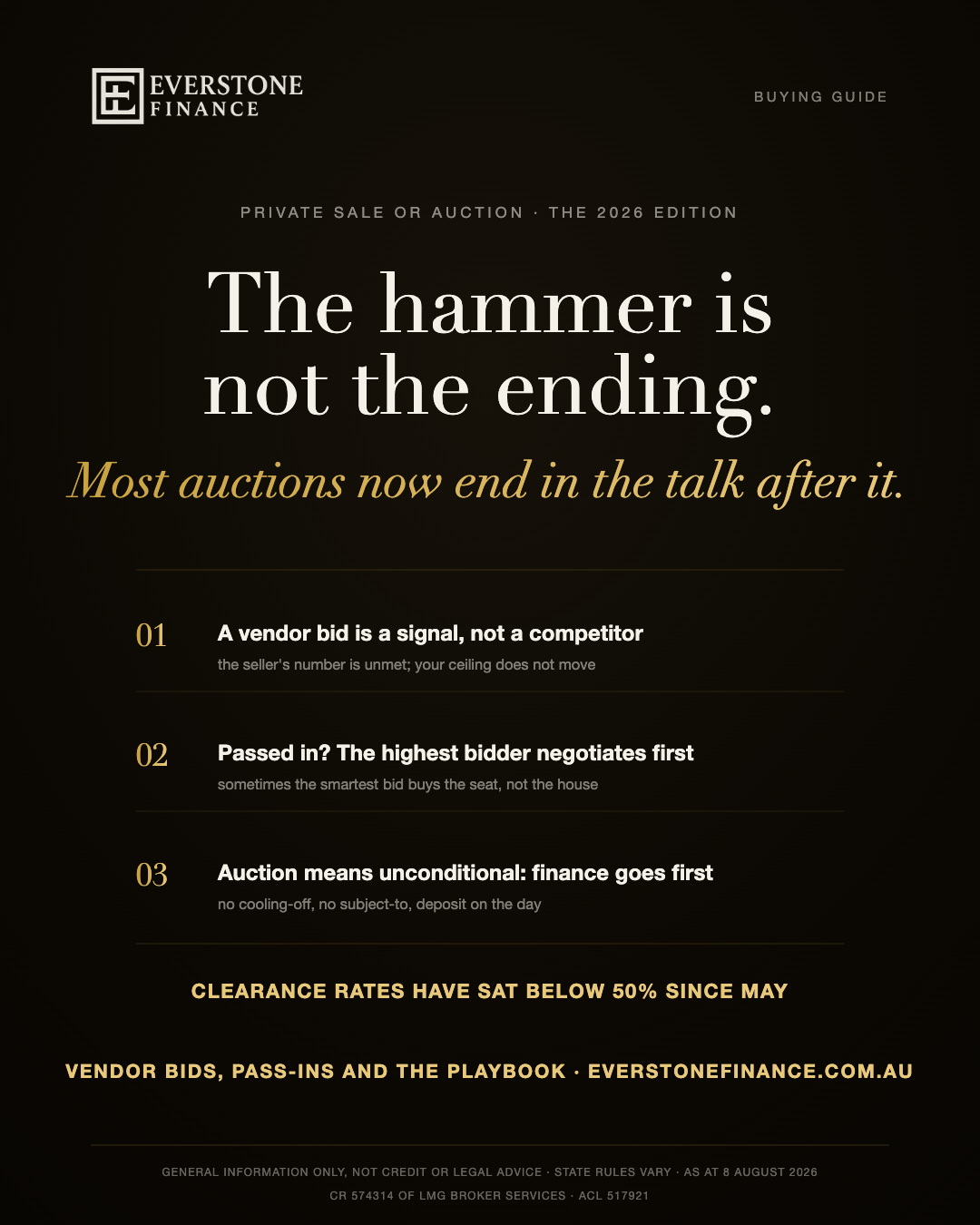
- A vendor bid is the auctioneer bidding on the seller’s behalf. It must be announced, and it tells you one thing: the bidding has not yet reached the seller’s number.
- With clearance rates under 50 per cent since May, most auctions now end not under the hammer but in the negotiation afterwards. This week The Age reported an inner-west Victorian home selling for $817,500 in post-auction negotiations: the new normal.
- The biggest practical difference between the two paths is finance. Private sale can be subject to finance; auction cannot, which is why auction-ready pre-approval is its own discipline.
Two ways to buy the same house
Australian residential property sells mainly by private sale, also called private treaty, where buyers negotiate offers through the agent with conditions possible, or by public auction, where open bidding produces an unconditional contract the moment the hammer falls. Auction rules differ by state, but the core distinctions are constant: private sale allows cooling-off periods and finance conditions in most circumstances, while auction purchases are final on the day with the deposit payable immediately. And however you buy, the deposit transfer itself deserves protection: our safe-transfer playbook against payment-redirection scams covers the five rules. For the season ahead specifically, our spring 2026 buyer’s guide sets the strategy.
Same house, two very different doors. A private sale is a negotiation: you offer, they counter, and the contract can carry the conditions you negotiate. An auction is a public contest with theatre, adrenaline and one legal cliff edge: the moment the hammer falls, you have bought it, unconditionally, deposit payable on the spot.
Neither is better in the abstract; they reward different preparation. What has changed in 2026 is the balance of power inside each. With auction clearance rates sitting below 50 per cent since late May, more than half of auctions are not producing a knockout bid, which moves the real action to the pass-in and the negotiation that follows. Understanding that machinery, vendor bids included, is now worth real money. The step-by-step of the whole journey, from deposit to settlement, lives in our buying process guide; this piece is about the contest itself. How far the table has tilted is quantified in our five-signal buyer’s market piece.
Private sale: the negotiation you can shape
In a private sale the buyer submits an offer through the agent, usually in writing, and can negotiate price and conditions including subject to finance, subject to building and pest inspection, and settlement timing. Cooling-off periods apply in most states for private sales, for example three clear business days in Victoria, giving a short legal exit after signing. Conditions protect the deposit: a subject-to-finance clause means the contract can end without penalty if the loan is declined.
A private sale runs at conversation speed. You inspect, you offer, the agent shops it, someone counters, and eventually a contract carries the terms both sides accepted. Three levers matter more than most buyers realise:
- Conditions are yours to negotiate. Subject to finance, subject to building and pest, longer or shorter settlement: all on the table in a private sale, and in a sub-50 per cent clearance market, vendors accept conditions they would have laughed at two years ago. A subject-to-finance clause is deposit insurance: if the loan falls over, you walk away whole.
- Cooling-off exists here. Most states give private sale buyers a short cooling-off window after signing, three clear business days in Victoria for example, with a small penalty for using it. It is a safety net, not a strategy, and it largely disappears at auction.
- Terms can beat price. A clean offer with proof of pre-approval and flexible settlement regularly beats a higher offer wrapped in maybes. Sellers price certainty, especially now.
Auction: the rules of the room
At an Australian auction the winning bid creates an unconditional contract: no cooling-off, no finance clause, and the deposit, commonly 10 per cent, is payable immediately. The seller sets a confidential reserve price, and the property is only announced as on the market once bidding reaches it. Some states require bidder registration. All due diligence, building and pest inspections, contract review and finance approval, must be completed before auction day, because there is no exit afterwards.
Auction compresses everything a private sale negotiates into one unconditional moment. The rules of the room, plainly:
- The hammer is a contract. Winning bid, hammer falls, you sign, you pay the deposit, usually 10 per cent, then and there. No cooling-off, no conditions, no subject-to-anything.
- The reserve is secret. The seller sets a minimum before the auction. Until bidding reaches it, the auctioneer is not obliged to sell; when it does, you will usually hear the magic words: the property is on the market. Everything after that phrase is a genuine contest.
- Registration may apply. Some states require bidders to register with identification before bidding; check the rules where you are buying.
- All the homework happens before. Contract reviewed by your conveyancer, building and pest done, finance genuinely settled. At auction, due diligence is a pre-event, not a condition.
Vendor bids, decoded
A vendor bid is a bid made by the auctioneer on behalf of the seller, used to move an auction along when genuine bidding sits below the reserve. Vendor bids must be announced as such when made, and the rules differ by state: Victoria requires each one to be identified openly, while New South Wales permits only one at a residential auction. A vendor bid signals that the seller’s number has not been reached, so buyers should treat it as information rather than competition and never chase it beyond their own limit.
The moment that confuses first-time auction-goers most: the auctioneer, mid-auction, announces a bid from nobody. That is a vendor bid: the auctioneer bidding on the seller’s own behalf, which sounds outrageous the first time and is entirely legal when done by the rules.
The rules, in short: a vendor bid must be announced as one when it is made. In Victoria the auctioneer can make them but must identify each openly; in New South Wales a residential auction allows only one. Other states run their own variations, which your contract and the auctioneer’s opening spiel will spell out.
What matters is not the legality but the signal. A vendor bid exists for one reason: genuine bidding has not reached the reserve, and the auctioneer is trying to restart the engine. Read it that way and it becomes useful information: the seller’s number is above the current bid, real competition may be thin, and a pass-in, followed by a negotiation you may lead, is now a live possibility. What a vendor bid should never do is stampede you: it is not a rival buyer, and your ceiling does not move because the seller bid against you. Set your walk-away number before the auction, in writing if that helps, and let the theatre be theatre.
The pass-in: where most 2026 auctions actually end
When bidding fails to reach the reserve the property is passed in, and by convention the highest genuine bidder earns the first right to negotiate with the seller immediately afterwards. With clearance rates below 50 per cent since May 2026, pass-ins have become the majority outcome, and many sales now complete in post-auction negotiation, such as the inner-west Victorian home The Age reported selling for $817,500 this week. In that negotiation, conditions like subject to finance can sometimes return to the table, though a contract signed on the day typically remains auction-terms.
Here is the 2026 reality the auction theatre hides: with clearance rates under 50 per cent, the most common ending is not a hammer, it is a pass-in: bidding stalls short of the reserve, the auctioneer confers with the vendor, and the property is passed in to the highest bidder.
That phrase matters, because the highest genuine bidder customarily earns the first right to negotiate, immediately, usually inside the house while everyone else drifts off. It happened again this week: The Age reported an inner-west Victorian home selling for $817,500 in post-auction negotiations, one more sale finished not under the hammer but in the conversation after it. That is not an auction failing; in this market it is how auctions work.
Play it deliberately: sometimes the smartest bid of the day is the one that makes you highest bidder just before the pass-in, buying you the negotiation seat without buying the house. In the talks that follow, the dynamic softens: the vendor has publicly not met the market, your position is known, and terms, occasionally including finance conditions, can re-enter the conversation, though anything signed on the day usually remains on auction terms. Go in knowing your ceiling and the vendor’s disclosed guide, and remember our falling-market piece: in the current tier data, patience is being paid.
The finance difference, and what auction-ready means
The decisive practical difference between the two sale methods is finance. A private sale contract can be made subject to finance, protecting the deposit if the loan is declined. An auction purchase cannot: the buyer must hold finance approval robust enough to survive the purchase before bidding, because a valuation shortfall or approval condition discovered after auction day is the buyer’s problem. Auction-ready means a strong pre-approval, deposit funds accessible on the day, a contract already reviewed, and a bidding limit set from real numbers. And if the loan side still feels foreign, our beginner guide to mortgages covers it from zero.
Strip everything else away and one difference decides how you prepare: a private sale can be subject to finance; an auction cannot. Bid successfully at auction with finance that is halfway, and you own the gap.
Auction-ready, properly, means four things:
- Pre-approval that would survive contact with this purchase: current, from a lender whose policy fits this property type, with headroom. What pre-approval does and does not promise is covered in our pre-approval explainer.
- The valuation risk understood. The lender values the property after you buy it. In a falling market, a bank valuation below your winning bid means finding the difference, which is precisely why your ceiling should come from arithmetic, not adrenaline.
- The deposit liquid on the day: cleared funds or a deposit bond arranged, not shares to sell on Monday.
- The contract reviewed before you raise a hand, because at auction you cannot negotiate it afterwards.
This is exactly the preparation we run for buyers: pre-approval matched to the actual property, a bid ceiling built from your real numbers, and finance that does not blink when the hammer falls, whichever door the right home is behind.
Bidding this spring? Walk in auction-ready.
Pre-approval with headroom, your ceiling worked out from real numbers, deposit funds sequenced, and a plain answer on whether the private sale terms or the auction contest suits your situation. Former bankers, no cost, no obligation.
Book a chat with a former bankerSide by side, the whole comparison:
| Private sale | Auction | |
|---|---|---|
| How you buy | Negotiated offer through the agent | Open public bidding |
| Conditions (finance, inspection) | Negotiable into the contract | None: unconditional at the hammer |
| Cooling-off | Applies in most states, length varies | None at auction |
| Deposit | On signing, timing negotiable | Commonly 10 per cent, on the day |
| Seller’s price floor | Asking price or range, negotiable | Confidential reserve |
| Seller can bid? | No, counters instead | Vendor bids, announced, state rules apply |
| If no deal on the day | Negotiation continues | Pass-in: highest bidder negotiates first |
Frequently asked questions
What is a vendor bid at an auction?
A bid the auctioneer makes on the seller’s behalf, used when genuine bidding sits below the reserve. It must be announced as a vendor bid when made, and state rules differ: Victoria requires each to be identified openly, while New South Wales residential auctions allow only one. It signals the seller’s number has not been reached.
Should I keep bidding after a vendor bid?
Only if the price is still inside the ceiling you set before the auction. A vendor bid is not a rival buyer; it is the seller declining the current price. Treat it as information about the reserve, not competition to beat, and never move your limit because of one.
Is there a cooling-off period when you buy at auction?
No. Auction purchases are unconditional in every state, and the exemption usually extends to contracts signed shortly before or after the auction. Cooling-off protections apply to private sales, with the length varying by state, for example three clear business days in Victoria.
What happens if a property is passed in to me?
As the highest genuine bidder you customarily get the first right to negotiate with the vendor immediately after the auction, before the property is offered more widely. In the current sub-50 per cent clearance market, that negotiation is where a large share of sales now complete.
Can I make an offer before auction day?
Usually, yes. Vendors weighing a soft market sometimes accept strong pre-auction offers rather than risk a public pass-in. A pre-auction offer generally needs to be compelling and clean, and once accepted it is typically signed on auction terms, so the finance homework must already be done.
Can an auction purchase be subject to finance?
Not under the hammer: the contract is unconditional. In a post-pass-in negotiation, conditions can sometimes be discussed, though vendors usually push to keep auction terms. The safe assumption is that any auction campaign requires finance robust enough to need no conditions.
How much deposit do I need at an auction?
Commonly 10 per cent of the purchase price, payable when you sign immediately after the hammer falls. It needs to be accessible that day, by cheque, transfer arrangement or an agreed deposit bond, which is part of what auction-ready preparation covers.
Is private sale or auction better for buyers in 2026?
The market has tilted both toward buyers: private sale vendors are accepting conditions again, and auctions clearing below 50 per cent mean pass-in negotiations, like the inner-west home The Age reported selling at $817,500 this week, are the common ending. The better path depends on the property, your finance readiness and your appetite for the room; the preparation is what decides the outcome in either.
The honest summary
Private sale rewards negotiation and protects you with conditions; auction rewards preparation and punishes its absence. In 2026 the two have converged more than the theatre suggests: most auctions end in a negotiation anyway, vendor bids are telling you the reserve is unmet, and the buyer who walks in with real pre-approval, a reviewed contract and a fixed ceiling holds the strongest hand in either room. The house decides the method. Your preparation decides the result.
The hammer does not wait for your bank. Get finance that is ready first.
Whichever door the right home is behind, one conversation sorts the pre-approval, the ceiling and the deposit sequencing, and gives you a former banker on call for the day itself. No cost, no obligation.
Book a chat with a former bankerAbout the author. Ahmed Lotfi is co-founder of Everstone Finance and a former banker who now works as a mortgage and finance broker in South Yarra, Melbourne, arranging home, investment and commercial lending for clients across Australia. Everstone Finance operates under the Best Interests Duty as Credit Representative 574314 of LMG Broker Services Pty Ltd, Australian Credit Licence 517921.