

Home Prices Just Fell the Fastest Since 2022. The Changeover Maths Now Favours Upgraders (2026)
- National home values fell 0.7 per cent in July, the largest single-month decline since December 2022. Sydney dropped 1.4 per cent and Melbourne 1.2.
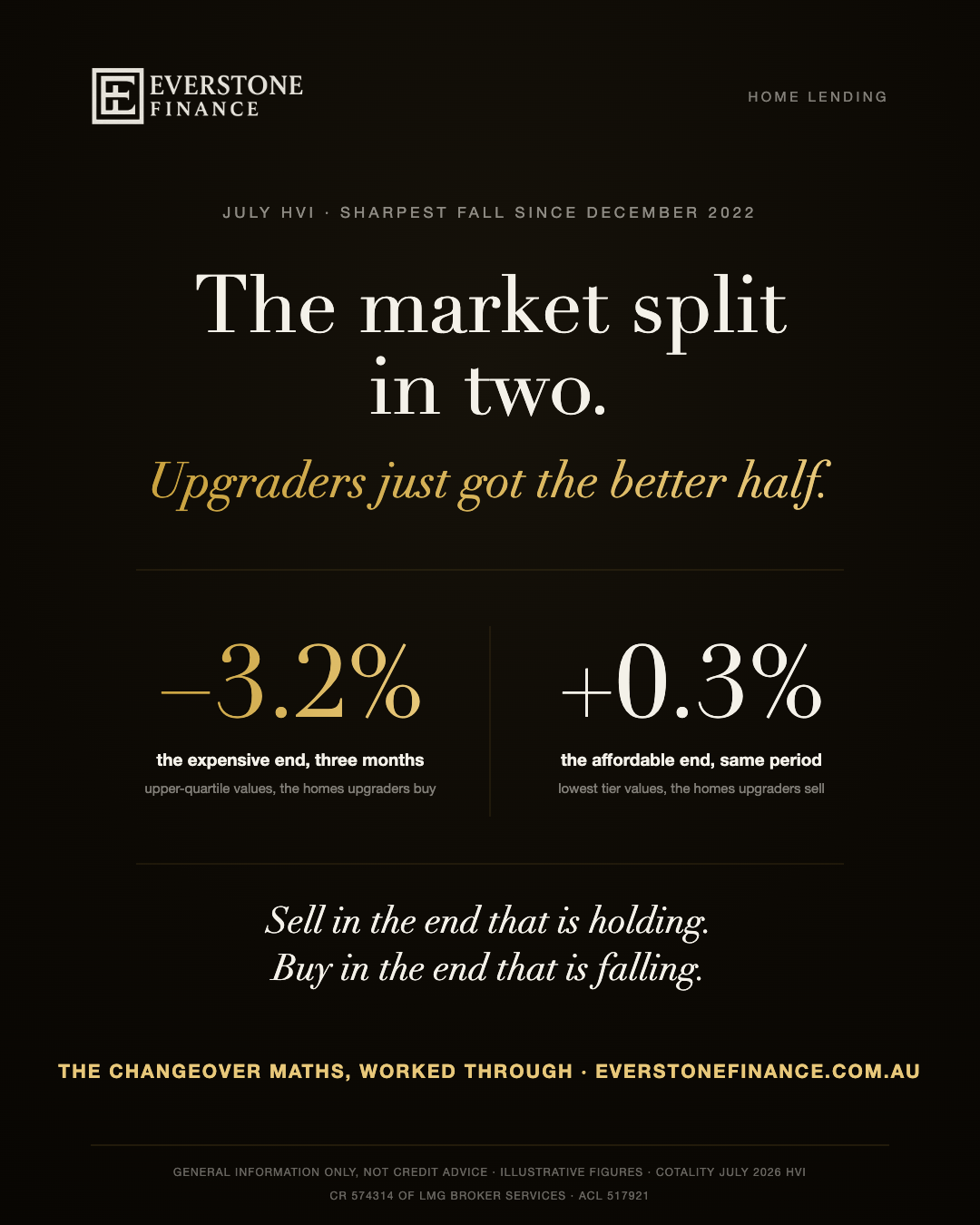
- The detail that matters more than the headline: upper-quartile values fell 3.2 per cent in three months while the lowest tier rose 0.3 per cent. The end you sell in is holding better than the end you buy in.
- On illustrative numbers, an $850,000 to $1.4 million changeover just got roughly $39,000 cheaper: the gap narrows in your favour and stamp duty is levied on the lower price.
- Falling markets reward organised buyers: pre-approval in hand, sale and purchase sequenced deliberately, bridging finance understood before it is needed.
What the July numbers actually said
Cotality’s national Home Value Index fell 0.7 per cent in July 2026, the largest single-month decline since December 2022. Sydney fell 1.4 per cent, Melbourne 1.2, Brisbane 0.6 and Adelaide 0.2, while regional Australia recorded its first fall since January 2023. Upper-quartile values fell 3.2 per cent over the three months to July while the lowest tier rose 0.3 per cent, meaning expensive properties are cheapening faster than entry-level ones, which improves the arithmetic for upgraders. The city where this maths is sharpest right now is covered in our Sydney 2027 forecast.
Cotality’s July index landed this weekend and the headline was blunt: national values fell 0.7 per cent in a month, the sharpest drop since December 2022. Sydney fell 1.4 per cent, Melbourne 1.2, and it is no longer a two-city story: Brisbane and Adelaide have now fallen two months running, and regional Australia slipped for the first time since January 2023. Listings are sitting 5.7 per cent above the five-year average and auction clearance rates have been under 50 per cent since late May. The room mechanics behind those clearance numbers, vendor bids and pass-in negotiations included, are decoded in our private sale versus auction guide.
If you want the long history of what downturns like this have meant, our piece on Australia’s ninth downturn and what the last eight did next covers it. This article is about one specific group the headlines keep missing, because for them the news is not bad at all. If you own a home and want a bigger one, July quietly moved the numbers in your favour.
The tier wedge: the top is falling, the bottom is not
The July data shows Australia’s housing downturn is concentrated in expensive property: upper-quartile values fell 3.2 per cent over three months nationally while the lowest tier rose 0.3 per cent. Commentary points to compressed borrowing capacity after rate rises, softer sentiment at the discretionary end, and an investor pullback ahead of announced negative gearing and capital gains tax changes, while demand support remains strongest at the affordable end.
Inside the national number is a split market. Over the three months to July, on Cotality’s tiers:
| Market segment | Three months to July |
|---|---|
| Upper-quartile values (the expensive end) | Down 3.2 per cent |
| Lowest tier (the affordable end) | Up 0.3 per cent |
The two ends of the market are moving in opposite directions. Market commentary points to a familiar cluster of reasons: rate rises have compressed how much buyers can borrow, which bites hardest at the discretionary top end; sentiment is weak; and reported investor caution ahead of the announced negative gearing and capital gains tax changes is thinning competition. Meanwhile the affordable end stays supported by first home buyer incentives and sheer depth of demand. The demand data has now landed: Westpac reported mortgage applications down 20 per cent since the May budget, and forecast investor housing credit growth to roughly halve, from 9.1 per cent this year to 4.5 in 2027, as reported by Reuters on 10 August. The full five-signal case that the market has tilted to buyers, expats included, is in our buyer’s market piece.
Why that wedge matters to an upgrader is almost too simple to notice: the home you are selling lives in the tier that is holding. The home you are buying lives in the tier that is falling. Every month that gap compounds, the trade gets cheaper.
The changeover maths, worked through
In a falling market an upgrader’s changeover cost shrinks because the more expensive target property loses more dollars than the cheaper home being sold, and stamp duty is calculated on the lower purchase price. On illustrative numbers, selling an $850,000 home that slips 1 per cent while buying a $1.4 million home that has fallen 3.2 per cent narrows the changeover gap by about $36,300, with roughly $2,500 less Victorian stamp duty, about $39,000 in total.
Run one honest example. The percentages are July’s actual tier moves; the prices are illustrations, and your numbers will differ.
| Three months ago | Now | |
|---|---|---|
| Your home (resilient tier, slips 1 per cent) | $850,000 | $841,500 |
| Target home (upper quartile, down 3.2 per cent) | $1,400,000 | $1,355,200 |
| The changeover gap | $550,000 | $513,700 |
You sell for $8,500 less. You buy for $44,800 less. The trade you actually make, the gap between the two, narrows by $36,300. Then stamp duty adds a second, smaller kicker: duty is levied on the price you pay, so the cheaper purchase trims roughly another $2,500 in Victoria at that price level. Call it about $39,000 on these illustrative numbers, for making exactly the move you already wanted to make. And if your sequencing ends up as buy first, then sell, budget the one line this table does not show: what the bridge itself costs.
Two honest footnotes. First, the same arithmetic runs in reverse for downsizers: trading down in a falling market shrinks the equity you release, so the timing logic is opposite. Second, if prices keep falling after you settle, your new home falls too. But you were always going to own a home either way; what a falling market changes is the cost of the swap, and that cost is locked in on the day you transact, not averaged over the cycle. And if you are checking which side of the equity line you sit on first, our negative equity explainer has a ten-second position checker.
Upgrading this spring? Know your number before the market does.
A pre-approval tells you exactly what you can offer while everyone else is still guessing. Tell us what you own, what you owe and what you are hoping to buy, and we will map the changeover properly: borrowing power, sequencing, bridging if it fits. No cost, no obligation.
Book a chat with a former bankerSell first or buy first in a falling market
In a falling market, selling before buying carries an underrated advantage: the sale price is locked while the purchase happens later into softer prices, and the seller knows exactly what they can spend. Buying first risks the sale price softening underneath the purchase. Bridging finance covers the case where the right home appears before the current one sells, and auction clearance rates under 50 per cent mean buyers currently have more room to negotiate.
The classic upgrader anxiety is being caught between two markets. In a rising market, buying first is the aggressive play, because the home you want runs away from you faster than your sale price improves. A falling market flips that logic:
- Selling first locks your number at today’s price, and your purchase then happens weeks or months later, further into the softness you are buying into. In a falling top end, the delay works for you. You also negotiate as a cash-ready buyer, which matters when clearance rates are under 50 per cent and vendors are watching passed-in auctions.
- Buying first secures the home but leaves your sale exposed to the same softening. If you go this way in this market, price your own sale realistically from day one rather than chasing the market down.
- Bridging finance is the tool for when the right home appears before yours is sold: it carries both properties for a defined window so you are never forced to sell badly or buy in a panic. The full mechanics, costs included, are in our complete guide to bridging loans.
There is no universally right sequence, but there is a right sequence for your equity, income and risk tolerance, and it is knowable in one conversation before you list anything.
What organised looks like, on the money side
An organised upgrader in this market holds a current pre-approval, knows their equity position before valuations soften, and has compared their existing loan against the market rather than carrying an old rate into a larger balance. Everstone’s refinance savings calculator shows what the existing rate is worth, and the buying process guide covers each step from pre-approval to settlement.
Three moves, all doable this month, all free:
- Get pre-approved. When clearance rates are low, vendors engage seriously with buyers who can act. A current pre-approval is the difference between negotiating and browsing. The step-by-step is in our guide to the buying process.
- Check your equity while it is strongest. Valuations follow the market down with a lag. If your current loan needs restructuring before an upgrade, doing it against today’s valuation rather than a softer one preserves options.
- Do not carry an old rate into a bigger loan. An upgrade usually means a larger balance, which makes the rate on it matter more, not less. Our refinance savings calculator shows what the gap on your current loan is worth over one, ten, twenty and thirty years, and where the median markets sit is in our city-by-city price rundown.
Watching the auctions pass in and wondering? The top quartile just got 3.2 per cent cheaper in three months. If the bigger home was already the plan, the arithmetic is finally leaning your way. Book a time with a former banker and get the changeover mapped before spring listings land.
Frequently asked questions
Is a falling market actually a good time to upgrade?
For the changeover cost, often yes. When the expensive end falls faster than the affordable end, which is exactly what July’s tier data shows, the dollar gap between your current home and the bigger one narrows, and stamp duty on the cheaper purchase falls with it. The trade gets cheaper even though both prices are lower. Whether it is right for you depends on job security, equity and buffer, which is a conversation, not a headline.
What if prices keep falling after I buy?
Then both your new home and the one you sold would have kept falling, and the changeover cost you locked in would look better still. The risk that matters is overstretching, not the paper value of a home you plan to hold. Australia’s previous eight downturns and what followed them are covered in our downturn history piece, and none of them rewarded panic in either direction.
Should I sell first or buy first right now?
In a falling market, selling first carries an underrated advantage: your sale price is locked while your purchase happens later, further into the softness. Buying first secures the home but exposes your sale. The right answer depends on your equity, borrowing power and how replaceable the target home is, and it should be decided before you list, not during a negotiation.
How does bridging finance work if I find the right home before I sell?
A bridging loan carries both properties for a defined period, typically six to twelve months, so you can buy without being forced into a rushed sale. You pay interest on the combined debt during the bridge, which is why it suits a clear sale plan rather than an open-ended one. Our complete bridging guide covers costs, risks and when it beats the alternatives.
Has my borrowing power changed with the rate rises?
Most likely, yes. Lenders assess repayments at current rates plus a buffer, so this year’s increases have trimmed most buyers’ maximums. That is one reason the expensive end is falling. A pre-approval resets your real number so you can negotiate confidently rather than guessing from an old approval.
Do I really pay less stamp duty because prices fell?
Yes. Stamp duty is calculated on the purchase price, so a cheaper purchase means less duty. On a Victorian purchase around $1.4 million, a 3.2 per cent price fall trims roughly $2,500 of duty on top of the price saving itself. The exact figure depends on your state and price bracket.
Does this only apply in Sydney and Melbourne?
No, though they are furthest into it. Brisbane and Adelaide have now recorded two consecutive monthly falls, while Perth is still rising slightly and regional markets are mixed. The tier wedge, expensive property falling faster than affordable property, is a national pattern in the July data, but check your own city’s numbers before applying the arithmetic.
I am thinking of downsizing, not upgrading. Does the same logic help me?
It works against you, in dollars. Trading down in a falling market shrinks the gap you pocket, in dollars: the expensive home you sell sits in the tier falling fastest, while the cheaper home you buy is holding its value. Downsizing decisions usually run on lifestyle, maintenance and capital release, all still valid, but on pure timing arithmetic a falling market favours trading up, not down.
The honest summary
July’s fall was the sharpest in over three years, and most of the coverage stopped at the fear. The part that matters for a household with a home and a plan to grow into a bigger one is the wedge inside the number: the expensive end is cheapening three months running while the affordable end holds. That is the arithmetic of a cheaper changeover, and it does not require predicting the bottom, timing the cycle or believing any forecast. It requires knowing your borrowing power, sequencing the sale and purchase deliberately, and not carrying an old loan structure into a bigger balance. All three are free to sort out, and all three are exactly what we do.
The gap to your next home just narrowed. Map the changeover properly.
Borrowing power at today’s rates, sell-first or buy-first sequenced for your situation, bridging costed if it fits, and your current loan checked so the bigger balance lands on the right rate. One conversation, former bankers, no obligation.
Book a chat with a former bankerAbout the author. Ahmed Lotfi is co-founder of Everstone Finance and a former banker who now works as a mortgage and finance broker in South Yarra, Melbourne, arranging home, investment and commercial lending for clients across Australia. Everstone Finance operates under the Best Interests Duty as Credit Representative 574314 of LMG Broker Services Pty Ltd, Australian Credit Licence 517921.