

How Much Would Refinancing Your Business Loan Save? Run Your Own Numbers (2026 Calculator)
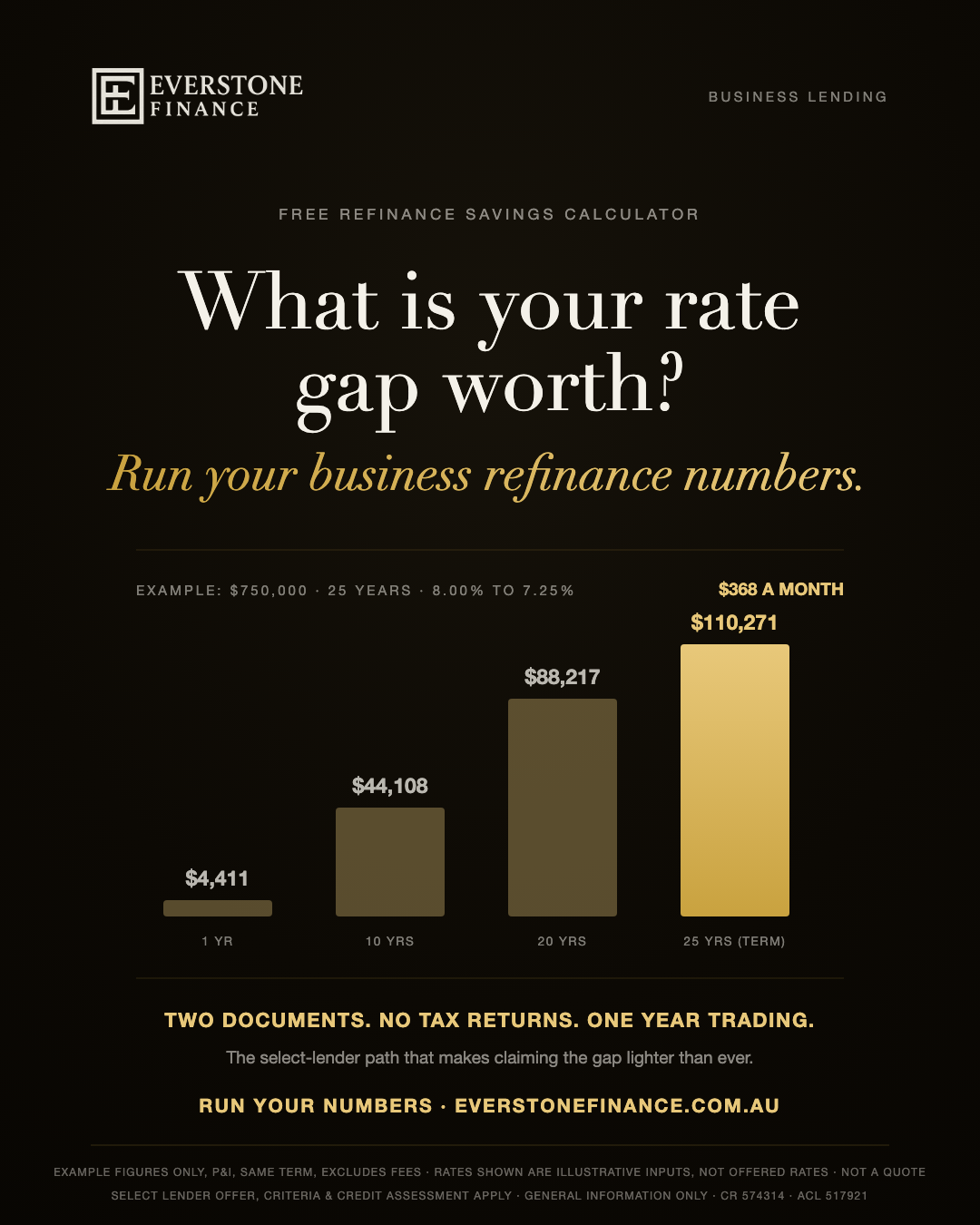
Every business owner suspects their loan could be cheaper. Almost none of them know by how much, and that missing number is exactly why the refinance never happens: a vague suspicion loses to a busy week every single time. So here is the number. The calculator below takes your balance, your current rate, a comparison rate you could refinance to, and your remaining term, and shows you the monthly difference and the cumulative savings over one year, ten years, twenty years and thirty years. It runs in your browser, stores nothing, and takes less effort than reading your loan statement. And if the number it shows you is worth acting on, the acting part has never been easier: as we covered when the offer launched, a select major lender is currently refinancing business lending for businesses trading a year or more on just two documents, 12 months of business bank statements and a statement of position, no tax returns. Written by former bankers who arrange business and commercial lending every week. Importing? The strong dollar case for refinancing now is set out in our piece on making the currency margin permanent.
- Business and commercial loan pricing drifts worse than home loans because facilities are reviewed less often. The cost compounds silently.
- The calculator below shows your monthly saving and the cumulative difference over 1, 10, 20 and 30 years, from numbers you enter yourself.
- The paperwork excuse is retired: a select major lender currently refinances business lending on two documents, no tax returns, for businesses trading a year or more.
- Rate is not the whole decision: fees, break costs and term structure matter, and extending your term can cost more overall even at a lower rate. We check all of it.
- Book a chat with a former banker: we compare the market, and if your current facility stands up, that is the answer you get.
The refinance savings calculator
Enter your loan balance, current interest rate, a comparison rate and your remaining term, and the calculator shows the monthly repayment at each rate and the cumulative saving over 1, 10, 20 and 30 years, capped at your remaining term. Estimates only, on a principal and interest basis, excluding fees; the rates are yours to enter, not offers.
Refinance savings calculator
Please fill every field with real numbers. Term is 1 to 30 years.
Estimates only, general information, not credit advice. Calculated on a principal and interest basis with both loans running your remaining term; excludes fees, charges and any break costs, which can change the outcome. The comparison rate is one you enter, not a rate we offer or predict. Savings horizons are capped at your remaining term. Calculations happen in your browser; nothing you enter is stored or sent anywhere.
See if the market beats your rate, freeNo cost, no obligation. The lender pays us on settlement.
Three notes for honest inputs. Use your actual current rate from your facility statement, not your memory of it. For the comparison rate, be realistic rather than hopeful; even a conservative gap usually produces a number worth seeing, and we will tell you what the market actually writes for your profile before anything is decided. And if your facility is interest-only, the arithmetic differs; the calculator assumes principal and interest, which is the common shape for term business debt, and we run the interest-only version with you in the review.
How to read your result honestly
The monthly saving is real cash-flow; the long-horizon figures assume both loans run the same remaining term, which is the honest comparison. A refinance that stretches your debt back out to a longer term can cost more in total interest even at a lower rate. Compare like with like, and count the fees.
Two disciplines keep the number honest. First, same term against same term. The seductive trick in refinancing is quoting a lower repayment that is really just a longer term wearing a disguise; stretching a loan with 15 years left back out to 25 years drops the repayment and can increase the total interest you pay, lower rate and all. Our calculator deliberately holds the term constant so the saving it shows is a rate saving, not a term illusion. If cash-flow relief through a longer term is genuinely the goal, that is a legitimate strategy, but it should be chosen with eyes open, not discovered later.
Second, net off the costs. Discharge fees, application fees, valuation and legal costs on commercial facilities, and break costs if any part of your lending is fixed: these come off the savings before the refinance clears its bar. The one-year figure in the calculator is the most useful yardstick here; if year one covers the switching costs with room to spare, the following years are pure margin. This is the same arithmetic we run in our commercial property loan review guide, and it pairs with the offset-style linkage checks from our offset calculator: features and rate, checked together.
The two-document path, recapped
A select major lender currently refinances existing business lending for businesses that have traded a year or more using 12 months of business bank statements and a statement of position, with no tax returns or accountant-prepared financials for the application. Standard credit assessment applies, and offers like this change without notice.
If the calculator just showed you a number worth acting on, here is why acting is lighter than you remember. The traditional wall in business refinancing was never the decision; it was the paperwork: two years of returns, accountant-prepared financials, interim statements. As we covered in detail in our no-tax-returns refinance piece, a select major lender currently assesses business refinances for businesses trading a year or more on exactly two documents: 12 months of business bank statements, downloadable from your internet banking tonight, and a statement of position, the one-page summary of what the business and its owners own and owe, which we prepare with you. No tax returns. Standard credit assessment still applies, conduct in your statements still matters, and the offer is one lender’s current policy, which can change without notice; that timing is half the argument for running your numbers this month rather than eventually.
The same review naturally extends to any commercial property lending attached to the business, and to the broader question our business loan refinancing guide walks through: whether the facility still fits the business it is funding.
Beyond the rate: what else we check
A proper facility review covers rate, fees, structure, security, guarantees and features together: the wrong structure quietly costs more than the wrong rate. We compare across the market, and where your current facility genuinely stands up, we say so.
Rate is the headline, and the calculator gives you that number, but the reviews that save businesses the most usually find their money elsewhere: security structures pledging more than the loan needs, personal guarantees that outlived their purpose, facilities priced for a riskier business than the one you now run, redraw and offset-style features paid for and never linked, and loan shapes, overdraft versus term debt versus equipment finance, that no longer match how the business actually uses money. A former banker reads a facility letter the way a builder reads a house: the cracks are structural, not cosmetic.
So bring the statement, run the calculator, and then let us do the part no calculator can: compare your whole facility against what 40+ lenders would write for your business today, fees and structure included, under the Best Interests Duty where it applies to credit assistance. If the honest answer is that your current lender is treating you well, you will hear exactly that, and you will have gained certainty at the price of one conversation.
You just saw the number. Now make it real.
Bring your facility statement and the calculator result, and a former banker will confirm what the market actually writes for your business, whether the two-document path fits, and what the switch truly nets after costs. No cost, no obligation.
Book a chat with a former bankerFrequently asked questions
How do I calculate savings from refinancing a business loan?
Compare the monthly repayment on your balance at your current rate against the same balance, same remaining term, at the rate you could move to, then multiply the difference across the years you will hold the loan and subtract switching costs. The calculator on this page does the repayment arithmetic for horizons of 1, 10, 20 and 30 years, capped at your remaining term; the honest comparison always holds the term constant.
Is the saving shown by the calculator guaranteed?
No. It is an estimate built entirely from figures you enter, on a principal and interest basis, excluding fees, break costs and structural differences between products, and the comparison rate is yours, not an offer. Treat the result as a reason to get your facility properly compared, not as a quote; the review confirms what the market actually writes for your business.
Can I really refinance a business loan without tax returns?
Currently yes, at a select major lender, for businesses that have been trading a year or more: the application runs on 12 months of business bank statements and a statement of position. Standard credit assessment and criteria apply, statement conduct matters, and lender offers change without notice, which is why we confirm the live policy before anything is lodged.
Does a lower rate always mean I save money overall?
Not automatically. If the refinance stretches your remaining term back out, total interest can rise even at a lower rate, and switching costs come off the savings before you are ahead. A lower rate on the same term with costs recovered inside the early years is the clean win; anything else deserves the full arithmetic, which is exactly what a review provides.
Will checking my refinance options affect my business credit file?
A review conversation does not: comparing your facility against the market involves no credit enquiry and nothing on file. An enquiry occurs only if you later choose to lodge an actual application with a lender. Running the calculator and having the conversation are both consequence-free ways to find out where you stand.
What about my commercial property loan?
Same logic, same review. Commercial property facilities drift at least as badly as business loans because they are reviewed even less often, and the same conversation covers both, alongside any equipment finance or overdrafts. Our commercial property loan review guide covers the property-specific mechanics, including valuations and LVR bands.
What does using a broker for a business refinance cost?
Commissions on business and commercial lending are generally paid by the lender, as with home loans, and where any engagement terms ever apply to a complex transaction they are agreed with you in writing before work begins. The comparison itself costs nothing, and if your current facility wins the comparison, that answer is free too. Home borrowers have their own version of this arithmetic: our same-repayment, fewer-years calculator runs it for residential loans.
Ran the numbers and the ten-year figure made you sit up? That is most people’s reaction. Book a free review with a former banker, bring the statement, and find out what is real.
Sources
Related guides
About the author. Ahmed Lotfi is co-founder of Everstone Finance and a former banker who now works as a mortgage and finance broker in South Yarra, Melbourne, arranging home, investment and commercial lending for clients across Australia. Everstone Finance operates under the Best Interests Duty as Credit Representative 574314 of LMG Broker Services Pty Ltd, Australian Credit Licence 517921.
Two documents. Decades of difference.
The calculator showed you what the rate gap is worth over the life of your loan. The two-document path makes claiming it lighter than it has ever been, while the offer lasts.
Book a chat with a former banker