

Business Loan Refinancing in Australia (2026): Is Your Rate Still Working for You?
Every business owner reaches the same point in the year: the books come out, and the true cost of running the business is finally staring back at you in black and white. Somewhere in that pile is the interest you are paying on your borrowing, and for many owners it is the line nobody has looked at since the loan was signed. If you are already pulling your financials together for the new financial year, that is the natural moment to ask whether your business loan refinance in Australia is overdue. Rates move, lenders change their appetites, and the deal that was competitive two or three years ago may now be quietly costing you more than it should. This guide explains, in plain terms, how business loan refinancing works, when it is worth doing, what it costs, and how an independent broker who knows the market can tell you in one conversation whether your rate is still earning its keep. If your paperwork is the sticking point, one select lender now refinances on bank statements alone, no tax returns.
- Most business facilities can be refinanced: term loans, overdrafts, lines of credit, equipment and asset finance, and unsecured business loans. If you are already reviewing your books for the new financial year, that is the right moment to review your rate too.
- Select lenders can move fast for eligible, well documented businesses, and a broker compares them so you do not have to shop around. Rates and appetites shift, so the deal you signed may no longer be the sharpest available.
- Our service is at no cost to you, because the lender pays us. The quickest way to know if you are overpaying is a short conversation. Book a free chat with an ex-banker.
If the loan you want to refinance is secured against your commercial building, that is a different process, see our guide to refinancing a commercial property loan. If you are buying business premises rather than refinancing, see commercial property loans in Australia.
- What is business loan refinancing, and how is it different from commercial property refinancing?
- Reviewing your financials for the new year? Review your rate too
- When should you refinance a business loan? Six signs it is time
- How does business loan refinancing work, and how long does it take?
- Can you really switch with just a couple of documents?
- Can you consolidate multiple business debts into one loan?
- Can you refinance a business loan to clear ATO or BAS tax debt?
- What does it cost to refinance a business loan, and what are break costs?
- Is refinancing your business loan actually worth it? The break-even maths
- How an independent broker compares your options across 40+ lenders
- Frequently asked questions
What is business loan refinancing, and how is it different from commercial property refinancing?
Business loan refinancing is replacing an existing business facility with a new one, usually to secure a lower rate, better terms, or a structure that fits the business today. It covers term loans, overdrafts, lines of credit, equipment and asset finance, and unsecured lending. It is separate from commercial property refinancing, which is secured against real estate and runs on a longer, more involved process.
At its simplest, refinancing a business loan means taking out a new facility and using it to pay out an old one. The business keeps operating exactly as before, but the debt behind it is now on cleaner terms. That might mean a lower interest rate, a longer or shorter term, a switch between variable and fixed, or simply moving to a lender whose approach suits how the business actually trades. What changes is the cost and the shape of the borrowing, not the day to day.
Almost every kind of facility is refinanceable. A term loan for growth or working capital can be moved. An overdraft or line of credit can be replaced or restructured. Equipment and asset finance on vehicles, machinery or fit-outs can be refinanced, sometimes releasing equity along the way. Even unsecured business loans, which many owners assume are locked in, can usually be switched to a sharper deal if the business is trading well and the repayment history is clean.
One distinction matters early. Refinancing a business loan is not the same as refinancing a commercial property loan. When the debt is secured against a commercial building, the lender needs a valuation of that property, so the process is more involved and takes longer. That is a genuinely different exercise, covered separately in our guide to refinancing a commercial property loan. This article is about the unsecured and asset-backed borrowing most owners actually carry, the kind that can often move far more quickly.
Reviewing your financials for the new year? Review your rate too
When you do your books, your tax and your BAS, you see the real cost of your debt for the first time in months. That is precisely the moment to check whether the rate you signed up to is still competitive, because lenders reserve their sharpest pricing for new customers, not the ones who have already signed.
There is a quiet truth in business lending. The rate you were offered when you signed is often not the rate a lender would offer you today to win your business. Lenders compete hardest for new customers. Once you are on the books, the incentive to keep sharpening your pricing largely disappears, and the gap between what you pay and what a fresh applicant would be quoted can widen year after year without you noticing. Nobody sends you a letter about it.
This is why the annual financial review is such a useful prompt. When you reconcile the year, lodge your BAS, and hand your accountant the numbers, the interest expense is right there in front of you, quantified and often larger than you remembered. You are already reassessing every cost the business carries. The rate on your borrowing belongs in that review, yet it is the line most owners skip, because switching feels like a hassle and they assume the difference is small. Frequently it is not.
We are not pointing at a deadline. There is no single date you have to act by, and anyone telling you otherwise is manufacturing urgency. The point is simpler than that. Any time you are reassessing your financials, whether that is the new financial year, a quarterly review, or the month you finally clear the paperwork, reassess your rate too. It costs nothing to find out where you stand, and the businesses that check regularly are the ones that stop overpaying.
When should you refinance a business loan? Six signs it is time
Refinancing is worth exploring when your rate feels high, your repayments are straining cash flow, your fixed term is ending, you are juggling several facilities, your business is stronger than when you borrowed, or you simply have not reviewed the loan in years. Any one of these is reason enough to check the market.
You do not need every box ticked. If any of the following describe your situation, a quick comparison is likely to be worth your time.
- Your rate feels high, or you have never checked it. If you cannot remember the last time anyone reviewed your rate, that alone is a sign. Pricing has moved, and a facility left untouched for a few years often sits well above what the same business could secure today.
- Repayments are straining cash flow. If the monthly commitment is tighter than it needs to be, refinancing to a lower rate or a longer term can ease the pressure and free up working capital, without changing how the business runs.
- A fixed-rate period is ending. When a fixed term rolls off, you are usually dropped onto a standard variable rate, which is rarely the best on offer. That rollover is one of the strongest triggers to compare the market rather than drift onto the default.
- You are juggling several facilities. Multiple loans, an overdraft, and an equipment finance agreement, all on different rates and due dates, is expensive and hard to manage. Consolidating can simplify the admin and often lower the blended cost.
- Your business is stronger than when you borrowed. If revenue is up, the trading history is longer, and the balance sheet is healthier, you are a lower risk to a lender now, and that improved profile can unlock better pricing.
- Your circumstances or plans have changed. A new growth phase, a change in ownership, or a shift in how the business trades can mean the original structure no longer fits. Refinancing is the chance to rebuild the borrowing around where the business is heading.
None of these is a crisis. They are simply the moments where the deal you have and the deal you could have are most likely to have drifted apart. The only way to know how far is to compare, and that is a conversation rather than a commitment.
How does business loan refinancing work, and how long does it take?
The process is straightforward: assess your current facility, compare the market, apply to the chosen lender, and pay out the old loan with the new one. Streamlined programs at select lenders can reach a decision in a matter of days for eligible, well documented businesses. A standard refinance more typically takes one to four weeks, and anything secured by commercial property runs longer.
A business loan refinance follows a clear sequence, and a broker handles most of it on your behalf.
- Assess where you are. We look at your current facility, rate, balance, term remaining and any fixed-rate arrangement, so we know what needs to be beaten and what it would cost to exit.
- Compare the market. We match your profile against the lenders on our panel to find which are pricing sharpest for a business like yours right now, and which run the faster, lighter-touch processes.
- Apply to the right lender. Rather than sending your details everywhere and denting your credit file, we go to the lender that genuinely fits, with the documentation packaged the way they want to see it.
- Settle and switch. The new facility pays out the old one. From there you simply make repayments on the better deal, with the business carrying on as before.
Timing depends on the facility and the lender. A handful of lenders run streamlined programs where an eligible, well documented small or medium business can reach a decision in a matter of days. A more standard refinance, with a fuller assessment, typically runs one to four weeks from application to settlement. Anything secured by commercial property takes longer again, because a valuation and extra checks sit in the middle of it. Knowing which path your business qualifies for is exactly what a broker can tell you up front, so you are not guessing.
Can you really switch with just a couple of documents?
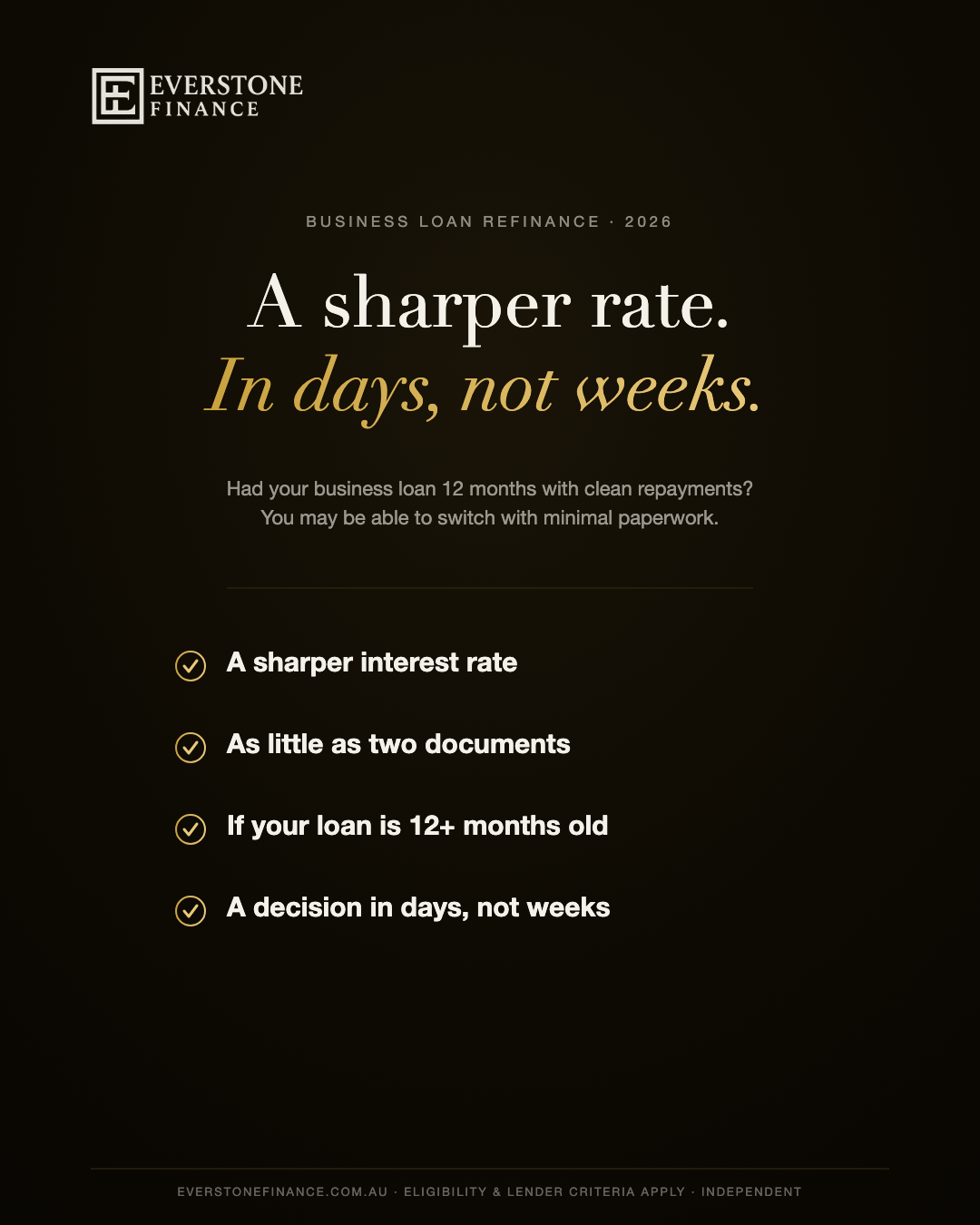
For eligible businesses, yes. A few lenders run streamlined low-documentation programs where a business with a clean twelve-month repayment history can apply with as little as two documents and get a decision fast. Eligibility is tight, and the value of a broker is telling you honestly whether you qualify and which lender fits, without you having to find out the hard way.
This is the part most owners do not know exists, and it is where a broker who works the market every day earns their place. A small number of lenders operate what is best described as a rapid, low-documentation refinance category. For a business that fits the profile, the paperwork is stripped right back, sometimes to as few as two documents, and the decision comes quickly rather than after weeks of back and forth. It is designed for good businesses underserved by a stale rate that simply want to move.
The catch, and it is an important one, is that eligibility is deliberately tight. These programs are not open to everyone, and the criteria typically include:
- A clean repayment history on the existing facility, usually over the past twelve months with no missed or late payments.
- A minimum facility age, so the loan being refinanced has been running long enough to demonstrate that track record.
- Repayments that stay equal or lower under the new facility, so the switch does not increase the burden on the business.
- A satisfactory credit check, confirming the business and its principals are in good standing.
Here is the honest information gap. These streamlined programs exist, but the eligibility rules are specific and differ from lender to lender. The businesses that benefit are the ones who know which lender to approach and can present cleanly against its criteria. That is our job. We tell you whether you qualify, and if you do, which lender fits, so you skip the trial and error of applying blind and getting knocked back. You do not shop around lender by lender, because knowing the answer in advance is precisely the value we bring.
Find out if you qualify for a fast refinance
A few lenders can move in days for eligible businesses, and we know which ones and what they look for. One short conversation tells you whether you qualify and how much you could be saving. No cost, no obligation.
Check my eligibilityCan you consolidate multiple business debts into one loan?
Yes. If you are carrying several business facilities, a term loan, an overdraft, and equipment finance, for example, they can often be refinanced into a single loan. That usually simplifies the admin, gives you one repayment and one due date, and can lower your blended cost of debt.
Many established businesses accumulate debt in layers. A term loan for the fit-out, an overdraft that crept up during a slow quarter, an equipment finance agreement on the delivery van, maybe an unsecured loan taken out in a hurry. Each was sensible at the time, but together they become a tangle of different rates, lenders and payment dates that is hard to stay on top of.
Consolidating your business debts means refinancing that tangle into one facility. You go from several repayments to one, which makes cash flow far easier to plan. You replace a spread of rates, some of which may be well above market, with a single rate. And you remove the mental load of tracking multiple due dates, each with its own consequences if missed.
The right structure depends on the mix of debts you hold, which facilities carry exit costs, and what each lender will accept as security. Consolidation is powerful when it lowers your genuine cost of debt and simplifies your life, and a poor idea when it quietly stretches short-term debt over a long term and costs more in total. We look at both sides honestly before recommending it, because the goal is a better position, not just a tidier one.
Can you refinance a business loan to clear ATO or BAS tax debt?
It is possible. Some businesses refinance, or take out new business borrowing, specifically to clear an Australian Taxation Office or BAS debt and move it onto more manageable terms. It can relieve pressure from the tax office, but it converts a tax liability into a loan, so the trade-offs need weighing carefully.
Tax debt is one of the more stressful pressures a business can carry, and the Australian Taxation Office has real teeth when it comes to collection. For that reason, some owners refinance existing borrowing, or arrange new business finance, to pay out an ATO or BAS debt and replace it with a structured loan on clearer terms. Done well, this takes the immediate heat off, puts the debt on a predictable schedule, and lets you get back to running the business rather than negotiating with the tax office.
The trade-offs deserve honest attention. Moving tax debt onto a business loan means it now carries interest and a fixed repayment commitment, and it uses up borrowing capacity you might otherwise want for growth. Whether it is the right move depends on the size of the debt, the rate you can secure, and the health of the business. Sometimes it is clearly the smarter path; other times an arrangement directly with the tax office is better. The only way to know is to run the specific numbers.
This is general information, not tax or financial advice; speak to your accountant and a broker before acting.
What does it cost to refinance a business loan, and what are break costs?
The common costs are a discharge or termination fee on the old facility, typically around $300 to $800, an establishment fee on the new one, and, if you are exiting a fixed-rate loan early, a break cost. That break cost is not a flat fee; it is calculated by the lender using a formula, so it varies with the loan and the timing.
Refinancing is not free, and any broker worth trusting will tell you the costs before you commit, not after. The fees usually fall into three buckets.
- A discharge or termination fee on the loan you are leaving, the lender's charge for closing out the facility, commonly around $300 to $800 depending on the lender and the loan.
- An establishment or application fee on the new facility, which covers setting it up and varies by lender and loan type. In some cases it is waived as part of a competitive offer.
- A break cost, if you exit a fixed-rate loan early. This is the one that catches people out, so it is worth understanding clearly.
A break cost applies when you leave a fixed-rate facility before its term is up. It is not a set fee and not a penalty in the punitive sense. It is the lender recovering the cost to them of you exiting the fixed arrangement early, worked out using the lender's own formula, which typically reflects how interest rates have moved since you fixed. Because it is a calculation rather than a flat number, it can be small or significant, depending heavily on timing. This is why the maths matters: a refinance only makes sense if the savings comfortably outweigh these one-off costs, and working out whether they do is a core part of what we assess for you.
Is refinancing your business loan actually worth it? The break-even maths
Refinancing is worth it when the savings clear the one-off costs within a sensible payback window and keep paying off after that. The test is simple: add up the switching costs, work out the annual saving from the better deal, and check that you recover the costs comfortably inside the life of the new loan.
The decision should never be about the rate alone, nor the fees alone. It is the relationship between the two that tells you whether refinancing is a good move, and the honest framework is a simple break-even calculation.
Total the one-off costs of switching: the discharge fee, any establishment fee on the new loan, and any break cost if you are leaving a fixed rate. Then work out the annual saving the new facility delivers, whether from a lower rate, a lower blended cost after consolidation, or reduced fees. Divide the costs by the annual saving and you get your payback period, the time it takes for the refinance to pay for itself.
If that payback period is comfortably short relative to the remaining life of the loan, refinancing is very likely worth it, because everything saved after break-even stays in the business. If the payback stretches close to the end of the loan term, the case is weaker and worth a harder look. This is a framework rather than a promise of specific figures, because your numbers are yours. We run this calculation with your actual costs and saving, so the answer fits your business rather than a generic example, and if the maths does not stack up, we tell you plainly that staying put is the better call.
How an independent broker compares your options across 40+ lenders
An independent broker compares your situation against more than 40 lenders, knows which ones run the fast, low-documentation programs, and knows which are pricing sharpest right now. You get the market checked for you in one conversation, and the service is at no cost to you, because the lender pays us, not you.
On your own, you can approach one or two lenders, take the deals they offer, and hope you have not left something better on the table. You cannot easily know which lender is pricing most aggressively this month, which one runs the streamlined program you might qualify for, or which one is likely to say no before you have dented your credit file applying. That information is the whole game, and it changes constantly.
As former bankers, we sat on the other side of these decisions, and we now compare your position across a panel of more than 40 lenders. We know which ones move fast and light on documentation, which want a business exactly like yours, and which are sharpening their pricing right now to win new business. Rather than have you shop around and collect knock-backs, we point you at the lender that fits, packaged the way they want to see it, so the application has the best chance of a clean, quick yes.
And the part that surprises people: our service is at no cost to you. We are paid by the lender when a loan settles, not by you, and our obligation under the Best Interests Duty is to you, not to any lender. So the incentive to find you the genuinely better deal and the duty to act in your interests point the same way. If you are already reviewing the numbers for the new financial year, adding your rate to that review costs nothing and could save you a great deal.
Let us check your rate against 40+ lenders
Send us your current facility and we will tell you, honestly, whether you are overpaying and which lender could do better, including the fast, low-documentation options. No cost, no obligation, no pressure.
Book my rate reviewFrequently asked questions
Can you refinance a business loan in Australia?
Yes. Most business facilities can be refinanced, including term loans, overdrafts, lines of credit, equipment and asset finance, and unsecured business loans. Refinancing means replacing your existing facility with a new one on better terms, usually a lower rate, a structure that suits the business today, or several debts consolidated into one. A broker compares the market and handles the process for you.
Can I switch my business loan quickly with minimal paperwork?
For eligible businesses, yes. Some lenders run streamlined programs where a business with a clean repayment history can apply with as little as two documents and get a decision in days. Eligibility is tight, and it varies from lender to lender. We tell you if you qualify and which lender fits, so you do not have to shop around or apply blind and risk being knocked back.
How long does it take to refinance a business loan?
It depends on the facility and the lender. Streamlined programs at select lenders can reach a decision in a matter of days for eligible, well documented businesses. A more standard refinance typically takes one to four weeks from application to settlement. Anything secured against commercial property runs longer, because a valuation and extra checks are involved.
Can I refinance a business loan to pay off ATO or BAS debt?
It is possible. Some businesses refinance existing borrowing, or arrange new business finance, specifically to clear an ATO or BAS debt and move it onto structured, more manageable terms. It can relieve pressure from the tax office, but it converts a tax liability into an interest-bearing loan, so the trade-offs need weighing. Speak to your accountant and a broker before acting, as this is general information, not tax advice.
What does it cost to refinance a business loan, and are there break costs?
The common costs are a discharge or termination fee on the old facility, typically around $300 to $800, an establishment fee on the new one, and, if you are exiting a fixed-rate loan early, a break cost. The break cost is not a flat fee; the lender calculates it using its own formula, so it varies with the loan and the timing. A refinance is worth it when the savings comfortably clear these one-off costs.
Not sure whether your rate is still competitive? That is exactly what a quick, no-cost chat sorts out. Book a time with an ex-banker and we will check your business loan against the market, honestly, while you have your financials in front of you.
Sources
Related guides
About the author. This article was written by Ahmed Lotfi, co-founder of Everstone Finance and a former banker who now works as an independent mortgage and commercial finance broker in South Yarra, Melbourne. Everstone Finance operates under the Best Interests Duty as Credit Representative 526374, Australian Credit Licence 391237. Book a chat with Ahmed.
Reviewing the books? Review the rate too
You are already looking at the numbers for the new financial year. Adding your business loan rate to that review costs you nothing and could save you a great deal. We compare the market for you and tell you honestly where you stand.
Book my rate review