
First Nations Home Loans in Australia (2026): The IBA Pathway, the Mainstream Stack, and How to Know Which Is Yours
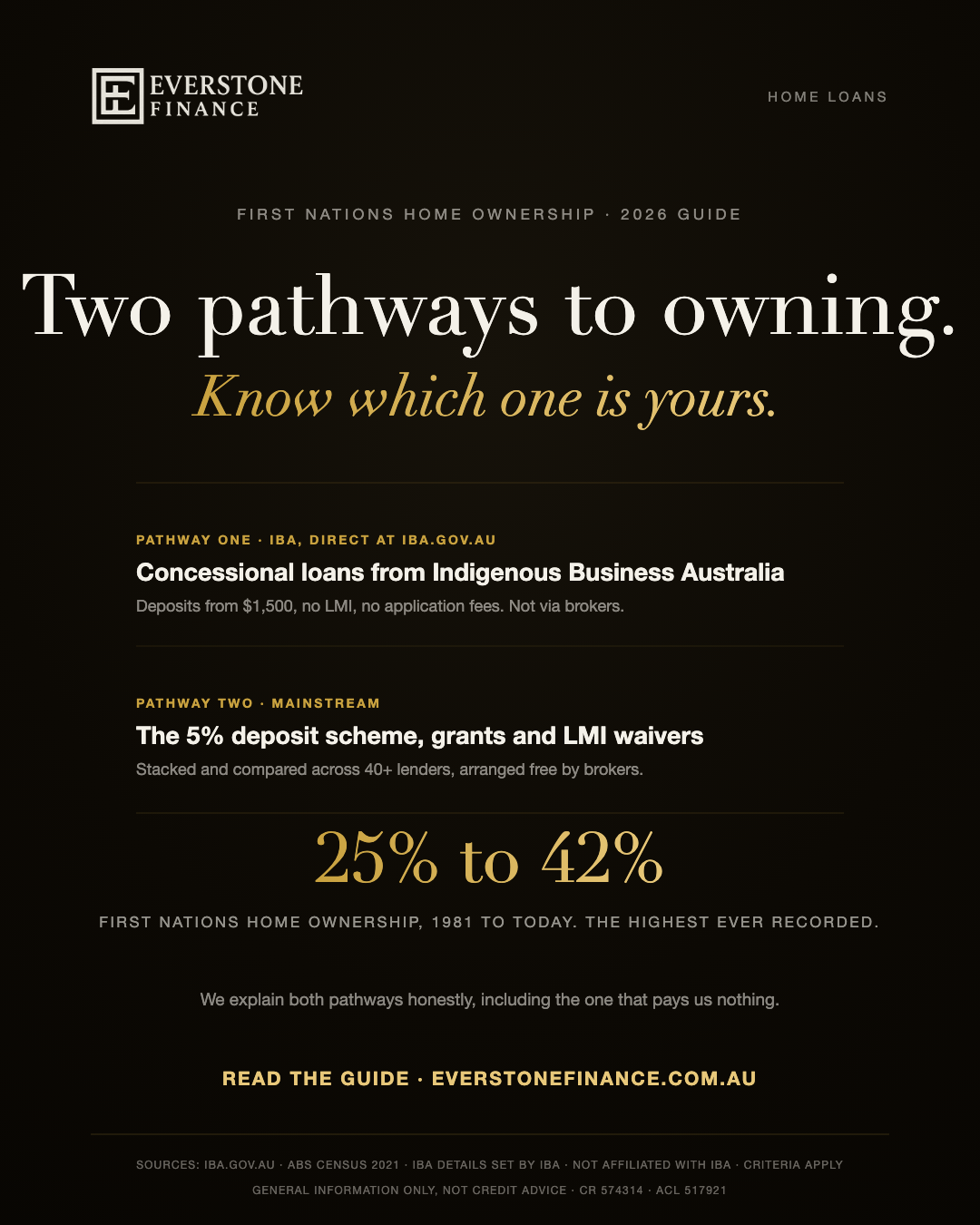
Here is a number that deserves more airtime: 42 per cent of Aboriginal and Torres Strait Islander households own their home, the highest rate ever recorded, up from 25 per cent in 1981. The gap to the wider population is still real, around 20 percentage points, but the direction is unmistakable, and every year thousands more First Nations families make the move from renting to owning. What surprises many of the buyers making that move is that there are two distinct pathways to get there, and almost nobody explains both in one place. One is the dedicated concessional pathway through Indigenous Business Australia, with deposits from as little as $1,500 and no Lenders Mortgage Insurance. The other is the mainstream lending stack, government deposit schemes, grants and ordinary bank lending, which is often stronger than people assume. This guide explains both honestly, including the important detail that the first pathway pays us nothing: IBA lends directly and brokers cannot arrange its loans. We cover it anyway, because the right answer is the right answer, and applications for it run entirely through IBA itself at iba.gov.au, start to settlement. Written by former bankers in South Yarra.
- First Nations home ownership is at 42 per cent, the highest ever recorded, up from 25 per cent in 1981 (ABS Census 2021).
- Indigenous Business Australia (IBA) offers concessional home loans for Aboriginal and Torres Strait Islander people who cannot access mainstream lending: deposits from $1,500 depending on income, no LMI, no application fees, and a possible $20,000 grant, subject to eligibility.
- IBA lends directly and handles its own applicants end to end at iba.gov.au. Brokers cannot arrange IBA loans, we are not affiliated with IBA, and anyone who implies otherwise is selling something.
- If you can access mainstream lending, that lane is genuinely strong: the 5 per cent deposit Home Guarantee Scheme, first home owner grants, stamp duty concessions and profession-based LMI waivers all stack.
- For the mainstream pathway, book a chat with a former banker and we will map it across 40+ lenders, free. For the IBA pathway, iba.gov.au is the direct door.
The ownership picture, honestly told
At the 2021 Census, 42 per cent of First Nations households owned their home, 28 per cent with a mortgage and 14 per cent outright, the highest rate ever recorded and up from 25 per cent in 1981. The gap to non-Indigenous households remains around 20 percentage points, which is exactly why the dedicated pathways below exist.
The story most often told about First Nations housing is a deficit story. The data tells a momentum story too: from 25 per cent ownership in 1981 to 42 per cent in 2021, rising steadily through every census in between, with 28 per cent of households paying down a mortgage and 14 per cent owning outright. That is four decades of families crossing from renting into owning, most of them doing it the same way everyone else does: a deposit, a loan, a settlement day. For the Territory market context around this, see our Garma week data piece on Darwin’s affordability and jobs numbers.
The gap that remains, roughly 20 percentage points against non-Indigenous households across age groups, is why dedicated support exists, and why knowing the full map matters more for First Nations buyers than for almost anyone else. Miss the IBA pathway when it fits you, and you may pay LMI and deposit requirements you never needed to. Miss the mainstream stack when it fits you, and you may wait in a queue you never needed to join. The rest of this guide is that map.
Pathway one: the IBA concessional loan
Indigenous Business Australia’s home ownership program offers concessional loans to Aboriginal and Torres Strait Islander people who cannot access mainstream bank lending: deposits from as little as $1,500 depending on income, no Lenders Mortgage Insurance, no application fees, and a possible $20,000 grant subject to eligibility. IBA lends directly; brokers cannot arrange these loans.
Indigenous Business Australia runs the Commonwealth’s dedicated home ownership program for Aboriginal and Torres Strait Islander people, and for the buyers it serves, the terms are genuinely concessional:
- Deposits from as little as $1,500, with the requirement scaled to your income and savings rather than a flat percentage of the price.
- No Lenders Mortgage Insurance, the cost that typically runs into five figures on a low-deposit bank loan, and no application fees on new home loans.
- Loans for buying an established home, building, buying land, or essential improvements, with a dedicated program for remote communities.
- A possible $20,000 grant for renovations, repairs and purchase-completion costs, subject to eligibility.
Two honest framing notes. First, IBA’s program is aimed at people who cannot access mainstream lending, typically because of deposit size or income shape, and it asks applicants to show a readiness for the responsibilities of ownership; it is a pathway, not a shortcut, and demand can mean waiting. Second, and this matters: IBA lends directly. Mortgage brokers cannot arrange, influence or accelerate an IBA loan, and we earn nothing when a client takes this path. We include it in this guide because a brokerage that only shows you the doors it gets paid for is not giving you advice, it is giving you a menu. To be completely clear: we are not affiliated with IBA in any way, and the entire IBA process, eligibility checks, application, guidance and settlement, runs through IBA’s own team. Full details and applications are at iba.gov.au.
Pathway two: the mainstream stack
First Nations buyers who can access bank lending have the full mainstream stack available: the government’s 5 per cent deposit Home Guarantee Scheme with no LMI, first home owner grants and stamp duty concessions by state, profession-based LMI waivers for eligible occupations, and 40+ lenders’ ordinary policies, which a broker compares free.
If your income and deposit can carry a bank loan, the mainstream lane is not the consolation prize; for many buyers it is the faster door, and it stacks generously:
- The Home Guarantee Scheme: eligible first home buyers purchase with as little as a 5 per cent deposit and no LMI, with the government guaranteeing the gap. Income caps were removed and places uncapped in the scheme’s 2025 expansion.
- State grants and stamp duty concessions: first home owner grants and duty exemptions vary by state and stack with the scheme, mapped in our state-by-state first home buyer guide.
- Profession-based LMI waivers: if you work in health, education, law, accounting or several other fields, select lenders waive LMI at 90 per cent regardless of the schemes, covered in our professionals waiver guide.
- Ordinary competition: 40+ lenders with different policies on casual income, overtime, family size and location. The difference between the right lender and the wrong one for your exact situation is routinely tens of thousands of dollars, which is the comparison we run free.
One practical note that applies across both pathways: deposit help and ownership help are different things. Grants and schemes solve the deposit wall; they do not change whether repayments fit your life, which is the conversation any honest broker or lender should have with you before contracts, not after. Our LMI explainer and deposit-by-city guide cover the foundations.
Which pathway is yours?
Broadly: if mainstream lending is out of reach on deposit or income shape, IBA is built for you, directly through iba.gov.au. If you can carry a bank loan, the mainstream stack is usually faster and highly competitive. If you sit near the line, it costs nothing to check both, and checking both is exactly what an honest first conversation does.
| Your situation | Likely pathway | Why |
|---|---|---|
| Small deposit, income that mainstream serviceability rules read poorly | IBA, directly | Deposits from $1,500, no LMI, assessment built for exactly this situation |
| Steady income, 5 per cent or more saved, first home | Mainstream, via the Home Guarantee Scheme | No LMI at 5 per cent deposit, plus grants and duty concessions, without a program queue |
| Eligible profession (health, education, law and others) | Mainstream, via an LMI waiver | 90 per cent lending with no LMI at select lenders, on top of any scheme eligibility |
| Remote community, or building on community-linked land | IBA’s remote program | Purpose-built lending mainstream banks generally will not write |
| Not sure which side of the line you sit on | Check both, free | One conversation with us covers the mainstream side; iba.gov.au covers theirs |
General information only, not credit or financial advice. IBA program details are drawn from IBA’s published materials and are set solely by IBA; Everstone Finance is not affiliated with IBA and receives nothing from IBA loans.
Where do we fit? We arrange mainstream lending only: the schemes, the grants stacking, the lender comparison across 40+ lenders, the settlement. The IBA pathway is entirely self-contained on IBA’s side: their website explains eligibility, their team assesses applications, and their process runs from first enquiry to settlement without any broker involved, which is exactly how it is designed. If the mainstream lane is yours, our comparison costs nothing and does not touch your credit file.
Two pathways. One honest conversation.
If the mainstream pathway is yours, tell us your deposit, your income and where you are hoping to buy, and a former banker will map the schemes, grants, waivers and lenders that fit, free. The IBA pathway starts and finishes at iba.gov.au.
Book a chat with a former bankerFrequently asked questions
What is an IBA home loan?
A concessional home loan from Indigenous Business Australia, a Commonwealth entity, available to Aboriginal and Torres Strait Islander people who cannot access mainstream bank lending. Loans can fund buying an established home, building, buying land or essential improvements, with a dedicated remote program, deposits scaled to income from as little as $1,500, no Lenders Mortgage Insurance and no application fees on new loans.
How much deposit do I need for an IBA loan?
From as little as $1,500, with the actual requirement determined by your gross income and savings rather than a flat percentage of the purchase price. That structure exists precisely so the deposit wall that blocks mainstream lending does not block ownership itself. Current requirements are set by IBA and confirmed during their application process at iba.gov.au.
Can a mortgage broker arrange an IBA loan for me?
No. IBA lends directly: eligibility, applications and guidance are all handled by IBA’s own team through iba.gov.au, from first enquiry to settlement, and brokers cannot arrange, submit or influence IBA loans. Everstone is not affiliated with IBA and earns nothing from IBA lending; we arrange the mainstream pathway only, where our 40+ lender comparison is free.
Can First Nations buyers use the 5 per cent deposit Home Guarantee Scheme?
Yes, on the same terms as any eligible buyer: first home buyers meeting the scheme’s criteria can purchase with as little as 5 per cent deposit and no LMI, and the scheme stacks with state first home owner grants and stamp duty concessions. For buyers who can access mainstream lending, this combination is often the fastest pathway to keys.
What is the First Nations home ownership rate in Australia?
42 per cent at the 2021 Census, the highest ever recorded: 28 per cent of Aboriginal and Torres Strait Islander households owned with a mortgage and 14 per cent owned outright. The rate has risen steadily from 25 per cent in 1981, while remaining around 20 percentage points below non-Indigenous households, which is the gap the dedicated pathways exist to close.
Can IBA loans be used to build a home or buy land?
Yes. IBA’s program covers purchasing an established home, constructing a new one, buying land and making essential improvements to an existing home, and a dedicated remote program serves communities where mainstream construction lending is generally unavailable. Eligibility and priorities are set by IBA.
Is there a grant attached to IBA home loans?
IBA’s published materials describe a possible grant of up to $20,000 for minor renovations, repairs and maintenance, and costs associated with completing a purchase, subject to eligibility. Like all program details it is set by IBA, can change, and is confirmed within their application process rather than by any outside party, including us.
Not sure which side of the line you sit on? That is the most common situation, and the cheapest one to fix. One free conversation maps the mainstream side; iba.gov.au maps theirs; you choose with the whole picture.
Sources
Related guides
About the author. Ahmed Lotfi is co-founder of Everstone Finance and a former banker who now works as a mortgage and finance broker in South Yarra, Melbourne, arranging home, investment and commercial lending for clients across Australia. Everstone Finance operates under the Best Interests Duty as Credit Representative 574314 of LMG Broker Services Pty Ltd, Australian Credit Licence 517921.
Forty years of momentum. Your move is next.
From 25 per cent to 42 per cent and climbing: the pathway exists, whichever door it runs through. If the mainstream door is yours, one free conversation maps it end to end.
Book a chat with a former banker