
Garma Week 2026: While Australia Looks to Arnhem Land, the Territory’s Property Numbers Deserve the Attention Too
Each year in early August, the country’s attention turns to Gulkula, a ceremonial site on the escarpment of northeast Arnhem Land, where the Yothu Yindi Foundation hosts Garma, Australia’s leading First Nations cultural gathering. The word itself comes from Yolŋu matha and describes a two-way learning process: four days of miny’tji, manikay and buŋgul, art, song and ceremonial dance, alongside forums where policy, education and economic questions get argued in the open. We have no affiliation with Garma or the Foundation; like much of the country this week, we are simply paying attention. And in the spirit of two-way learning, here is something the rest of Australia could learn from the Territory while looking north: by the numbers we track all year, the NT is quietly the strongest value story in Australian property. Darwin is the only capital sitting meaningfully under its affordability benchmark, and it just ranked as the second fastest-growing city in the country on LinkedIn’s jobs and migration data. Two independent datasets, one direction. Written by former bankers who read the numbers for a living.
- Garma gathers at Gulkula in northeast Arnhem Land in early August: four days of Yolŋu culture and national conversation, hosted by the Yothu Yindi Foundation.
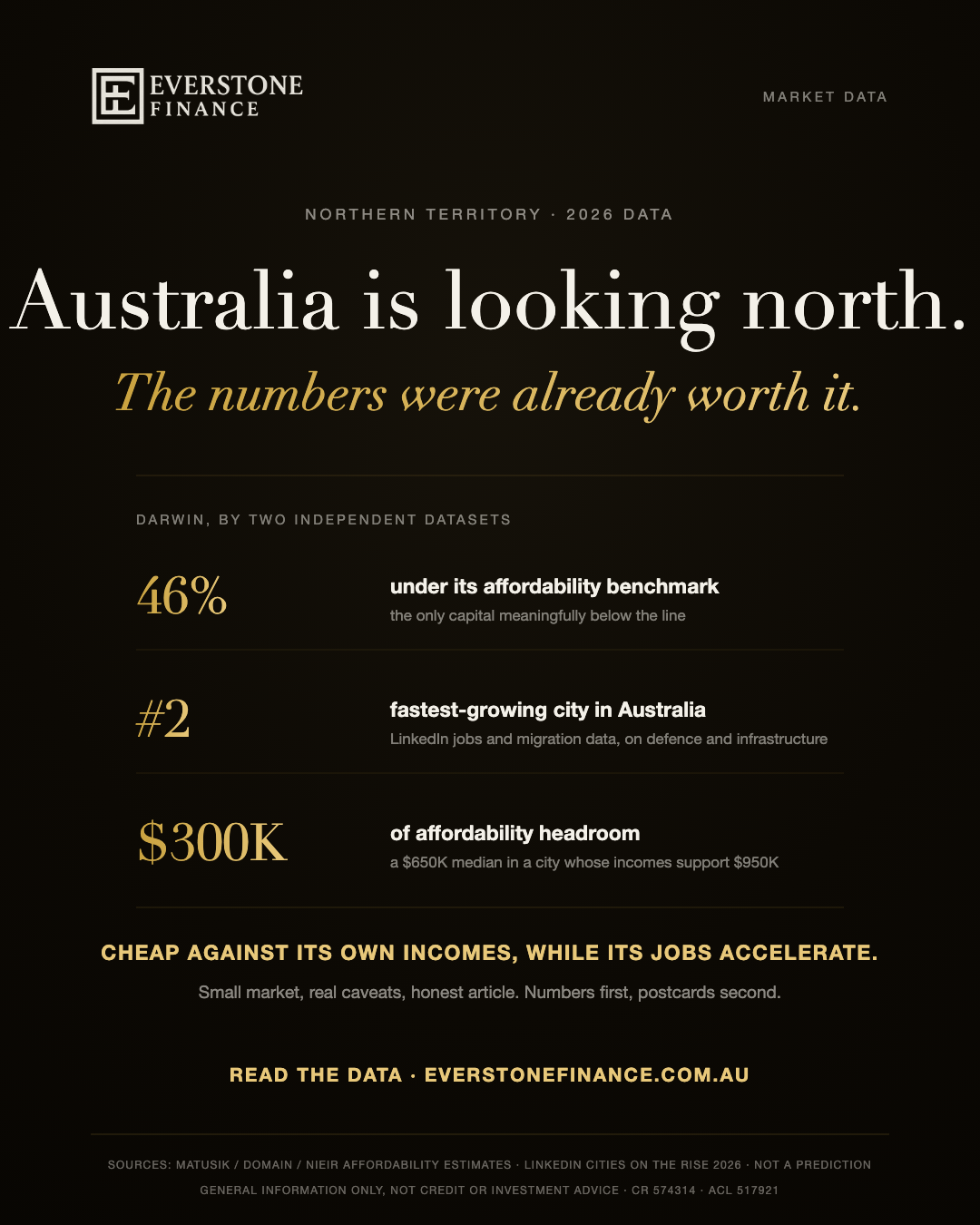
- By the affordability benchmark we covered this month, Darwin’s median house costs $300,000 less than local incomes support, 46 per cent under the line, the most affordable capital in Australia.
- On LinkedIn’s 2026 Cities on the Rise data, Greater Darwin ranks second nationally for jobs momentum and migration, driven by defence, infrastructure and logistics investment.
- A market that is cheap against its own incomes while its job market accelerates is rare; the honest caveats about small markets still apply, and they are in here too.
- Buying or investing from interstate is routine: book a free chat with a former banker and we will map your borrowing power wherever the property is.
Garma, briefly and respectfully
Garma is Australia’s leading First Nations cultural exchange event, held annually in early August at Gulkula, a Gumatj ceremonial site in northeast Arnhem Land, hosted by the Yothu Yindi Foundation for the Yolŋu people. The name means a two-way learning process, and the festival pairs ceremony and art with national forums on policy, education and economic development.
For readers who know Garma only as a headline: it is a four-day gathering on Yolŋu country, roughly 40 kilometres from Gove, where saltwater and freshwater meet and, in the Foundation’s words, Yolŋu and balanda, non-Indigenous people, come together as one. Alongside the miny’tji, manikay and buŋgul, the art, song and ceremony at its heart, Garma functions as one of the country’s most consequential policy forums, where education, economic participation and the practical business of closing gaps get discussed with the people they concern. Guests are asked to bring a willingness to learn. That is the entire reason this article exists in this form: we have nothing to sell Garma and no association with it, but the two-way learning idea cuts both ways, and what the south could learn from the Territory this week includes something our own datasets have been saying for months.
The Territory numbers nobody is talking about
Two independent datasets point the same way: on 2026 affordability estimates, Darwin’s median house price of about $650,000 sits $300,000 below what local incomes support, 46 per cent under the benchmark and the best in the nation, while LinkedIn’s 2026 Cities on the Rise ranking places Greater Darwin second nationally for jobs momentum and migration, on the back of defence, infrastructure and critical minerals investment.
Start with affordability, from the Matusik, Domain and NIEIR estimates we unpacked in our 2026 affordability league table. Against the benchmark of a house price at five times disposable household income, every east-coast capital sits over the line, Sydney by $580,000. Darwin sits $300,000 under it: a median house around $650,000 in a city whose incomes would support $950,000. That is not “cheap for a reason nobody wants”; that is the largest affordability cushion of any capital in the country, by a factor of four over the next best.
Now the momentum side, from LinkedIn’s Cities on the Rise data we covered this month: Greater Darwin ranks second nationally for job market momentum and migration inflows, behind only Hobart, with the growth attributed to major defence, infrastructure and logistics investment plus critical minerals development, and with government, university and health employers anchoring the base. Cities usually offer you one or the other: affordability without jobs, or jobs without affordability. The 2026 data has Darwin offering both at once, and almost nobody south of the Berrimah Line is talking about it.
Who these numbers actually serve
Movers with portable or defence-linked work get capital-city incomes against the country’s most affordable housing. Renters priced out down south can own in Darwin at price points no other capital offers. Investors get income-supported fundamentals, with proper advice. And First Nations buyers have dedicated pathways alongside the mainstream ones, covered in our companion guide.
- Movers and defence-linked workers. If your work is portable, or tied to the defence and infrastructure build-out driving the jobs data, the arithmetic is blunt: Darwin offers a genuine capital-city job market against a $650,000 house median. The same household maths that fails in Sydney by half a million dollars clears in Darwin with room to spare.
- Priced-out renters. For households renting down south and watching medians run away from them, our rents analysis made the ownership case in general; the Territory is where that case meets price points that still work.
- Investors. A market trading under its income benchmark with accelerating employment is what fundamentals-first investors say they want. Investment decisions carry their own risks, tax settings and structure questions that deserve advice, and our rental yields guide is the sensible next read rather than a rush north.
- First Nations buyers. In the week the country looks to Arnhem Land, it is worth knowing that dedicated home-ownership pathways exist: Indigenous Business Australia lends directly, with deposits from $1,500 and no LMI, applications running entirely through IBA at iba.gov.au, and the mainstream schemes stack for buyers in bank-lending territory. Both pathways are explained honestly in our First Nations home loans guide.
The honest caveats
Darwin is a small market: fewer transactions mean prices move faster in both directions, it still trades below its long-ago peak, and costs like insurance run higher in the north. The numbers are a reason to look properly, not to skip the looking. We arrange lending Australia-wide, and the borrowing-power conversation is free wherever the property is.
We publish the caveats with the same energy as the headline, because that is the deal on this site. Darwin is a small market: transaction volumes are a fraction of the east coast’s, which means medians can swing on modest activity, in both directions. Its history includes a long stretch below a prior peak, which is part of why the affordability cushion exists at all. Holding costs, insurance in particular, run higher in the north, and remote-area lending policies vary more between lenders than city buyers are used to, which makes lender selection matter more, not less. None of that undoes the data; it just means the right response is a properly-researched decision, not a flight booking.
What we bring to that decision: we arrange lending Australia-wide, by phone and Zoom, we know which lenders read Territory postcodes generously and which do not, and a borrowing-power conversation costs nothing and touches nothing on your credit file. Whether the answer is Darwin, your own city, or waiting, you make it with the numbers in front of you.
The country is looking north. Look with your numbers ready.
Tell us what you earn, what you have saved and what you are weighing, and a former banker will map your borrowing power across 40+ lenders, for the Territory or anywhere else. Free, no obligation.
Book a chat with a former bankerFrequently asked questions
What is the Garma Festival?
Garma is Australia’s leading First Nations cultural exchange event, hosted annually by the Yothu Yindi Foundation at Gulkula, a Gumatj ceremonial site in northeast Arnhem Land, for the Yolŋu people. Across four days it combines traditional art, song, ceremonial dance and storytelling with national forums on education, policy and economic participation, and its name describes a two-way learning process in Yolŋu matha.
When and where is Garma held?
Garma is held annually in early August at Gulkula, on the Gove Peninsula in northeast Arnhem Land in the Northern Territory, roughly 40 kilometres from Gove. Attendance details and dates are published by the Yothu Yindi Foundation, which organises the festival; Everstone Finance has no affiliation with the event.
Is Darwin really Australia’s most affordable capital city?
On the 2026 affordability estimates compiled by Matusik with Domain and NIEIR data, yes, and by a wide margin: Darwin’s median house price of about $650,000 sits 46 per cent below the level local disposable incomes would support, a cushion of roughly $300,000. Every east-coast capital sits above its benchmark on the same measure.
Why is Darwin’s job market growing?
LinkedIn’s 2026 Cities on the Rise analysis, which ranked Greater Darwin second nationally for hiring momentum and migration, attributes the growth to major defence, infrastructure and logistics investment alongside critical minerals development, with the Northern Territory Government, Charles Darwin University and Royal Darwin Hospital among the anchor employers.
Can I buy Northern Territory property from interstate?
Yes, and it is routine: purchases, refinances and investment lending in the NT can be arranged from anywhere in Australia, with inspections handled through local agents and conveyancers and the lending run by phone and Zoom. Lender policies on Territory and remote postcodes vary more than city buyers expect, which makes comparing across the market particularly worthwhile.
Is Darwin a good place to buy an investment property?
The 2026 data shows income-supported prices and an accelerating job market, which are genuine fundamentals, alongside real caveats: small transaction volumes, faster medians in both directions, higher insurance costs and a history of long cycles. Whether it suits you depends on your finances, goals and risk appetite; this is general information, not investment advice, and decisions of this kind warrant professional advice on your circumstances.
Do First Nations buyers have dedicated home loan options?
Yes. Indigenous Business Australia offers concessional home loans for Aboriginal and Torres Strait Islander people who cannot access mainstream lending, with deposits from $1,500 and no LMI, applied for directly through iba.gov.au from enquiry to settlement. Buyers who can access bank lending have the full mainstream stack of schemes, grants and waivers. Our First Nations home loans guide explains both pathways honestly.
Two-way learning, applied: the Territory taught the data something this year. Book a free chat with a former banker and find out what your numbers can do with it.
Sources
Related guides
About the author. Ahmed Lotfi is co-founder of Everstone Finance and a former banker who now works as a mortgage and finance broker in South Yarra, Melbourne, arranging home, investment and commercial lending for clients across Australia. Everstone Finance operates under the Best Interests Duty as Credit Representative 574314 of LMG Broker Services Pty Ltd, Australian Credit Licence 517921.
Numbers first. Postcards second.
Darwin’s data earned the attention; your decision deserves the arithmetic. One free conversation maps your borrowing power for the Territory, your own city, or both.
Book a chat with a former banker