

What It Costs to Buy a Home in Each Australian Capital City (2026): Monthly Repayments Compared
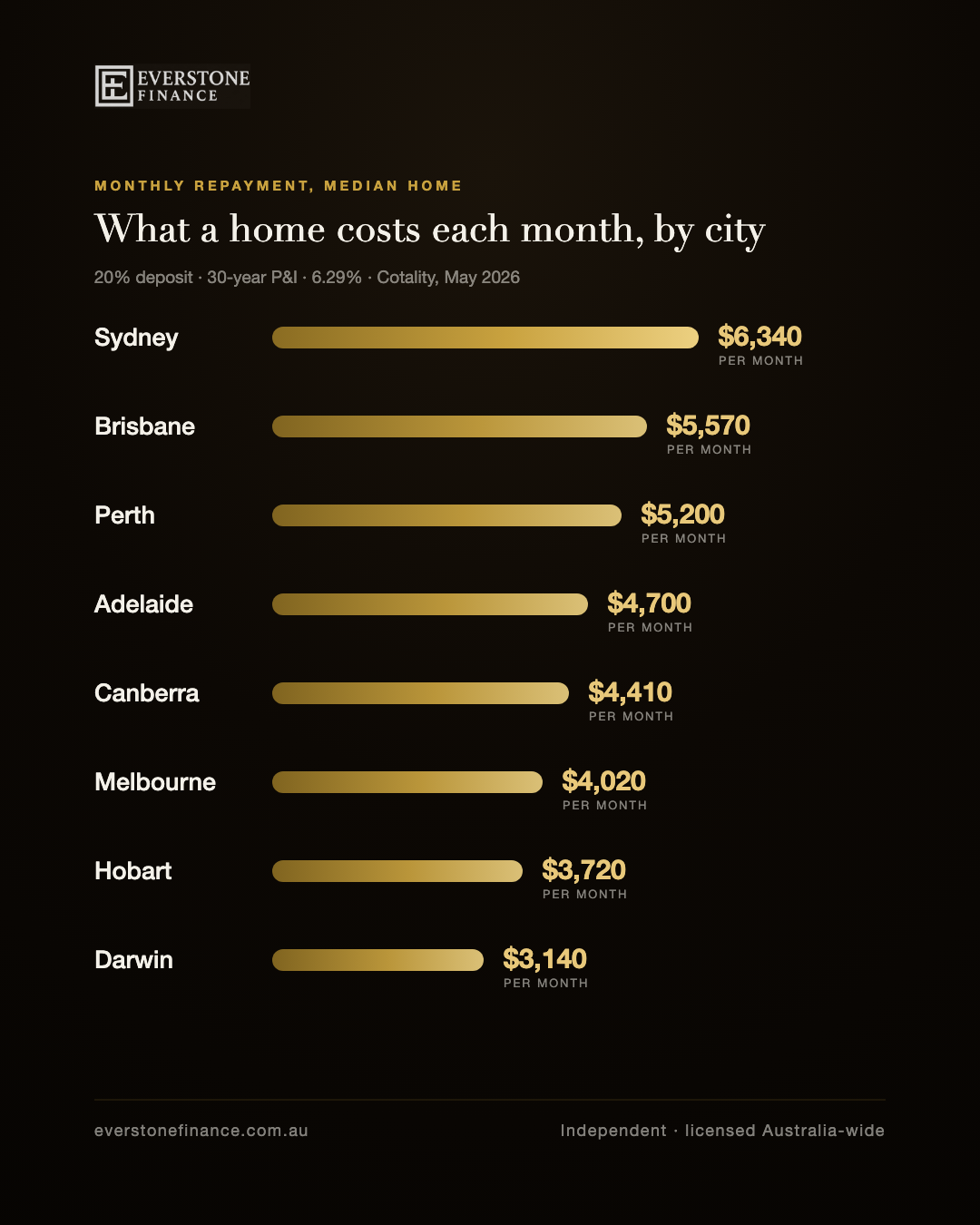
Estimated monthly principal-and-interest repayment on a median-priced home in each capital city, May 2026. Indicative only, assuming a 20% deposit, a 30-year loan, and a 6.29% rate.
Here is the surprise hiding in the 2026 numbers. Melbourne, long filed under “expensive”, now costs less per month on its median home than Brisbane, Perth, or Adelaide. The old pecking order has reshuffled. While those three cities boomed, Melbourne softened, so on a monthly repayment basis the map looks nothing like most buyers expect. Sydney is still clearly the priciest, Darwin the cheapest, and the spread between them is roughly $38,000 a year. This piece ranks all eight capitals by what the loan actually costs you each month, not by the sticker price. These figures are indicative, based on the assumptions stated below, and subject to change. For the renter’s version of this comparison, see our Q2 2026 rents analysis.
- Sydney’s median home costs about $6,340 a month to repay, the dearest in the country at the stated assumptions.
- Darwin is the cheapest at roughly $3,140 a month, a gap of about $3,200 a month, near $38,000 a year, versus Sydney.
- Melbourne, at about $4,020 a month, now sits below Brisbane ($5,570), Perth ($5,200), and Adelaide ($4,700).
- Every figure assumes a 20% deposit, a 30-year principal-and-interest loan, and a 6.29% interest rate. Change the rate and every number moves.
- All figures are indicative and subject to change. We compare a panel of over 40 bank and non-bank lenders, and we are licensed Australia-wide.
Below is the estimated monthly principal-and-interest repayment on a median-priced home in each capital, ranked from dearest to cheapest. Figures are indicative, based on Cotality median dwelling values for May 2026, a 20% deposit, a 30-year loan, and a 6.29% interest rate.
| Capital city | Monthly repayment |
|---|---|
| Sydney | $6,340 |
| Brisbane | $5,570 |
| Perth | $5,200 |
| Adelaide | $4,700 |
| Canberra | $4,410 |
| Melbourne | $4,020 |
| Hobart | $3,720 |
| Darwin | $3,140 |
- What a median home costs per month in each Australian capital city
- The reshuffle: why Melbourne is now cheaper per month than Brisbane, Perth, and Adelaide
- Why the monthly cost matters more than the sticker price
- What actually changes your number: deposit, rate, term, and loan type
- Buying interstate, and how a multi-speed market works
- How Everstone helps, licensed Australia-wide
- FAQ
What a median home costs per month in each Australian capital city
At a 6.29% rate, 20% deposit, and a 30-year loan, the indicative monthly repayment on a median home runs from about $6,340 in Sydney down to $3,140 in Darwin. The full ranking is Sydney, Brisbane, Perth, Adelaide, Canberra, Melbourne, Hobart, then Darwin.
Ranked from dearest to cheapest, the estimated monthly principal-and-interest repayment on a median-priced home is: Sydney $6,340, Brisbane $5,570, Perth $5,200, Adelaide $4,700, Canberra $4,410, Melbourne $4,020, Hobart $3,720, and Darwin $3,140.
Sydney sits in a league of its own at the top, and Darwin is comfortably the most affordable to service. The difference between the two is about $3,200 a month, roughly $38,000 a year, on a single median home. That is the part most buyers underestimate. The deposit and the purchase price grab the headlines, but the monthly repayment is the number you actually live with.
These are indicative figures only, calculated on Cotality median dwelling values for May 2026 and the stated assumptions. They are general information, not credit assistance, and lender criteria apply. If you want the companion view of what each home actually costs to buy, our guide to median house prices in Australia for 2026 ranks every capital by price and deposit.
The reshuffle: why Melbourne is now cheaper per month than Brisbane, Perth, and Adelaide
Because the boom happened elsewhere. Brisbane, Perth, and Adelaide surged while Melbourne’s median softened. At a 6.29% rate that flips the monthly cost order: Melbourne now repays about $4,020 a month, below Adelaide ($4,700), Perth ($5,200), and Brisbane ($5,570).
The familiar mental ranking went Sydney, then Melbourne, then everywhere else. That ordering no longer holds on a cost-of-ownership basis. Brisbane, Perth, and Adelaide ran hard while Melbourne’s median values eased back, and the monthly repayment follows the median value directly. So the city most people still think of as expensive now sits sixth of eight on what its median home costs to repay each month.
The practical takeaway is that Melbourne offers capital-city access, infrastructure, and a deep job market at a monthly cost that now undercuts three cities that boomed past it. Sydney remains clearly the most expensive and Darwin the cheapest, but the middle of the table has genuinely changed shape. For the price story behind this shift, see our median house prices ranking for 2026. This piece stays on the angle that matters once you own the place: the monthly repayment.
Why the monthly cost matters more than the sticker price
Because you pay the repayment every month, while the price is a one-off at settlement. The monthly figure is the true affordability test, and it can swing your budget by roughly $38,000 a year between the dearest and cheapest capitals on a median home.
A purchase price tells you what you need to save and borrow. The monthly repayment tells you what the home does to your budget month in, month out. Two buyers with identical incomes can land in very different positions depending on which capital they buy in, because the gap between Sydney’s $6,340 a month and Darwin’s $3,140 is the difference between a comfortable budget and a stretched one.
This is why where you buy can affect your finances as much as what you buy. A smaller, cheaper city can free up real cash flow each month, money that compounds into savings, offset balances, or simply breathing room. Before you fixate on a price tag, it is worth pressure-testing the ongoing number. Our home loan self-audit walks you through checking whether your current or prospective repayment is competitive, and our refinance guide covers how to lower it on a loan you already hold.
What actually changes your number: deposit, rate, term, and loan type
Four levers move the repayment: the deposit (how much you borrow), the interest rate, the loan term, and whether you are an owner-occupier or investor. Of these, the interest rate is the one variable a buyer can genuinely shop around for, and small rate moves are worth real money each month.
The deposit sets the loan size. The bigger the deposit, the smaller the loan, and a deposit under 20% can trigger lenders mortgage insurance, which adds to the cost. The loan term spreads the same debt across a longer or shorter schedule. And owner-occupier loans are generally priced below investor loans, so your purpose changes the rate you are offered.
But the lever you can actually pull is the interest rate. The figures above assume 6.29%. On a Sydney-sized loan, even a small reduction in rate is worth a few hundred dollars a month, which adds up to a serious sum. That is precisely where a broker comparing a panel of over 40 bank and non-bank lenders earns its keep, finding the sharper rate you would not see by walking into a single branch. Start with the home loan self-audit to see where your rate sits. These figures are indicative and subject to change, eligibility and lender criteria apply.
Buying interstate, and how a multi-speed market works
Australia is a multi-speed market: capitals boom and soften at different points, which is exactly why the monthly cost order reshuffled. Buying interstate is entirely workable, and because we are licensed Australia-wide we can help you finance a home in any capital city, not only Melbourne.
A multi-speed market means no single national trend tells the whole story. While Melbourne softened, Brisbane, Perth, and Adelaide climbed, and that divergence is the whole reason the monthly cost ranking flipped. For a buyer, this opens a real strategic question: you can choose the city, and therefore the monthly cost, that fits your budget and your plans, rather than defaulting to the one you happen to live in.
Financing a purchase in another state is straightforward. The lender assesses your income, deposit, and the property, not your postcode. As a broker holding Credit Representative 574314 under Australian Credit Licence 517921, Everstone is licensed Australia-wide, so we can compare lenders and arrange finance for a home in Sydney, Brisbane, Perth, Adelaide, Canberra, Hobart, Darwin, or here in Melbourne. If you are weighing one city against another, the price ranking and this repayment ranking together give you both halves of the picture.
How Everstone helps, licensed Australia-wide
Everstone is a mortgage broker run by former bankers. We compare a panel of over 40 bank and non-bank lenders to find your sharper rate, the lever that moves the monthly repayment most. Our advice is free because the lender pays us, and we are licensed to help buyers in every capital city.
The repayments above are set by the median value of each city, which you cannot change, and the interest rate, which you can. Our job is the second part. We are former bankers who now sit on your side of the table, comparing a panel of over 40 lenders to find the rate and structure that fit your situation, whether you are buying for the first time, upgrading, or investing interstate.
Because the lender pays us, our advice costs you nothing. Because we are licensed Australia-wide under Australian Credit Licence 517921, we are not limited to Melbourne buyers. If you want to know what your number could actually be, run the home loan self-audit or read the refinance guide, then talk to us. Everything here is general information, not credit assistance, and the figures are indicative and subject to change.
What does your city cost you per month?
Send us the city and the price you are weighing up. We will compare it across a panel of over 40 bank and non-bank lenders and tell you the real repayment, and how much a sharper rate would save you. No cost, no obligation, anywhere in Australia.
Talk to a former bankerFrequently asked questions
Which Australian capital city is the most expensive to buy a home in per month?
Sydney. At a 6.29% rate, a 20% deposit, and a 30-year loan, the indicative monthly principal-and-interest repayment on Sydney’s median home is about $6,340, clearly the highest of the eight capitals. These figures are indicative and subject to change.
Which capital city is the cheapest to buy a home in per month?
Darwin, at roughly $3,140 a month on its median home at the stated assumptions, followed by Hobart at about $3,720. The gap between Darwin and Sydney is around $3,200 a month, close to $38,000 a year, on a single median home.
Why is Melbourne cheaper to repay each month than Brisbane now?
Because Brisbane boomed while Melbourne’s median value softened. The monthly repayment follows the median value, so at 6.29% Melbourne now repays about $4,020 a month against Brisbane’s $5,570, even though Melbourne was long seen as the more expensive city. Figures are indicative.
How much does the interest rate change the monthly repayment?
A lot. The rate is the single variable a buyer can shop around for. On a large loan like Sydney’s median, even a small rate reduction is worth a few hundred dollars a month, which adds up. That is why comparing a panel of over 40 lenders matters. Figures are indicative and subject to change.
How much deposit do I need to buy a median-priced home?
The figures here assume a 20% deposit, which avoids lenders mortgage insurance and gives the indicative repayments shown. You can often buy with less, though a smaller deposit means a larger loan and possibly LMI. Our median house prices guide breaks deposits down by city. Eligibility and lender criteria apply.
Can a broker help me buy a home interstate?
Yes. Everstone is licensed Australia-wide under Australian Credit Licence 517921 (Credit Representative 574314), so we can compare lenders and arrange finance for a home in any capital city, not just Melbourne. Lenders assess your income, deposit, and the property, not your home postcode.
Related guides
Sources and important information
- Monthly repayments are indicative, calculated on Cotality median dwelling values (May 2026), a 20% deposit, a 30-year principal and interest loan, and a 6.29% interest rate. Rates and values vary and are subject to change.
- Repayments are calculated at an indicative interest rate; for the current cash rate see the RBA, and for dwelling value data the ABS.