

Nurses’ Pay Rises Are Landing Right Now (2026): What 16 to 28 Per Cent Does to Your Borrowing Power
While Victorian teachers spend this week striking for a pay rise, Australia’s nurses are in a very different July: their rises are landing in payslips right now. In New South Wales, the Industrial Relations Commission’s historic ruling delivered public sector nurses and midwives increases of 16 to 28 per cent over three years, backpay has already been paid, and the second tranche, another 3 per cent, takes effect this month. Nationally, the Fair Work Commission lifted modern award minimum wages by 4.75 per cent from 1 July, covering award-reliant nurses, assistants in nursing and aged care workers, with a separate aged care work value decision anticipated as soon as August. Here is the part of that story a mortgage brokerage is qualified to tell: payslips are what lenders read, a ratified rise counts the moment it lands in yours, and for a profession that already attracts some of the best lending policies in the market, this month’s pay movement converts directly into borrowing power. Written by former bankers, with the arithmetic below. The evergreen policy picture, the waiver, the income treatment and who qualifies, is in our guide to home loans for nurses. The story has since widened: two in three nurses now say they often think about leaving the profession, and our piece on what the leaving question and the new pay rates mean for a home loan covers the timing decision.
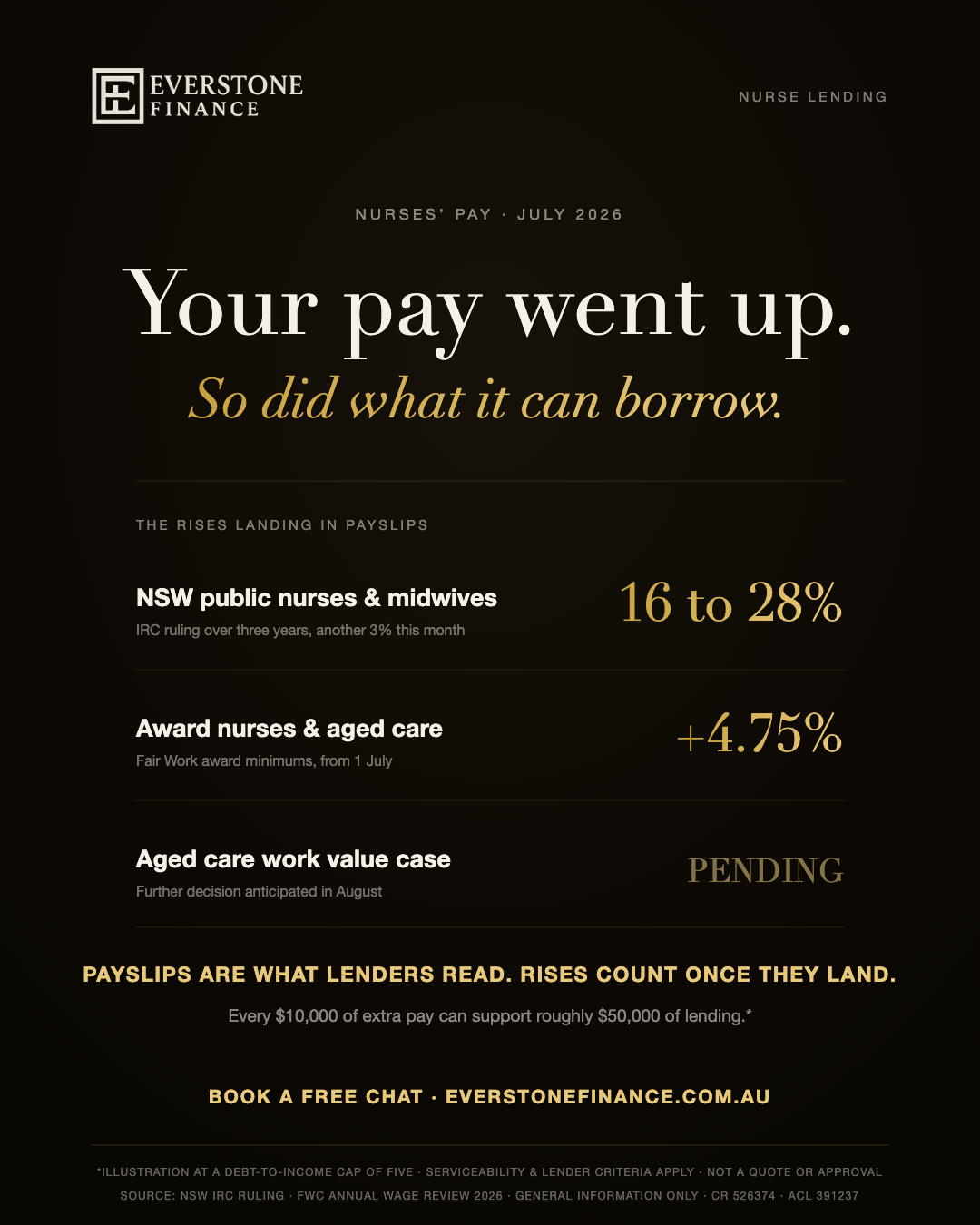
- NSW public sector nurses and midwives won 16 to 28 per cent over three years: 10 to 22 per cent backdated to July 2025, plus 3 per cent this month, plus 3 per cent in July 2027. Backpay began flowing in May.
- Award-reliant nurses and aged care workers nationally received the Fair Work Commission’s 4.75 per cent increase from the first full pay period on or after 1 July 2026.
- A further aged care work value decision is anticipated around August; Victorian public sector nurses have their own scheduled enterprise agreement increases.
- Unlike a claim or a strike demand, a rise that has landed in your payslip counts for lending immediately. As a rule-of-thumb illustration, every $10,000 of extra pay can support up to roughly $50,000 of lending under a debt-to-income cap of five, subject to full serviceability assessment.
- It stacks with the profession’s standing advantages: LMI waivers at select lenders and overtime counted in full.
Nurses: has your pay rise reached your borrowing power yet? A former banker recalculates it, free.
Have a recent payslip handy and tell us your award or agreement. We show which lenders count the new rate, the allowances and the overtime, and what it changes on your budget.
Recalculate my borrowing with a former bankerThe three pay streams landing in 2026
Three separate increases are reaching nurses this year: the NSW Industrial Relations Commission ruling of 16 to 28 per cent over three years for public sector nurses and midwives, with 3 per cent landing this month; the Fair Work Commission’s 4.75 per cent lift to award minimum wages from 1 July for award-reliant nurses and aged care workers; and an anticipated aged care work value decision around August.
The pay story reaching nursing stations this month is really three stories, and which one applies to you depends on where and how you are employed:
- NSW public sector: 16 to 28 per cent over three years. The Industrial Relations Commission’s ruling, described by the state government as the largest increase in more than two decades, delivered a reset of 10 to 22 per cent backdated to July 2025, with reporting putting registered nurses and midwives at 16 per cent total, enrolled nurses at 18, and assistants in nursing at 28. Backpay started flowing in May, and the second tranche of 3 per cent takes effect this July, with a further 3 per cent in July 2027.
- Award-reliant nurses nationally: 4.75 per cent from 1 July. The Fair Work Commission’s annual wage review lifted modern award minimums, covering nurses, enrolled nurses and AINs paid under the Nurses Award, along with aged care and home care workers under their awards, from the first full pay period on or after 1 July 2026. The honest footnote: nurses on enterprise agreements, which covers most public hospital staff, generally sit above award minimums already, so this stream mainly reaches aged care, general practice and smaller private employers.
- Still to come. A separate Fair Work aged care work value decision is anticipated as soon as August, and Victorian public sector nurses have their own scheduled increases under their enterprise agreement. Neither is money in hand yet, and we treat them accordingly below.
The payslip rule: why nurses are ahead of teachers this month
Lenders assess the income you can evidence, so a ratified rise showing in your payslip lifts borrowing power immediately, while a claim, a strike demand or an anticipated decision adds nothing until it lands. This month that puts nurses, whose rises are flowing, in a materially different lending position from professions still negotiating.
We wrote about the Victorian teachers strike this week, and the contrast is instructive. Teachers are fighting for a rise that, until it is ratified and paid, adds precisely nothing to a loan application. Nurses are on the other side of that line: the NSW reset is in payslips, the backpay has been paid, this month’s 3 per cent is flowing, and the award increase is live nationally. In lending terms, that is the whole difference between a claim and income.
Two practical notes on how the machinery reads your rise. First, evidence beats announcements: a lender wants to see the new rate on a payslip or an employer letter, so the useful moment to have your borrowing power reassessed is once a pay cycle or two shows the new figure, which for the July tranches is about now. Second, backpay is read differently from base pay: the lifted base rate counts as ongoing income, while the backpay lump sum generally does not, though it can absolutely strengthen your deposit, and how lenders treat it for genuine savings varies, which is a matching question we handle case by case.
New rate on your payslip? WhatsApp or text Ahmed a photo of it, or call him, and talk through what it means for your borrowing power. His own mobile, no call centre, and the first chat is free.
The borrowing-power arithmetic
As an illustration only: a registered nurse whose $80,000 base has risen 16 per cent is earning $12,800 more, which under a debt-to-income cap of five can support up to roughly $64,000 of additional lending, subject to full serviceability assessment. Add overtime and penalties counted in full at select lenders and the true movement is often larger.
Here is the mechanical translation from pay rise to purchasing power, with the standing caveat that serviceability assessment always governs and these are illustrations, not quotes. Under lending policies carrying a maximum debt-to-income ratio of five, total debt can reach five times household income. Run the July numbers through that frame: a registered nurse on an $80,000 base whose pay has stepped up 16 per cent is earning roughly $12,800 more a year, which can support up to about $64,000 of additional lending capacity. An AIN whose award pay lifted 4.75 per cent on $60,000 adds $2,850, roughly $14,000 of capacity. A dual-nurse household compounds both. To see where your own income, expenses and debts land, use our borrowing power calculator.
And for nurses specifically, the base rate is rarely the whole story. Shift penalties, overtime and allowances make up a large share of real nursing income, and select lenders will count that variable income in full rather than shading it, a difference that routinely moves borrowing power by more than the pay rise itself. How that works, lender by lender, is the core of our guide to home loans for nurses, and pairing the right income treatment with your new base rate is exactly the optimisation a former banker runs before anything is lodged.
The waiver that now covers your next home, not just your first
A select lender has expanded its LMI waiver for healthcare and education workers: up to 90 per cent lending with no LMI premium on loans up to $1.5 million, for owner-occupied purchases, with only one borrower needing to work in healthcare, and no longer restricted to first home buyers. Criteria and credit assessment apply, and offers change.
The pay rises land in a market where nurse lending policy has just moved too. As we covered in the teachers piece, a select lender we work with has reopened and expanded its LMI waiver for the healthcare and education professions: lending up to 90 per cent of the property value with no LMI premium, on loans up to $1.5 million, for an owner-occupied purchase of an established or completed home, with only one borrower needing to work in healthcare. The change that matters most: the first home buyer restriction is gone, so a nurse upgrading to the next family home now qualifies, precisely the group the Australian Government 5% Deposit Scheme (formerly the Home Guarantee Scheme) leaves out. The premium waived typically runs $15,000 to $30,000, criteria and genuine savings requirements apply, and offers like this change without notice, which is why we confirm the live policy before anything is lodged. The broader map of profession-based waivers is in our LMI waiver guide for professionals.
Who can act on this, by situation
First home buyer nurses can stack the new pay with the 5% Deposit Scheme or a 10 per cent no-LMI waiver. Upgraders can use the expanded waiver that no longer requires first home buyer status. NSW nurses holding backpay have a deposit boost. And any nurse with an existing loan has new serviceability strength for a rate review.
Cutting it into instructions:
- Buying your first home: your new base rate lifts what you can borrow, and it stacks with the 5% Deposit Scheme, profession waivers, state grants and full overtime counting. The combinations are mapped in our first home buyer guide and the nurses guide’s first-home section.
- Upgrading: the expanded waiver removed its first home buyer rule at exactly the moment your income stepped up. A 10 per cent deposit with no LMI on the next family home, up to $1.5 million of lending, is a different upgrade equation from the one you may have priced last year.
- Holding NSW backpay: a lump sum spanning a year of backdated increases can materially strengthen a deposit. How it counts toward genuine savings differs by lender and by how long it has been held, which changes which lender we would point you at.
- Already own: higher evidenced income improves serviceability, which reopens refinancing doors that may have been closed at your old pay. If your rate has not been reviewed since before the ruling, the review is free and the timing is now genuinely better.
Every path starts the same way: a current payslip showing the new rate, and one conversation about what it now supports. We are former bankers in South Yarra who arrange lending for healthcare workers every week, we know which lenders run the waivers and count the overtime, and under the Best Interests Duty the recommendation is legally required to suit you, not any lender.
Your pay went up. Find out what it can do now.
Bring a payslip showing the new rate and we will tell you plainly what your borrowing power looks like across 40+ lenders, waivers and overtime counting included. No cost, no obligation, and your July numbers deserve the check.
Book a chat with a former bankerFrequently asked questions
When do the 2026 nurses pay rises take effect?
In NSW, the second tranche of the Industrial Relations Commission ruling, 3 per cent, takes effect in July 2026, following the 10 to 22 per cent reset backdated to July 2025 whose backpay began in May; a further 3 per cent follows in July 2027. Nationally, the Fair Work Commission’s 4.75 per cent increase to award minimum wages applies from the first full pay period on or after 1 July 2026 for award-reliant nurses and aged care workers.
Does a pay rise increase my borrowing power straight away?
Once it is ratified and visible in your pay, effectively yes: lenders assess the income you can evidence, so a payslip showing the new rate is what moves the number. As an illustration, each $10,000 of additional annual pay can support up to roughly $50,000 of extra lending under a debt-to-income cap of five, always subject to the lender’s full serviceability assessment of your whole position.
Does backpay count toward a home loan?
The lifted base rate counts as ongoing income; the backpay lump sum itself generally does not, because it is one-off. It can still help materially as deposit funds, and whether it qualifies as genuine savings typically depends on the lender and how long the money has been held, usually around three months. That treatment differs enough between lenders that it genuinely changes which one we would recommend.
Do overtime, penalties and agency shifts count as income?
At select lenders, yes, and sometimes in full rather than shaded to 80 per cent, which for shift-working nurses often matters more than the pay rise itself. Casual and agency income usually needs a consistent history, commonly six to twelve months depending on the lender. Matching your income shape to the lender that reads it most generously is the core of our nurses lending work.
Can nurses get an LMI waiver if they are not first home buyers?
Under the expanded offer we describe above, yes: the first home buyer restriction has been removed, so a qualifying owner-occupied purchase of your next home is eligible, with lending up to 90 per cent, no LMI premium, and loan sizes up to $1.5 million. Only one borrower needs to work in healthcare or education. Criteria, genuine savings and credit assessment apply, and lender offers change without notice.
I work in aged care on the award. Does the 4.75 per cent apply to me?
If you are paid under the relevant modern awards, the increase applies from the first full pay period on or after 1 July 2026. Nurses employed under enterprise agreements, which covers most public hospital staff, generally already sit above award minimums, so their movement comes from their agreement instead. A separate aged care work value decision is anticipated later in 2026, but it is not money in hand until decided and paid.
Should I wait for the next pay decision before applying for a loan?
Anticipated decisions add nothing to an application until they are ratified and in your pay, so waiting on one is waiting on uncertainty. The practical approach is to run your numbers on today’s evidenced income, and reassess if a further rise lands; if you are close to a purchase, the July increases already in your payslip are the ones that count.
Finishing a night shift and reading this? Your payslip just became a better argument. Book a time with a former banker and find out what the new number actually unlocks, free.
Sources
Related guides
About the author. Ahmed Lotfi is co-founder of Everstone Finance and a former banker who now works as a mortgage and finance broker in South Yarra, Melbourne, arranging home, investment and commercial lending for clients across Australia. Everstone Finance operates under the Best Interests Duty.
The rise took years to win. Using it takes one conversation.
New base rate, overtime counted properly, a waiver that no longer cares if it is your first home: your July payslip is holding better cards than your last application did. We will read them with you, free.
Book a chat with a former banker