

Australian Property Price Forecast 2027: Where Prices Are Tipped to Fall, Where They Rise, and What It Means for You
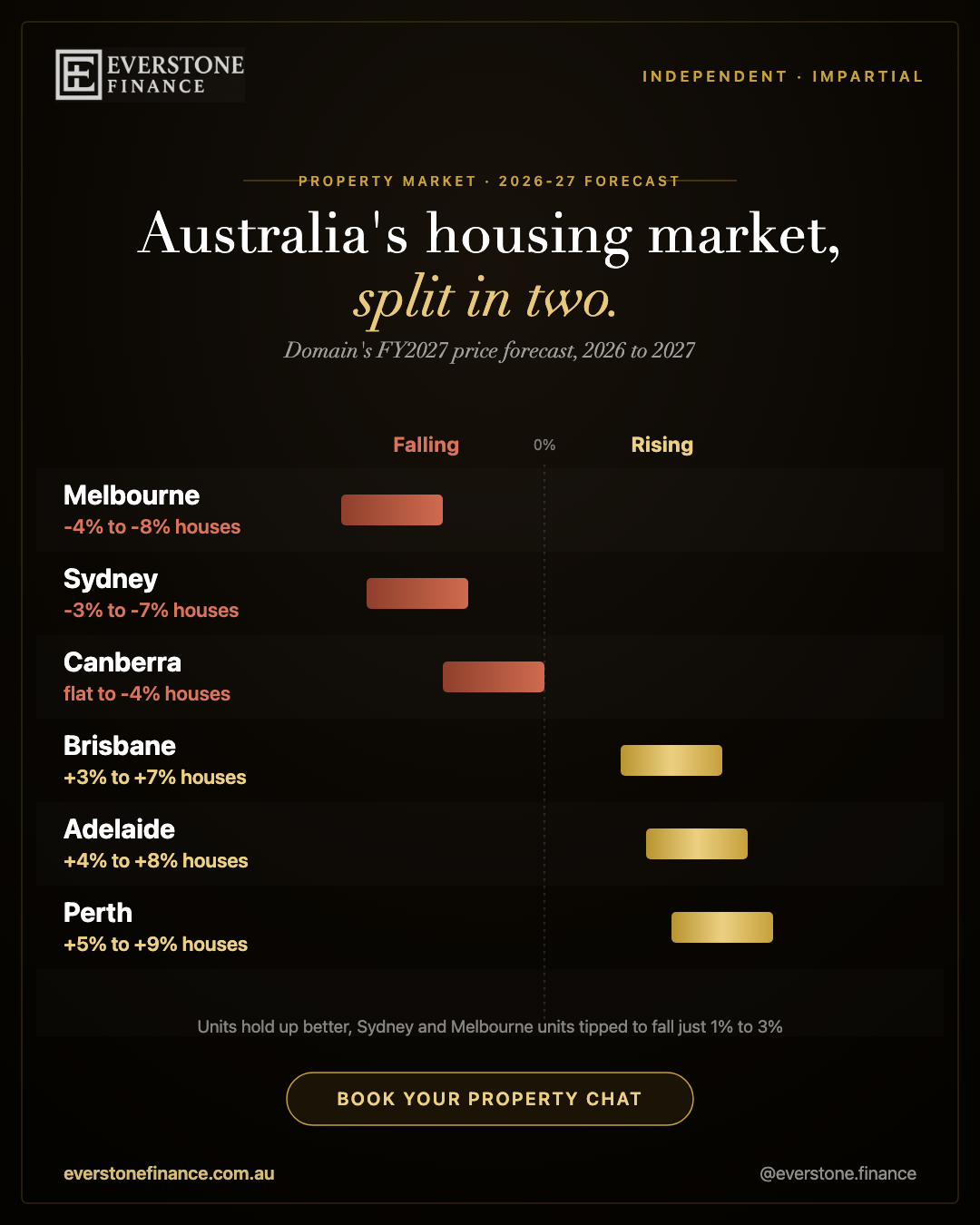
Domain’s FY2027 forecast splits the country in two. The lending strategy splits with it.
- Sydney and Melbourne house prices are forecast to fall. Domain’s FY2027 forecast tips Melbourne houses to drop the most, by 4% to 8%, Sydney next at 3% to 7%, and Canberra flat to down 4%.
- The mid-tier capitals rise instead. Perth leads at 5% to 9%, Adelaide 4% to 8% and Brisbane 3% to 7%, with all three tipped to hit record highs.
- Units hold up far better than houses. Sydney and Melbourne units are forecast to slip just 1% to 3%, with Sydney’s unit median easing about $25,000 to around $821,000.
- Higher interest rates are the main driver. They bite hardest in Sydney, Melbourne and Canberra, where buyers borrow more, while under-supplied Perth, Adelaide and Brisbane keep climbing.
- A turning point is in sight. Domain expects prices to start gradually recovering from mid-2027.
Domain’s FY2027 forecast tips Sydney house prices to fall 3% to 7% and Melbourne 4% to 8% across 2026-27, while Perth, Adelaide and Brisbane rise to record highs. Higher interest rates are the main driver. For buyers and refinancers, a softer southern market changes both how much you can borrow and how you should play it. Unsure how a forecast like this should shape your plans? Book a free chat with an ex-banker broker. What you could actually borrow against these forecasts depends on how a lender reads your income, mapped occupation by occupation in our professionals hub. For teachers and educators weighing up when to enter this market, our teacher home loans guide covers the deposit and LMI shortcuts that change the timing maths. The full city-level picture is in our Brisbane 2027 forecast. The full city-level picture is in our Perth 2027 forecast. The full city-level picture is in our Sydney 2027 forecast. The full city-level picture is in our Melbourne 2027 forecast.
The national headline hides two very different markets. According to Domain’s FY2027 forecast, reported by the ABC this week, Sydney, Melbourne and Canberra are set to give back ground while Perth, Adelaide and Brisbane push to fresh records. If you are buying, refinancing or investing, the number that matters is not the national average, it is what is happening in your city and your price bracket. Business owners weighing a premises purchase have their own version of this question, covered in our commercial property loans guide.
At Everstone Finance we are mortgage brokers in South Yarra, and this is the plain-English read on what the forecast means for your borrowing, whichever side of the divide you sit on.
What the 2026-27 forecast says
Domain forecasts house prices to fall in Sydney (3% to 7%), Melbourne (4% to 8%) and Canberra (flat to 4% lower) over 2026-27, and to rise in Perth (5% to 9%), Adelaide (4% to 8%) and Brisbane (3% to 7%). Units across Sydney and Melbourne are tipped to fall only 1% to 3%.
The split is stark. Here is the forecast for the major capitals over the 2026-27 financial year.
| City | House price forecast | Unit price forecast |
|---|---|---|
| Melbourne | Fall 4% to 8% | Fall 1% to 3% |
| Sydney | Fall 3% to 7% | Fall 1% to 3% |
| Canberra | Flat to fall 4% | Flat to fall 4% |
| Brisbane | Rise 3% to 7% | Rise (record highs) |
| Adelaide | Rise 4% to 8% | Rise (record highs) |
| Perth | Rise 5% to 9% | Rise (record highs) |
Two themes stand out. First, units are holding up far better than houses in the falling cities, with Sydney and Melbourne units forecast to ease just 1% to 3%, and Sydney’s unit median slipping around $25,000 to about $821,000. Second, the gap is wide enough that Brisbane is tipped to overtake Sydney as the country’s most expensive unit market within the year. For where every capital sits before these moves land, our guide to median house prices in every capital city has the current numbers.
Why the south falls while the north and west rise
Higher interest rates weigh most on Sydney, Melbourne and Canberra, where buyers borrow larger amounts, so each rate move bites harder. Perth, Adelaide and Brisbane are under-supplied, with demand still ahead of supply, so they keep growing. Federal budget tax reform and a slowing economy add to the southern pressure.
Domain’s Chief Residential Economist, Dr Nicola Powell, put it plainly: “Higher interest rates are weighing heavily on Sydney and Melbourne, while more affordable segments and mid-tier cities are continuing to hold up.” That squares with our breakdown of the least affordable cities in Australia, where Sydney and Melbourne already stretch household incomes the furthest.
The mechanism is borrowing power. “Any change in interest rates affects cities like Sydney, Melbourne and Canberra the most because buyers there tend to borrow more, while they tend to be better at providing more housing supply,” Powell said. “On the other hand, Brisbane, Adelaide and Perth have very under-supplied housing markets, and demand is still ahead of where supply is. They’ll still have price growth, but it will be more subdued.”
Layered on top is the federal budget. The changes to negative gearing and the capital gains tax discount shift the maths for investors, which we cover in our guide to the 2026 Budget property changes. Add a slowing economy and rising unemployment, and the southern capitals are carrying the most weight.
Forecasts move yearly. Readiness is yours to control.
Whatever 2027 brings, buyers with finance arranged move first. A former banker maps your borrowing power and gets pre-approval moving, across more than 40 lenders, free.
Get finance-ready nowWhat it means if you are buying
A falling market can favour buyers, but only if your finance is ready. Lower prices in Sydney and Melbourne are partly offset by higher rates cutting borrowing power, so the real question is your budget today. Pre-approval, room to negotiate, and a lender that values the property well matter more than ever.
Falling headline prices sound like good news for buyers, and they can be, but the same higher rates that are pushing prices down also trim how much you can borrow. The two move together. The buyers who win in a softer market are the ones who know their real budget, hold finance ready, and can move on the right property without scrambling. For owners trading up, there is a further lever: if the right home appears before your current one sells, a bridging loan funds the overlap so you can buy first and sell on your own timeline.
Buying from outside the country changes the file more than the market: our guide to buying property in Australia from overseas covers the expat version of this playbook, from foreign income assessment to remote settlement.
Three things to get right. Hold a current pre-approval so you can act and negotiate from strength. Expect valuations to be more conservative in a falling market, which can change your deposit, so choose the lender whose valuation suits the property. And if this is your first home, the schemes and concessions still apply, which we lay out in our first home buyer guide. If you work in nursing or midwifery, note that some lenders offer home loans for nurses with a 10% deposit and no LMI regardless of where prices head.
What it means if you are refinancing
Higher rates make refinancing more valuable, not less. If your rate has crept up or your fixed term is ending, a review can cut your repayments or move you to a lender that values your property properly. In a softer market, the valuation and the lender you choose matter as much as the rate.
When rates rise, the gap between a sharp rate and a lazy one widens, and lenders keep their best pricing for new customers. If you have not checked your rate, you may be paying for the privilege of staying still. Our plain-English guide to refinancing walks through how it works, and if your fixed rate is ending, the fixed rate cliff guide covers what to do before it does.
The one wrinkle in a falling market is the valuation. As prices ease, lenders value more cautiously, which can affect your loan-to-value ratio and whether you can release equity. The fix is matching your property to a lender comfortable with it, which is exactly the part we handle.
A hold is not a pause for borrowers. It is when the gap between what lenders offer new customers and what existing customers quietly pay does its compounding in the background, because nothing prompts anyone to look. The arithmetic takes minutes: our refinance savings calculator shows what a sharper rate is worth on your balance, and if the numbers say stay, our guide to negotiating your rate shows how to get the sharper number without moving at all.
What it means for investors
The growth has moved. Perth, Adelaide and Brisbane are forecast to rise to record highs on tight supply, while Sydney and Melbourne soften. Units are also outperforming houses in the falling cities. For investors, that shifts both where the capital growth sits and where the stronger rental yields are.
For investors, the forecast is a map of where momentum sits. The under-supplied mid-tier capitals are tipped to keep growing, and rental yields in many of those markets already outpace Sydney and Melbourne, which we track in our guide to the best rental yields in Australia. The right structure and lender matter more when you are buying interstate or building a portfolio across markets moving in different directions.
At the top end, prestige property continues to follow its own rules, driven by scarcity and equity rather than headline rates, as our guide to high value and prestige home loans explains.
How Everstone helps in a shifting market
We were bankers before we were brokers, and a divided market is exactly where lender choice earns its keep. We work out your real borrowing power at today’s rates, match your purchase or refinance to a lender whose valuation and policy suit it, and structure the loan around where you are buying and what you are buying. We are based in South Yarra and work with clients across Melbourne and Australia-wide by phone and Zoom. It costs you nothing to start; we are paid by the lender when your loan settles.
Buying or refinancing into this market?
Tell us your city, your price bracket and your position. We will work out what you can really borrow now, and match you to the lender that suits the property and the moment. No cost, no obligation.
Talk to an ex-bankerProperty price forecast FAQ
Will Sydney and Melbourne house prices keep falling?
Domain forecasts house price falls of 3% to 7% in Sydney and 4% to 8% in Melbourne across the 2026-27 financial year, driven mainly by higher interest rates. The forecast then has prices starting to recover gradually from mid-2027, so the falls are expected to be a phase rather than a long slide.
When will property prices recover?
Domain expects prices in the falling cities to begin a gradual recovery from around mid-2027. The timing depends heavily on the interest rate path, since rates are the main force behind the current falls in Sydney, Melbourne and Canberra.
Should I wait to buy until prices fall further?
It depends more on your finances than on timing the market. Lower prices are partly offset by higher rates reducing borrowing power, and the best property for you may not wait. Holding a current pre-approval and knowing your real budget puts you in a position to act when the right home appears, which usually beats waiting for a perfect bottom.
Are units a safer bet than houses right now?
In the falling cities, yes, on these forecasts. Sydney and Melbourne units are tipped to ease just 1% to 3%, far less than houses, because they sit in more affordable and supply-constrained segments. Brisbane units are even forecast to reach record highs. The right answer still depends on your goals and the specific property.
Why are Perth, Adelaide and Brisbane rising while Sydney falls?
Those markets are under-supplied, with demand still running ahead of new housing, so prices keep climbing even as rates rise. Buyers there also tend to borrow less than in Sydney and Melbourne, so each rate move bites less. Domain expects all three to reach record highs over 2026-27.
Does a falling market change refinancing?
It makes the lender and the valuation matter more. As prices ease, lenders value property more cautiously, which can affect your loan-to-value ratio and your ability to release equity. Higher rates also widen the gap between a sharp deal and a lazy one, so a review is often worth more in this market, not less.
Should I refinance while the RBA is on hold?
A hold freezes the cash rate, not lender competition. New customer pricing keeps moving through a hold while existing customers stand still, which is exactly how the gap between a sharp rate and a lazy one widens. A review during a hold costs nothing and often finds the most.
Is it better to negotiate with my current lender or switch?
Both paths work, and the order matters: negotiation comes first because it costs nothing beyond a phone call and keeps everything else in place. Switching wins when the gap is too wide to close on that call, or when the valuation and lender fit have changed since you borrowed.
How often should you review your home loan?
Industry convention is a yearly review, and it earns its place: pricing moves, lender appetite moves, and your own equity position moves with the market. Whether a refinance follows depends on the gap between your rate and the market and on the costs of switching, not on the calendar.
Related guides
Sources and useful references
- Domain, FY2027 Price Forecast Report, domain.com.au
- ABC News, coverage of the Domain forecast, 25 June 2026, abc.net.au