

Home Loans for Veterinarians in Australia (2026): Borrow to 90% With No LMI
Ask most veterinarians about professional home loan deals and you will get a blank look. Ask most doctors and you will get a knowing one. That gap is the whole story of this article. At select lenders, veterinarians sit on the same professional list as doctors, dentists and surgeons, which means a registered vet can borrow up to 90 per cent of a property’s value with no lenders mortgage insurance, keeping a five figure premium in their pocket. Almost nobody tells vets this. The clinics are busy, the lenders do not advertise it, and the policy detail that decides eligibility, your state veterinary board registration, is one that plenty of brokers get wrong. This guide covers how home loans for veterinarians in Australia actually work in 2026: what the waiver is worth in dollars, who qualifies, what changes if you are buying rural or own the practice, written by former bankers who read lender credit policy for a living.
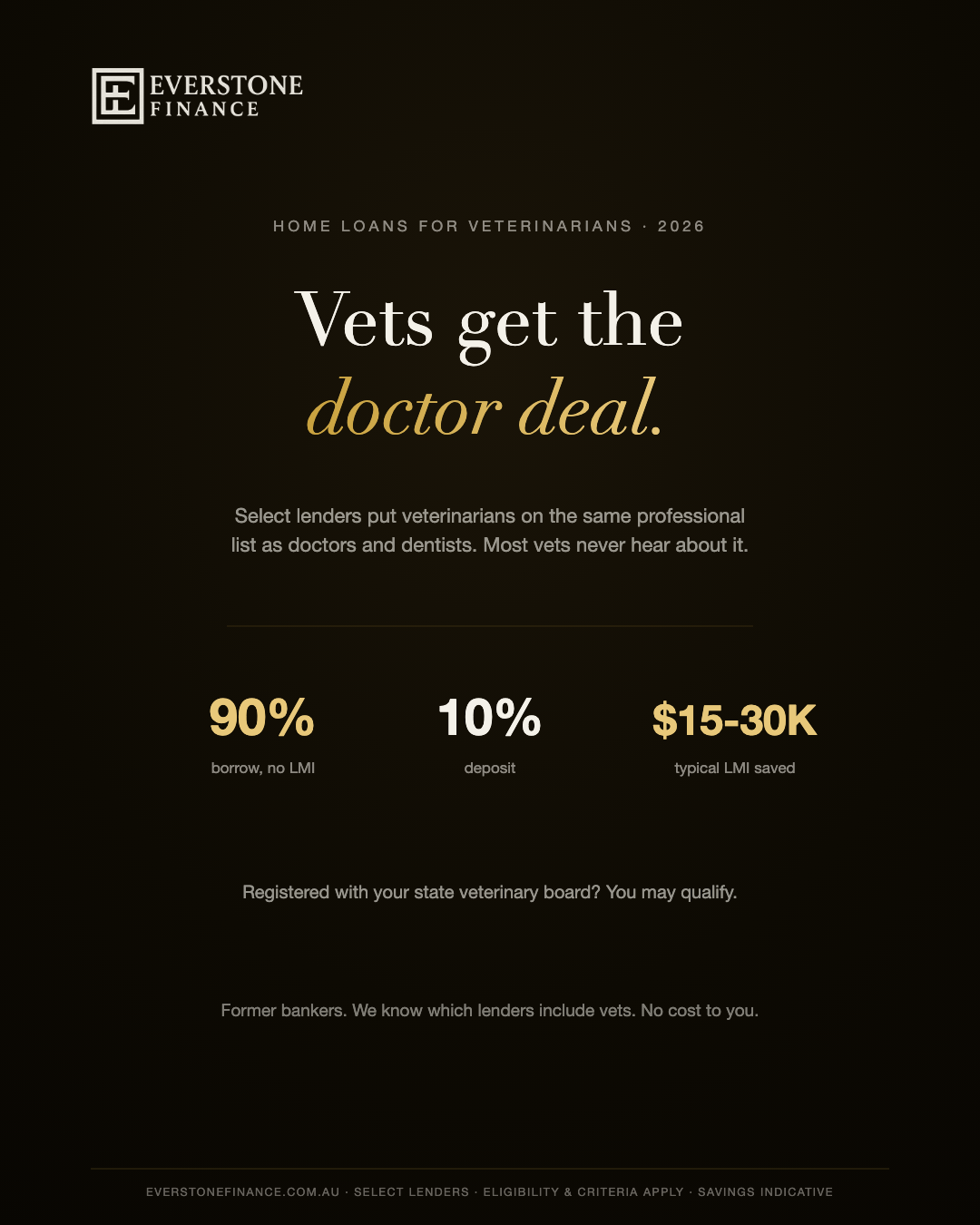
- Select lenders include veterinarians on their medical professional list, alongside doctors and dentists.
- That means borrowing up to 90 per cent with no LMI: a 10 per cent deposit and no insurance premium.
- The saving is typically roughly $15,000 to $30,000 depending on property price. Figures are indicative.
- Eligibility runs on your state veterinary board registration, not AHPRA. Vets are not AHPRA registered.
- Book a chat with a former banker to check whether you qualify.
- Do veterinarians get an LMI waiver in Australia?
- How much does the vet LMI waiver actually save?
- Who qualifies for the veterinarian LMI waiver?
- Buying rural or regional: what changes for vets?
- What about practice owners and self-employed vets?
- Why veterinarians work with Everstone
- Frequently asked questions
Do veterinarians get an LMI waiver in Australia?
Yes. Select lenders include veterinarians on their medical professional list, the same list as doctors, dentists and surgeons. A registered vet can borrow up to 90 per cent of a property’s value with no lenders mortgage insurance, so a 10 per cent deposit buys without the premium that other borrowers pay at that level.
Lenders mortgage insurance exists to protect the lender, not you, whenever a loan goes above 80 per cent of a property’s value. For most borrowers it is simply the price of buying with less than a 20 per cent deposit, and it is not a small price: on a high value property the one-off premium can run well into five figures. You pay it, the lender is protected by it, and you get nothing back.
For a short list of professions, select lenders waive it entirely up to 90 per cent. The logic is cold actuarial maths rather than flattery: registered professionals in fields like medicine default at very low rates, their incomes are resilient, and their qualifications take years to earn and travel with them anywhere in the country. Doctors have known about this for decades, and our guides to home loans for doctors and home loans for dentists cover their versions of it.
What almost never gets said out loud is that veterinarians are on the same list at select lenders. A vet’s training is as long as a dentist’s, registration is legally required to practise, and veterinary unemployment is close to a rounding error, so the same actuarial logic applies. The difference is purely informational. Medical recruiters, accountants and colleagues pass the doctor deal around like folklore, while a vet can go an entire career without anyone mentioning that their degree changes their mortgage.
One honesty note before the numbers. Not every lender does this, the ones that do apply criteria, and policies change. That is why this article says select lenders throughout, and why the eligibility section below matters more than the headline.
How much does the vet LMI waiver actually save?
Typically roughly $15,000 to $30,000 on properties in the $800,000 to $1,200,000 range, based on indicative LMI premiums at 90 per cent lending. The exact premium depends on the lender, insurer, loan size and loan-to-value ratio, so treat every figure here as illustrative rather than a quote.
The waiver’s value is simply the LMI premium you never pay. Premiums scale with both the loan size and the loan-to-value ratio, and at 90 per cent they are at their steepest. Here is what that looks like at three property prices a vet might realistically buy at, with a clear label attached: every number in this table is illustrative only, not a quote, and actual premiums vary by lender and insurer.
| Property price | 10% deposit | Loan at 90% | Indicative LMI avoided |
|---|---|---|---|
| $800,000 | $80,000 | $720,000 | Roughly $15,000 |
| $1,000,000 | $100,000 | $900,000 | Roughly $22,000 |
| $1,200,000 | $120,000 | $1,080,000 | Roughly $28,000 |
Illustrative only, not a loan offer or quote. LMI premiums differ between lenders and insurers and change over time. Stamp duty, other purchase costs and lending criteria still apply. This is general information, not credit advice.
There is a second saving hiding behind the first: time. Without the waiver, avoiding LMI means saving a 20 per cent deposit. On a $1,000,000 purchase that is $200,000 of savings instead of $100,000, and for a vet a few years out of university, the difference between those two numbers can be several years of saving. The waiver does not just remove a premium, it can bring the purchase forward, and being in the market earlier matters in ways no premium comparison captures.
A fair question at this point is whether lenders claw the saving back through a higher interest rate. In our experience the waiver is a credit policy setting rather than a pricing product: eligible professionals access the same loan products and pricing they would otherwise, minus the insurance premium. As always, the comparison worth doing is the whole package, rate, fees, features and policy together, which is exactly the comparison a broker runs across lenders before recommending anything.
Registered vet weighing up a purchase, in the city or out in a regional practice? WhatsApp, text or call Ahmed about the vet waiver and how it fits your deposit. His own mobile, no call centre, and no obligation.
Who qualifies for the veterinarian LMI waiver?
A veterinarian registered with the veterinary board in their state or territory, meeting the lender’s standard income and credit criteria. Vets are not AHPRA registered, and lenders that know the profession check the state board register instead. Employed and self-employed vets can both qualify, and there is no long years-of-experience hurdle at select lenders.
The core requirement is current registration as a veterinarian. Here is the detail that trips people up, including some brokers: veterinarians are not registered with AHPRA. AHPRA covers doctors, dentists, nurses and other human health practitioners. Vets are registered with the veterinary board of their state or territory, eight separate boards coordinated through the Australasian Veterinary Boards Council, and it is that state board registration a lender verifies when assessing a vet for the waiver. If you have ever had a lender or broker ask for your AHPRA number, you were dealing with someone who does not know the profession, and that is exactly the kind of file presentation error that gets an eligible application mishandled.
Beyond registration, the shape of eligibility at select lenders looks like this:
- Standard income and credit criteria still apply. The waiver removes the insurance premium, not the serviceability assessment. Your income still needs to support the loan.
- New graduates can qualify. What matters is being registered and employed, not years in practice, so the waiver is available at the exact career stage where a 20 per cent deposit is least realistic.
- Owner occupied and investment purchases can both be eligible at select lenders, commonly on principal and interest repayments.
- Loan size caps apply, and the maximum loan-to-value ratio can step down on larger loans, so the policy detail needs checking against your actual purchase price.
Every line above carries the same footnote: this is the general shape of the policy at select lenders, each lender writes its own rules, and the rules move. The practical step is not to memorise criteria, it is to have someone check your specific situation against current policy before you apply anywhere. That is routine work for a broker who already knows which lenders include vets, and our guide to who qualifies for the 90 per cent LMI waiver shows where vets sit among the other eligible professions.
Buying rural or regional: what changes for vets?
Veterinary work is unusually regional, and property policy changes outside the cities. Lenders set limits on land size, treat some postcodes more cautiously, and differ on acreage and mixed-use properties. The vet waiver and rural property policy are two separate hurdles at the same lender, so lender choice matters twice for a regional vet.
Veterinary medicine is one of the few high skill professions where the work is genuinely spread across the country. Large animal and mixed practice vets live where the livestock are, and even small animal clinics anchor most regional towns. So for a meaningful share of vets, the property being bought is not a suburban house, it is a home on acreage outside town, or a property in a postcode a city credit team has never heard of.
That raises a second, quieter policy question. Lenders apply different rules to land size, location and property type: many are comfortable up to certain acreage limits and become conservative beyond them, some restrict lending in specific regional postcodes, and properties with significant farming use can fall outside standard residential policy altogether. None of this is vet specific, but it collides with vet life more often than with most professions.
The practical consequence: a regional vet needs a lender that clears two hurdles at once, a professional list that includes veterinarians and a property policy comfortable with the actual house and land being bought. Those are independent settings, and the lender with the friendliest waiver is not automatically the one comfortable with 20 hectares outside Wagga. Matching both at the same lender is precisely the kind of two-variable puzzle where a broker who can see multiple lenders’ policies earns their keep, at no cost to you.
Buying in town instead? Then the rural wrinkle disappears and the standard waiver path applies. Either way, the eligibility check is simple: book a time with a former banker and bring nothing but your registration details.
What about practice owners and self-employed vets?
Self-employed vets and practice owners can still qualify for the waiver, with self-employed income verification, commonly financials and tax returns, replacing payslips. Practice ownership also opens commercial lending questions, from buying the clinic premises to refinancing practice debt, which Everstone arranges alongside home lending.
A large share of experienced vets do not collect a payslip, they own or co-own the practice. That changes the paperwork, not the principle. The waiver runs on registration; the income assessment runs on whatever form your income takes. For a self-employed vet that typically means tax returns and business financials rather than payslips, and lenders differ on how many years they want and how they treat add-backs, retained profits and a strong recent year. It is the same terrain we map in our guide to self-employed home loans in Australia, with the waiver layered on top. When ownership itself is the goal, our guide to buying a medical, dental or veterinary practice covers the financing from buy-in to buyout.
Practice ownership also tends to arrive with a second set of lending questions that most mortgage articles ignore:
- Buying the clinic premises. Owning the building your practice pays rent on is one of the classic wealth moves for practice owners, and it runs through commercial property lending rather than a home loan.
- Practice debt. Fitout loans, equipment finance and practice purchase debt written years ago are worth reviewing periodically; our guide to business loan refinancing explains when a review pays.
- Structuring across both. How the home loan, practice lending and any premises purchase sit together affects borrowing power on each. Assessing them as one picture, rather than three separate applications, is where former bankers are most useful.
Everstone arranges residential and commercial lending under one roof, which for a practice owner means one conversation instead of three, and a broker who understands that the practice financials behind your home loan are the same financials behind the premises loan.
Why veterinarians work with Everstone
Because the vet waiver is a credit policy detail, and credit policy is what former bankers read for a living. Everstone Finance knows which lenders include veterinarians on their professional lists, verifies eligibility through the correct state board, and arranges home and commercial lending Australia wide at no cost to you, paid by the lender on settlement.
The veterinarian waiver is a niche inside a niche. It is not on comparison websites, most bank branch staff have never processed one, and as covered above, even the registration check is routinely done wrong. Getting it right takes exactly one thing: someone who knows which lenders include vets, what each one’s criteria say this quarter, and how to present a vet’s file, employed, locum or practice owner, so the assessor ticks the professional box on the first pass.
That is our home ground. We are former bankers who worked inside the institutions that write these policies, and reading them is the core of what we do. We check your eligibility against current policy before anything is lodged, match the property side of your purchase, city, regional or acreage, to a lender comfortable with it, and run the whole comparison across our panel rather than defaulting to whoever you bank with. If you want the wider context first, our guide to home loans for professionals in Australia maps every profession-based policy we work with.
There is no cost to you for any of it. Like most Australian mortgage brokers, we are paid a commission by the lender when your loan settles, and our recommendation must meet the Best Interests Duty, which legally requires us to act in your interests rather than any lender’s. Moneysmart’s guide to using a mortgage broker explains how the arrangement works.
Ten years of study should be worth something to a lender
It is. Send us your registration details and we will confirm whether you qualify to borrow at 90 per cent with no LMI, and what that means for your deposit and timeline. No cost, no obligation.
Book a chat with a former bankerFrequently asked questions
Do veterinarians get an LMI waiver in Australia?
Yes. Select lenders include veterinarians on their medical professional list, the same list as doctors and dentists, which allows a registered vet to borrow up to 90 per cent of a property’s value with no lenders mortgage insurance. Standard income and credit criteria still apply, and policies vary between lenders, so eligibility is worth confirming against current policy before you apply.
Do I need AHPRA registration to qualify as a vet?
No. Veterinarians are not AHPRA registered; AHPRA covers human health practitioners such as doctors, dentists and nurses. Vets are registered with the veterinary board of their state or territory, and it is that state board registration lenders verify for the waiver. If a lender or broker asks a vet for an AHPRA number, they are unfamiliar with the profession.
How much deposit does a veterinarian need?
With the waiver, a 10 per cent deposit plus purchase costs such as stamp duty is enough to buy without paying lenders mortgage insurance at select lenders. Without it, borrowers generally need a 20 per cent deposit to avoid LMI. On a $1,000,000 purchase that is the difference between saving $100,000 and $200,000, which for many vets means buying years earlier.
Can new graduate vets get the LMI waiver?
Yes, at select lenders. Eligibility runs on current registration and meeting standard income and credit criteria, not on years in practice, so a newly registered vet in their first job can qualify. That makes the waiver most valuable at exactly the career stage where saving a full 20 per cent deposit is least realistic.
Does the vet LMI waiver apply to investment properties?
At select lenders, yes. The waiver can cover both owner occupied and investment purchases, commonly on principal and interest repayments, with loan size caps that vary by lender. Because investment lending policy differs more between lenders than owner occupied policy, this is one of the details worth checking against current credit policy before applying.
Can self-employed vets and practice owners qualify?
Yes. The waiver itself runs on registration, and self-employed income verification, typically tax returns and business financials, replaces payslips. Practice owners also commonly have commercial lending alongside the home loan, from practice purchase debt to buying the clinic premises, and assessing the whole picture together usually produces a better structure than three separate applications.
Does it cost anything to use a broker?
No. Everstone Finance is paid a commission by the lender when your loan settles, so there is no fee to you for our service, and our recommendation must satisfy the Best Interests Duty, which requires us to act in your interests rather than any lender’s. You get former bankers reading credit policy for you at no cost.
Between consults and surgeries? We work around clinic hours. Book a time with a former banker, bring your registration details, and we will tell you plainly whether the waiver applies to you.
Sources
Related guides
About the author. Ahmed Lotfi is co-founder of Everstone Finance and a former banker who now works as a mortgage and finance broker in South Yarra, Melbourne, arranging home, investment and commercial lending for clients across Australia. Everstone Finance operates under the Best Interests Duty as Credit Representative 574314 of LMG Broker Services Pty Ltd, Australian Credit Licence 517921.
Keep your deposit where it belongs
You spent long enough earning the qualification. One short chat to confirm eligibility and you will know exactly what your registration is worth to a lender.
Book a chat with a former banker