

Home Loans for Professionals in Australia (2026): Who Gets No LMI
Australian lenders keep lists of occupations they trust, and if yours is on one, the rules change in your favour. Doctors, dentists, nurses, midwives, teachers, lawyers and accountants can all buy with a smaller deposit and skip lenders mortgage insurance entirely through select lenders. But every profession gets a slightly different deal, and every lender runs a different list. This page is the directory: what each occupation gets, the conditions attached, and where to read the detailed guide for your profession. We are Everstone Finance, independent ex-banker brokers, and matching professionals to the lender that runs their waiver is a large part of what we do. Veterinarians sit on the same professional list at select lenders, see our guide to home loans for veterinarians. For the wider allied health picture, optometrists, pharmacists, physios and more, see our guide to home loans for allied health professionals. Bank employees hold a version of the same deal, mapped in our bank employee guide. For technology employers specifically, our tech employee guide explains the named-employer lists. New to brokers entirely? Start with our teachers strike analysis.
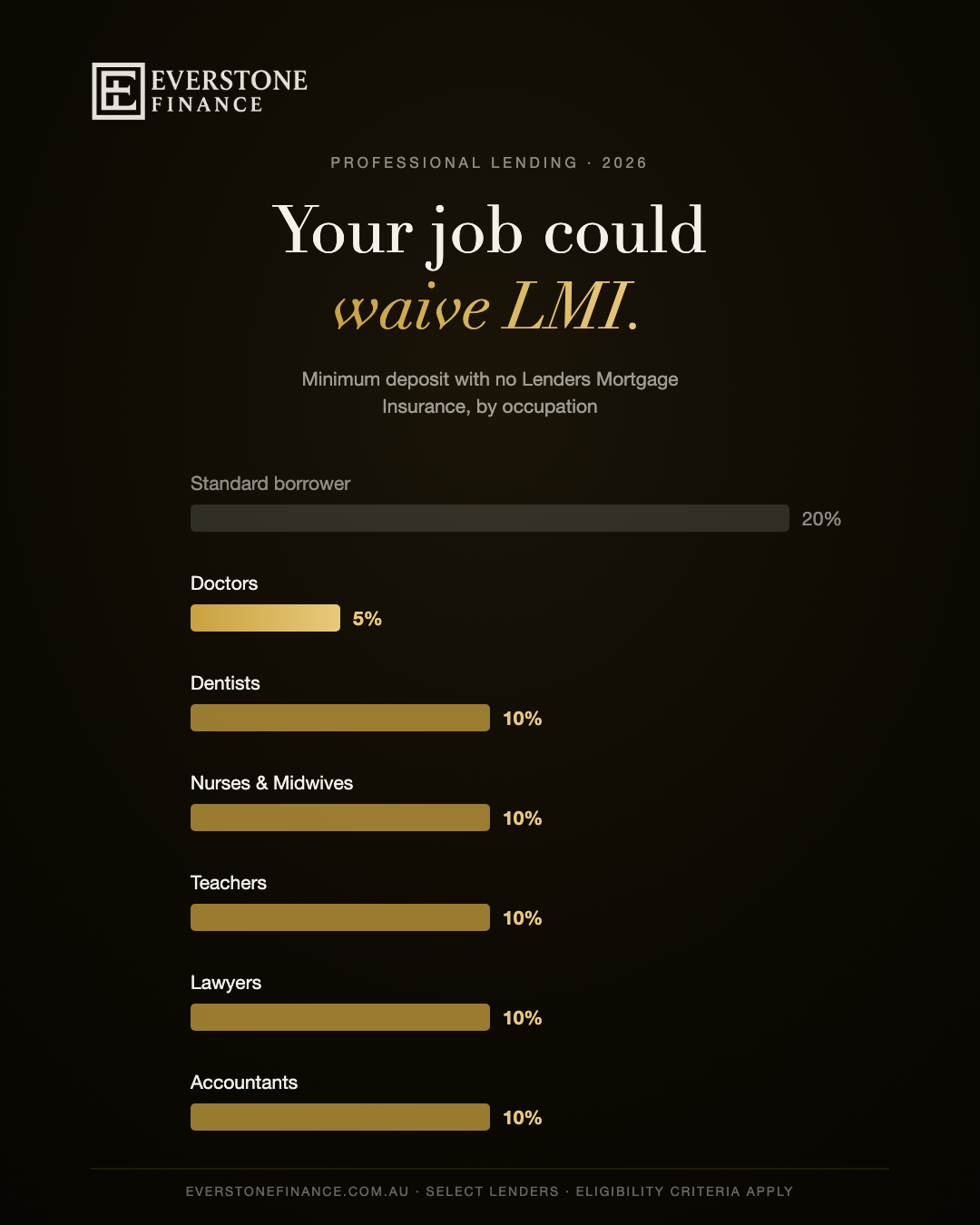
Doctors, dentists, nurses, midwives, teachers, lawyers and accountants can buy with a 5 to 10 per cent deposit and pay no LMI through select lenders, saving $10,000 to $40,000. The deal differs by occupation, and a broker matches you to the lender that runs your waiver. Book a free appointment and we will confirm yours.
- Professional LMI waivers at a glance
- Doctors: the strongest deal in the market
- Dentists: 90 per cent with AHPRA registration
- Nurses and midwives: the underused waiver
- Teachers: the deal most have never heard of
- Lawyers: strong deal, income strings attached
- Accountants: CA or CPA is the key
- How the LMI waiver actually works
- Not on the list? You still have options
- Why go through a broker for a professional home loan
- Home loans for professionals FAQs
Professional LMI waivers at a glance
Here is what each occupation can access in 2026. Every figure below depends on the individual lender's policy, which is exactly why the same borrower gets different answers at different institutions.
| Occupation | Minimum deposit | Max LVR with no LMI | Key conditions |
|---|---|---|---|
| Doctors | 5% | 95% | Medico list registration, AHPRA |
| Dentists | 10% | 90% | AHPRA registration |
| Nurses & midwives | 10% | 90% | RN or RM earning $90,000+ |
| Teachers | 10% | 90% | Registered teachers, select lenders |
| Lawyers | 10% | 90% | Practising certificate; income expectations around $150,000 with some lenders |
| Accountants | 10% | 90% | CA or CPA membership |
Doctors: the strongest deal in the market
No occupation is courted harder by Australian lenders than medicine. If your specialty appears on a lender's medico list and you hold current AHPRA registration, you can buy with a 5 per cent deposit and borrow up to 95 per cent of the property value with no LMI, the most generous waiver available. Interns and residents are accepted early in their careers, most medico policies apply no fixed income floor, and some lenders extend the waiver to investment purchases. The catch is the list itself: each lender defines eligible specialties differently, so where you apply decides the outcome. Our guide to home loans for doctors covers medico lists, junior doctors and how overtime and on-call allowances are assessed. For the resources version of the income story, see our FIFO and mining home loans guide.
Dentists: 90 per cent with AHPRA registration
Dentists sit just behind doctors on the professional ladder. With current AHPRA registration as a dental practitioner, you can borrow up to 90 per cent with no LMI through select lenders, and recognised specialists such as orthodontists, periodontists and oral surgeons are sometimes assessed even more generously. New graduates are accepted with a signed contract and their first payslips, while practice owners are assessed on tax returns and business financials rather than what the practice bills. As with every waiver on this page, one lender will approve what another declines on the same file. Our guide to home loans for dentists explains the waiver, new graduate policies and how practice owners are assessed.
Nurses and midwives: the underused waiver
Nurses and midwives are a newer addition to professional lending lists, and in our experience this is the most underused waiver in the country. Registered nurses and registered midwives earning $90,000 or more can borrow up to 90 per cent with no LMI through select lenders. Importantly, some lenders count shift loadings, overtime and allowances toward that figure, which brings many full-time nurses over the line even when their base salary sits below it. The right lender choice matters as much for how your income is read as for whether the waiver exists. Our guide to home loans for nurses covers the income test, how penalty rates are assessed and which working arrangements qualify.
Teachers: the deal most have never heard of
Teachers are the quiet achievers of professional lending. A small group of lenders extends the 90 per cent no LMI deal to registered teachers, from early childhood through to secondary educators, yet most teachers have never heard of it because the major banks generally do not offer it. Registration with your state or territory teaching authority is the anchor, and permanent part-time and contract teachers can qualify with the right lender. Because so few lenders run this policy, matching matters more here than for any other occupation on this page. Our guide to home loans for teachers explains who qualifies, how teaching income is assessed and which lenders run the waiver.
Lawyers: strong deal, income strings attached
Lawyers appear on most professional lists, with a twist. Solicitors and barristers holding a current practising certificate can borrow up to 90 per cent with no LMI through select lenders, but some lenders pair the waiver with an income expectation of around $150,000, while others apply none at all. That makes lender choice unusually decisive: a second-year solicitor can be declined by one lender and approved by another on the same numbers. In-house counsel and government lawyers are treated differently again depending on the institution. Our guide to home loans for lawyers covers practising certificate requirements, the income expectations and how different legal roles are assessed.
Accountants: CA or CPA is the key
Accountants round out the professional lists. Full membership of CA ANZ or CPA Australia is what unlocks the 90 per cent no LMI deal with select lenders; an accounting degree or a bookkeeping role alone is generally not enough. The waiver covers employed accountants, and self-employed accountants and partners can qualify too, assessed on tax returns and business financials rather than firm revenue. Some lenders also recognise related professional designations, which we confirm case by case rather than assume. Our guide to home loans for accountants covers membership requirements, employed versus self-employed assessment and how to pick the lender whose list you are actually on.
How the LMI waiver actually works
Lenders mortgage insurance normally applies when you borrow more than 80 per cent of a property's value, and it protects the lender rather than you. For eligible professions, select lenders waive the premium entirely at up to 90 or 95 per cent, which on a typical purchase is a saving of $10,000 to $40,000.
The waiver is a policy setting, not a discount, so the premium disappears rather than being reduced. Each lender maintains its own list of eligible occupations, its own evidence requirements and its own LVR ceiling, which is why the same borrower gets different answers from different lenders. For the full mechanics, including how the waiver compares with government deposit schemes and simply paying LMI, read our deep dive on the 90 per cent LMI waiver for professionals.
Not on the list? You still have options
The waiver lists are generous, but they are not the only path to a strong deal. If you work for yourself, lenders read your tax returns and business financials rather than your job title, and choosing the right lender matters just as much; our guide to self-employed home loans explains how income, add-backs and business structures are assessed. Australians living and earning overseas can still buy at home, with foreign income converted under each lender's policy; see our guide to Australian expat home loans. And if you are buying rooms, a practice or premises rather than a home, that is commercial lending, which we cover in our guide to commercial property loans. And for income earned in another currency, our foreign income and non-resident guide covers the cross-border rules.
Why go through a broker for a professional home loan
Every lender publishes a different occupation list, applies a different income rule and sets a different LVR ceiling, and none of them advertises how the policy is actually applied behind the scenes. Apply to the wrong lender and you can pay tens of thousands in LMI that another lender would have waived on the same file. We are ex-bankers, so we have sat on the other side of these policies and know how credit teams read a professional application. We compare more than 40 lenders, identify the ones that run your waiver, and present your income the way each lender assesses it. Our advice costs you nothing: the lender pays us on settlement, so you get bank-level knowledge working for you rather than for the bank.
Which waiver fits your profession?
Tell us what you do and how you are paid. We will confirm the lenders that waive LMI for your occupation and match you to the sharpest deal. No cost, no obligation.
Talk to an ex-bankerHome loans for professionals FAQs
Which professions get no LMI in Australia?
Doctors, dentists, nurses, midwives, teachers, lawyers and accountants can all access an LMI waiver with select lenders. Doctors get the strongest deal, borrowing up to 95 per cent with no LMI, while the other professions can generally reach 90 per cent. Each lender runs its own eligible occupation list, so the outcome depends on where you apply.
Do professionals get lower interest rates?
Not usually through a separate advertised rate. Professionals are priced on each lender's standard professional package, which sits at the sharp end of normal pricing, and we negotiate from there. The genuine saving is the LMI waiver itself, which usually outweighs a small rate difference, so we compare the whole cost of the loan rather than the headline rate.
Can I use a professional LMI waiver for an investment property?
Some lenders allow the waiver on investment purchases, while others restrict it to owner occupied homes. Keep in mind that investment loans are priced higher than owner occupier loans, and investment rates currently start with a 6. We confirm which lenders extend your waiver to an investment purchase before you apply.
What income do I need for a professional home loan?
It depends on the occupation and the lender. Doctors and dentists generally face no fixed income floor, nurses and midwives typically need to earn $90,000 or more, and some lenders expect lawyers to earn around $150,000. Teachers and accountants are usually assessed on registration or membership rather than a set income threshold.
Do professional packages cost anything?
Most professional packages carry an annual package fee in exchange for rate discounts, an offset account and fee waivers, and the LMI waiver itself costs nothing. Our advice is also free to you, because the lender pays Everstone a commission when your loan settles rather than charging you a fee.