

Home Loans for Doctors (2026): 5% Deposit, No LMI, Up to 95% LVR
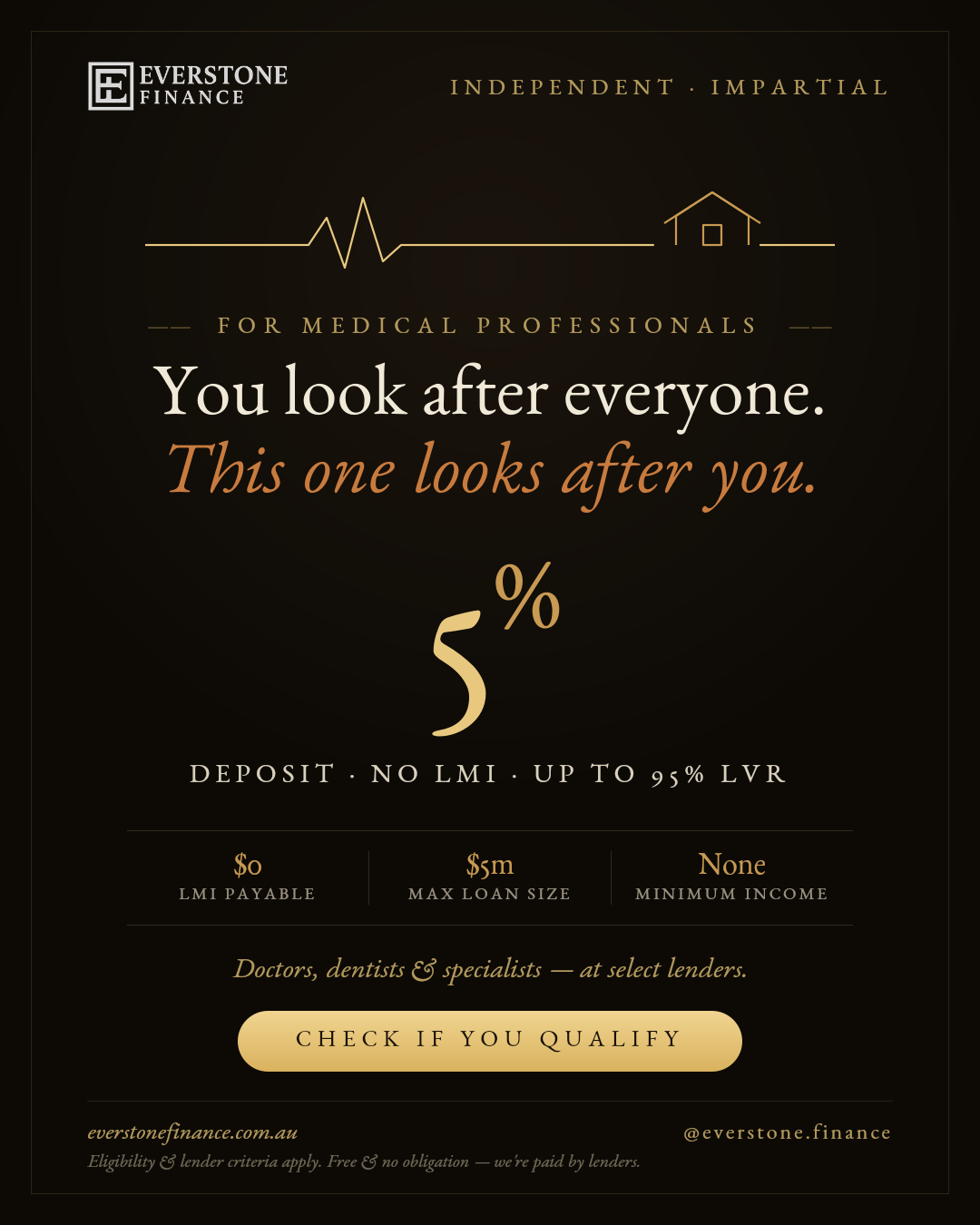
Doctors, dentists and specialists can buy with a 5% deposit and pay no LMI, with no minimum income, at select lenders (2026).
- Doctors, dentists and medical specialists can borrow up to 95% LVR with no LMI at select lenders, a 5% deposit, with no minimum income requirement and loans up to $5 million ($7.5m total lending under the waiver).
- The saving is the largest of any professional waiver. LMI at 95% LVR is the most expensive tier, the waived premium can run from roughly $15,000 to $80,000+ depending on the purchase price.
- Allied health professionals can qualify too, physiotherapists, registered nurses, pharmacists, psychologists, vets and more can access 90% LVR no-LMI lending at some lenders, typically with an income threshold around $90,000.
- Lender policies differ sharply. Professions that are ineligible at one major bank are fully eligible at another, which is exactly why the lender panel, not the first “no”, decides your outcome.
- Hospital-employed doctors qualify from intern level at some lenders, you don’t need to be a consultant to use the medico policy.
No profession gets a better deal on home loans in Australia than medicine. Lenders compete so hard for doctors, dentists and specialists that the standard rules, the 20% deposit, the LMI premium, even minimum income tests, are simply waived for eligible applicants at select banks. The result is the strongest borrowing position in the country: a 5% deposit, no Lenders Mortgage Insurance, no minimum income, and loan sizes up to $5 million. At Everstone Finance, we’re ex-bankers who structure medico lending for medical professionals across Australia. This guide explains exactly what the medico policy is, who qualifies (including allied health), how much it saves at each price point, where lenders differ, and how to use it, whether you’re an intern buying your first apartment or a specialist financing a $3 million home.
- What is the medico home loan policy?
- Why do banks give doctors special home loans?
- Who qualifies for the full 95% LVR waiver?
- Allied health: the 90% LVR tier
- The same job can be eligible at one bank and rejected at another
- Medico waiver vs the Home Guarantee Scheme: which 5% path?
- How much does the medico LMI waiver save?
- Beyond the waiver: what else medico lending unlocks
- Do doctors get discounted interest rates?
- Which banks offer home loans for doctors?
- How to claim the medico waiver
- Mistakes medical professionals make with home loans
- Salary packaging: the borrowing-power boost for hospital doctors
- Medico home loan glossary
- Home loans for doctors FAQ
Many eligible Australian doctors can borrow up to 95% of a property’s value with the Lenders Mortgage Insurance waived, a concession that can save tens of thousands of dollars. Select lenders extend this to recognised medical roles, including GPs, specialists, dentists and some allied health professionals, subject to income and accreditation checks.
What is the medico home loan policy?
The medico policy lets eligible medical professionals borrow up to 95% of a property’s value (a 5% deposit) without paying Lenders Mortgage Insurance, with no minimum income requirement at select lenders and maximum loans of $5 million (up to $7.5m total lending under the waiver). For every other borrower, lending above 80% LVR triggers an LMI premium that can run into tens of thousands of dollars; for eligible doctors, it’s waived entirely.
It is, without exaggeration, the most generous lending policy in Australian banking. Where the accountant waiver (covered in our guide to home loans for accountants) typically caps at 90% LVR, the medico policy extends to 95%, the most expensive LMI tier there is, which makes the waived premium correspondingly larger. Lenders verify professional qualifications as part of the application, so the benefit hinges on registration and evidence, not negotiation.
Why do banks give doctors special home loans?
Lenders treat medical professionals as the lowest-risk borrowers in the country: near-guaranteed employment demand, high and rising lifetime income, and statistically minimal default rates. Because the risk is so low, banks compete for doctors with their most aggressive policies, LMI waived to 95% LVR, no income floors, larger maximum loans and sharper rate discounts.
It’s the same risk-pricing logic behind every professional package, taken to its endpoint. A junior doctor’s income trajectory is one of the most predictable in the economy, which is why some lenders extend the full waiver to hospital-employed interns, residents and registrars, not just consultants. The banks aren’t being generous; they’re bidding for the most reliable customers they’ll ever have. Your job is simply to collect the winning bid, and that’s a comparison exercise.
Who qualifies for the full 95% LVR waiver?
At select lenders, the full medico waiver, 95% LVR, no LMI, no minimum income, applies to: general practitioners, medical specialists, dentists, and hospital-employed doctors at every level (intern, resident, registrar, staff specialist). Current registration (e.g. AHPRA) and evidence of qualification are required.
| Occupation | Typical maximum | Minimum income |
|---|---|---|
| General Practitioners | 95% LVR, no LMI | None |
| Medical Specialists | 95% LVR, no LMI | None |
| Dentists | 95% LVR, no LMI | None |
| Hospital-employed Doctors (Intern, Resident, Registrar, Staff Specialist) | 95% LVR, no LMI | None |
Junior doctors take note: at some lenders the full waiver applies from intern level. If you’re a PGY1 with a 5% deposit, you may already hold the strongest borrowing profile in the country, years before your consultant income arrives.
Allied health: the 90% LVR tier
A second tier covers allied health professionals at some lenders: 90% LVR with no LMI, typically with a minimum income around $90,000. Eligible occupations commonly include physiotherapists, registered nurses, midwives, pharmacists, psychologists, optometrists, chiropractors, osteopaths, podiatrists, occupational therapists, audiologists, sonographers, radiographers, speech pathologists and veterinary practitioners.
This tier is broader but more conditional than the doctors’ tier: the income threshold applies, the LVR cap is lower, and, crucially, the eligible list varies more between lenders than almost any other policy in the market. Which brings us to the part most medical professionals never hear about. Our allied health home loans guide maps that variation profession by profession.
The same job can be eligible at one bank and rejected at another
Medico policies differ sharply by lender. For example, one major bank’s published waiver list excludes nurses, midwives, pharmacists, psychologists and podiatrists, while another major lender includes all of them at 90% LVR. Same profession, same income, opposite answers. The lender panel, not your eligibility in the abstract, decides your outcome.
This is the single most practical fact in this entire guide. A registered nurse or pharmacist who walks into the wrong branch hears “you don’t qualify” and reasonably assumes that’s the end of it, when across the street, a different lender would waive their LMI entirely. Even within the doctors’ tier, details differ: maximum loan sizes, whether the waiver pairs with fast-track income verification, how self-employed specialists are assessed, and which registrations are accepted all vary. A broker’s job is to know, on the day you apply, which lender’s policy fits your profession, structure and loan size best, and to send the application there first.
Medico waiver vs the Home Guarantee Scheme: which 5% path?
Junior doctors buying a first home often qualify for both the government’s Home Guarantee Scheme and the medico waiver, and the right answer depends mostly on price.
| Home Guarantee Scheme | Medico waiver | |
|---|---|---|
| Deposit needed | 5% | 5% |
| Who can use it | First home buyers, owner-occupiers only | Any eligible medico: first home, upgrade, and investment at select lenders |
| Property price caps | Yes (around $950,000 in Melbourne; check current caps) | None beyond the lender maximum (loans to $5m) |
| How LMI is avoided | Government guarantees the gap | Lender waives the premium for the profession |
| Above the price cap | Not available | The only 5% deposit path |
The practical rule: under the price cap and buying your first home to live in, the scheme is often the simpler route. Buying above the cap, upgrading, or investing, the medico waiver is the only 5% deposit road, and it travels with you for every purchase after the first. A broker checks your numbers against both on the day, because caps and lender policy move.
How much does the medico LMI waiver save?
The saving equals the LMI premium avoided, and at 95% LVR premiums sit in the most expensive tier. Depending on purchase price, the waived premium commonly ranges from about $15,000 on a $600,000 purchase to $80,000 or more above $2 million, on top of needing only a quarter of the standard 20% deposit.
| Property price | 5% deposit | Loan (95% LVR) | Indicative LMI avoided |
|---|---|---|---|
| $600,000 | $30,000 | $570,000 | ~$15,000 to $20,000 |
| $800,000 | $40,000 | $760,000 | ~$22,000 to $30,000 |
| $1,000,000 | $50,000 | $950,000 | ~$30,000 to $42,000 |
| $1,500,000 | $75,000 | $1,425,000 | ~$48,000 to $60,000 |
| $2,000,000 | $100,000 | $1,900,000 | ~$65,000 to $80,000+ |
Two compounding effects make the real value even larger. First, avoiding LMI means the premium is never capitalised onto your loan, so you never pay interest on it. Second, buying with 5% down instead of saving 20% can bring your purchase forward by years, which, in the markets we covered in our guide to Australia’s least affordable cities, frequently matters more than the premium itself. On a Sydney or Melbourne trajectory, two years of waiting can cost more than any insurance bill ever would.
Beyond the waiver: what else medico lending unlocks
- Larger lending capacity, medico maximums (up to $5m per loan, $7.5m total under the waiver at select lenders) are well beyond standard policy, suiting specialists buying in premium suburbs.
- Professional-package rate discounts and fee waivers, available even if you hold a 20% deposit and don’t need the waiver at all.
- Self-employed flexibility, some lenders assess eligible self-employed medicos on streamlined income verification while preserving the full waiver, valuable for specialists operating through practices or trusts.
- Overtime and allowances counted, hospital-employed doctors can have overtime and allowances assessed at up to 100% under emergency-services-style policies at some lenders, lifting borrowing power materially.
- Investment lending, the waiver generally isn’t limited to owner-occupied first homes; investment purchases qualify at many lenders.
Do doctors get discounted interest rates?
Often, yes. Most lenders offer professional packages with rate discounts and fee waivers to eligible medical professionals, and credit teams hold pricing discretion they use more readily for medico applicants than for almost anyone else. That said, the LMI waiver is usually worth far more than any headline rate difference, so we compare the whole cost of the loan, not just the rate.
Two things are worth understanding here. First, the discount you see advertised is rarely the limit of what is available: lenders price case by case, and a well-presented medico application, strong profession, clean conduct, sensible LVR, gives the credit team every reason to sharpen their pencil. We know how those pricing requests work because we used to sit on the other side of them. Second, chasing the sharpest rate at a lender whose medico policy is weak can cost you the waiver, and the waiver is usually the bigger number by a wide margin. The sensible order is waiver first, structure second, rate third, and a broker can push on all three at the same time.
Which banks offer home loans for doctors?
Medico lending is available across three broad camps: the major banks, most of which run formal medico policies with LMI waivers and published eligible-occupation lists; specialist medico lenders, whose policies are often the most flexible on occupations and structures; and non-bank lenders, which can suit complex income or credit histories. No single lender is best for every doctor, the right fit depends on your occupation, employment type and loan size.
The majors compete hardest for the core tier, salaried doctors, dentists and specialists with straightforward income, and their eligible-occupation lists are where the sharpest differences show up. Specialist medico lenders tend to win when the file is less standard: self-employed specialists, practice and trust structures, or allied health occupations the majors exclude. Non-banks rarely lead the market on price, but they can approve profiles the others decline. We hold current policy across all three camps, so rather than naming a “best bank for doctors”, which changes month to month, we match your file to whichever lender’s policy reads it most generously on the day.
If you’re a dentist rather than a doctor, the same tiers apply with a few policy differences of their own, we cover them in our guide to home loans for dentists. And if you’re buying with a partner who teaches, our guide to teacher home loans explains the concessions their profession attracts.
How to claim the medico waiver
To use the medico policy: 1) confirm your registration is current (e.g. AHPRA) and gather evidence of your qualification, 2) have a broker match your exact occupation, employment type and loan size to the lender whose medico policy fits best, 3) structure the application so income (including overtime and allowances) is presented the way that lender assesses it, and 4) get pre-approved. A broker does steps 2 to 4 at no cost to you.
The medico market moves constantly, lenders adjust eligible lists, LVR caps and maximums to compete for the profession, so the “best lender for doctors” is not a fixed answer; it’s a current-policy question. We hold the panel policies, we know which lender is strongest for an intern versus a self-employed specialist versus a practice purchase, and we package the registration evidence the way each credit team wants to see it. You keep doing the rounds; we’ll do the comparison. For how to choose a broker, see our guide to the questions to ask a mortgage broker. We cover the full acquisition playbook in our guide to buying a medical or dental practice.purchase
Mistakes medical professionals make with home loans
- Taking the first “no” as final. Nurses, pharmacists, psychologists and podiatrists are ineligible at some majors and fully eligible at others. The answer depends on the lender, not just the profession.
- Waiting to save 20%. With a 95% LVR waiver available, years spent saving a full deposit can cost more in price growth than LMI would ever have cost, and you were never going to pay LMI anyway.
- Assuming juniors don’t qualify. At some lenders the full waiver starts at intern level with no minimum income. Your payslip matters less than your registration.
- Ignoring structure as a self-employed specialist. Practice entities, trusts and variable income need the right lender match to preserve both the waiver and your borrowing power.
- Never revisiting an old loan. If you bought before you qualified, or paid LMI you wouldn’t pay today, a review may unlock a sharper structure now, at no cost.
Salary packaging: the borrowing-power boost for hospital doctors
If you are employed by a public hospital, as an intern, resident, registrar or salaried consultant, you can salary package amounts free of fringe benefits tax, plus a meal and entertainment cap. The right lender grosses these up to their pre-tax value and counts them as income, which can lift your borrowing power on top of an already strong medical salary.
Most hospital doctors package to save tax and never connect it to their home loan. They should. A lender that understands health-sector packaging adds the grossed-up benefit to your assessable income, which can be worth a meaningful amount of extra borrowing capacity. Lenders treat it differently, and some ignore it entirely, so matching you to one that reads it generously matters. If you are in private practice rather than salaried, you are assessed as self-employed, which is a different path we also handle.
You look after everyone. This one looks after you.
Book a no-obligation chat and we’ll confirm your eligibility, compare medico policies across 40+ lenders, and show you the saving in plain English, around your roster.
Check if you qualifySources and useful references
Medico home loan glossary
- Medico policy
- A lender policy offering medical professionals the strongest borrowing terms in the market: typically up to 95% LVR with no LMI, no minimum income and elevated maximum loan sizes.
- Lenders Mortgage Insurance (LMI)
- A one-off insurance premium lenders charge when you borrow more than 80% of a property’s value. It protects the lender, not you, and is the cost the medico waiver removes.
- Loan-to-Value Ratio (LVR)
- The loan amount as a percentage of the property’s value. A 5% deposit means 95% LVR, the tier the medico waiver uniquely reaches without LMI.
- AHPRA
- The Australian Health Practitioner Regulation Agency. Current AHPRA registration is the standard evidence lenders require for medical eligibility.
- Allied health tier
- The second medico tier at some lenders: 90% LVR with no LMI for occupations like physiotherapists, nurses and pharmacists, usually with an income threshold around $90,000.
- Maximum loan size
- The largest single loan a policy allows, up to $5m under the medico waiver at select lenders, with total lending to $7.5m under the waiver.
- Professional package
- A lender package offering ongoing rate discounts and fee waivers to eligible professionals, available to medicos even with a 20% deposit.
- Borrowing power
- The maximum a lender will lend you based on income, expenses, debts and their assessment rate. For medicos, treatment of overtime and allowances can move it materially between lenders.
More terms, defined properly, in our plain-English mortgage glossary.
Home loans for doctors FAQ
Do doctors get special home loans in Australia?
Yes, the strongest in the market. At select lenders, eligible doctors, dentists and medical specialists can borrow up to 95% LVR (a 5% deposit) with no Lenders Mortgage Insurance, no minimum income requirement, and maximum loans of $5 million.
How much deposit does a doctor need to buy a home?
As little as 5% at select lenders, with no LMI payable. A standard borrower with a 5% deposit would pay an LMI premium that can run into tens of thousands of dollars; for eligible medical professionals it’s waived.
Which medical professionals get the full 95% LVR waiver?
Typically general practitioners, medical specialists, dentists, and hospital-employed doctors at every level, intern, resident, registrar and staff specialist, with current registration and evidence of qualification. Exact lists vary by lender.
Do nurses, physios or pharmacists qualify for an LMI waiver?
At some lenders, yes, the allied health tier commonly covers registered nurses, midwives, physiotherapists, pharmacists, psychologists, optometrists, chiropractors, osteopaths, podiatrists, occupational therapists, audiologists, sonographers, radiographers, speech pathologists and vets, typically at 90% LVR with a minimum income around $90,000. At other lenders, several of these professions are ineligible, the lender choice decides the answer.
Do junior doctors and interns qualify?
At some lenders, yes. Hospital-employed doctors qualify from intern level for the full 95% LVR waiver with no minimum income, because lenders price the profession’s income trajectory, not just the current payslip.
How much can a doctor save with the medico LMI waiver?
The waived premium scales with price: roughly $15,000, $20,000 on a $600,000 purchase, $30,000, $42,000 around $1 million, and $65,000, $80,000+ at $2 million, on top of needing only a 5% deposit instead of 20%.
Is there a minimum income for doctor home loans?
For the core medico tier (doctors, dentists, specialists, hospital-employed doctors) some lenders apply no minimum income at all. The allied health tier typically carries a threshold around $90,000. Requirements vary by lender.
Can doctors use the waiver for investment properties?
Generally yes at many lenders, the medico waiver isn’t limited to owner-occupied first homes. Policy details vary, so confirm purpose eligibility with the specific lender.
Can self-employed specialists access the medico waiver?
Yes at some lenders, including with streamlined income verification. Specialists operating through practices or trusts need the right lender match to preserve both the waiver and full borrowing power, which is where structuring advice matters most.
What evidence do I need for a medico home loan?
Typically current registration (e.g. AHPRA) and evidence of your qualification or professional membership, alongside standard income documents. Lenders verify professional eligibility as part of the application.
Does it cost anything to check my eligibility with a broker?
No. Brokers like Everstone Finance are paid by the lender when a loan settles, so checking your eligibility and comparing medico policies across lenders is free, with no obligation to proceed.
Where does this doctor home loan information come from?
The figures reflect published major-lender broker policy as at 2026, including 95% LVR no-LMI no-minimum-income medico tiers with $5m maximum loans, and 90% LVR allied-health tiers with income thresholds. Policies change frequently and vary by lender; confirm current eligibility before applying.
Do I need to be in Melbourne or South Yarra to work with Everstone Finance?
No. Everstone Finance is based in South Yarra and meets locally in person, but works with medical professionals across Melbourne and Australia-wide by phone and Zoom.
The bottom line: medicine holds the strongest borrowing position in Australia, a 5% deposit, no LMI, no income floor and $5m capacity at select lenders, but the benefit only lands if your application goes to the right lender, because the same registration can be waved through at one bank and declined at another. You look after everyone. Let us make sure your loan looks after you.
Claim your medico advantage, around your roster
No cost, no obligation. We’ll confirm eligibility, compare 40+ lenders’ medico policies, and show you the saving clearly and in writing, by phone or Zoom, whenever suits your shifts.
Should a first home buyer doctor use the medico waiver or the Home Guarantee Scheme?
If the property sits under the scheme’s price cap and you plan to live in it, the Home Guarantee Scheme is often the simpler route. Above the cap, or for an upgrade or investment purchase, the medico waiver is generally the only 5% deposit option, so most doctors end up using both at different stages.
Check if you qualifyThis guide is part of our home loans for professionals series covering every occupation that can buy with no LMI.