

Melbourne Property Market Forecast 2027: What the Banks Actually Expect
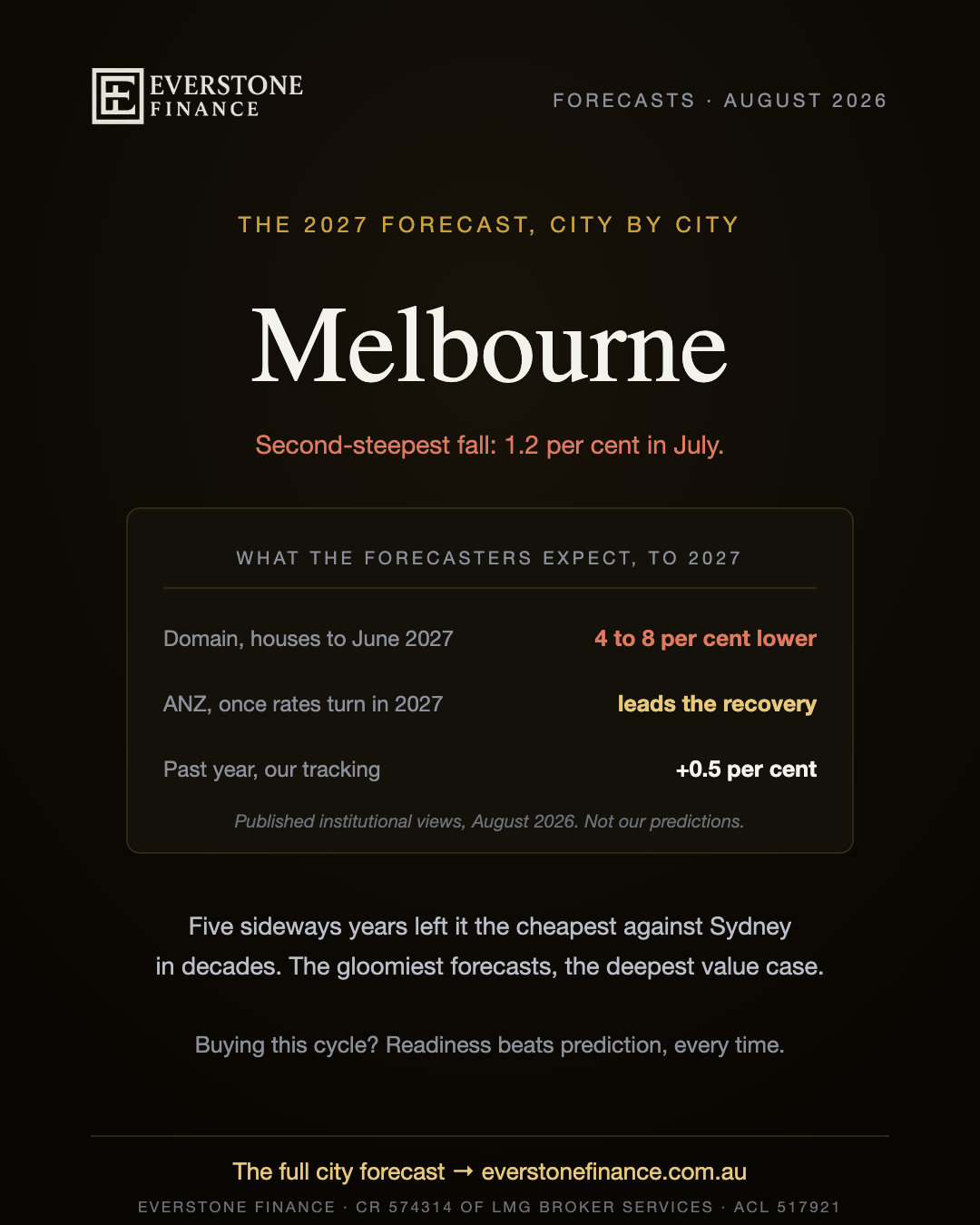
- Melbourne fell 1.2 per cent in July, second only to Sydney. Melbourne’s median has barely moved over the past year, up just 0.5 per cent on our tracking, while smaller capitals ran 19 to 26 per cent.
- Domain’s FY2027 forecast has Melbourne house prices falling 4 to 8 per cent across the year to June 2027, the deepest forecast fall of any capital. ANZ Research expects capital city prices to fall about 4.3 per cent this year and 3.4 per cent next, and pairs Melbourne with Sydney leading the recovery once rates start falling in 2027.
- The national backdrop: the RBA held at 4.35 per cent in a hawkish hold with no cuts forecast this year, auction clearances have sat below 50 per cent since late May, and mortgage applications are down at both of the country’s two biggest lenders since the May budget.
- Forecasts are the banks’ and portals’ published views, not our predictions, and they change. What they agree on: the capitals are diverging, and Melbourne’s path has its own drivers.
Where the Melbourne market is right now
Melbourne fell 1.2 per cent in July, second only to Sydney, against a national July fall of 0.7 per cent, the sharpest month since December 2022. Melbourne’s median has barely moved over the past year, up just 0.5 per cent on our tracking, while smaller capitals ran 19 to 26 per cent, the weakest result of any mainland capital. Nationally, upper-quartile values fell 3.2 per cent over the three months to July while auction clearance rates have held below 50 per cent since late May, with capital-city listings running 5.7 per cent above the five-year average. If you already own in Melbourne, refinance cashback offers are one way to bank value while the market decides.
Melbourne enters the forecast period as the great underperformer, and that is precisely its story: five years of going sideways while every other capital ran has left it, on most relative measures, the cheapest it has been against Sydney in decades. The near-term forecasts are the country’s gloomiest, and the same forecasters nominate it to lead the recovery with Sydney when rates turn, because value eventually gets found.
The August 2026 backdrop applies everywhere: the RBA’s hawkish hold means rates are not doing the work for anyone, the May budget’s investor tax changes have thinned one cohort of bidders, and both of the country’s biggest lenders have reported double-digit falls in mortgage applications since. The full five-signal picture is in our buyer’s market analysis; this page is about how those forces land in Melbourne specifically.
The 2027 forecasts, bank by bank
For Melbourne, Domain’s FY2027 forecast has house prices falling 4 to 8 per cent across the year to June 2027, the deepest forecast fall of any capital. ANZ Research expects capital city prices to fall about 4.3 per cent this year and 3.4 per cent next, and pairs Melbourne with Sydney leading the recovery once rates start falling in 2027. These are published institutional views as at August 2026, they differ because their models weight rates, migration and supply differently, and they are revised through the year, which is why the direction and the reasoning matter more than any single number.
Domain’s financial-year 2027 view has Melbourne house prices falling 4 to 8 per cent across the year to June 2027, the deepest forecast fall of any capital. ANZ Research expects capital city prices to fall about 4.3 per cent this year and 3.4 per cent next, and pairs Melbourne with Sydney leading the recovery once rates start falling in 2027. Westpac’s broader forecast across the capitals has medians rising by up to $134,000 by the end of 2027, though the distribution of that rise is anything but even.
Read the spread honestly: forecasters disagree because the inputs genuinely are uncertain, and last year’s consensus missed in several cities. Treat every number on this page as a published institutional view with a date on it, not a promise, and treat the agreement between them, that the capitals are diverging sharply, as the more reliable signal. Our national forecast hub compares the full set side by side.
What actually decides Melbourne’s path
Melbourne’s cycle is being set by three forces: rate sensitivity, shared with Sydney; a state tax settings environment that has pushed some investors to other markets, thinning demand; and population growth that quietly leads the nation, which is the force the bear case tends to ignore. The gap between weak prices and strong migration is exactly the kind of tension that resolves upward eventually, and the forecast argument is only about when.
Melbourne’s cycle is being set by three forces: rate sensitivity, shared with Sydney; a state tax settings environment that has pushed some investors to other markets, thinning demand; and population growth that quietly leads the nation, which is the force the bear case tends to ignore. The gap between weak prices and strong migration is exactly the kind of tension that resolves upward eventually, and the forecast argument is only about when. The rate environment is the shared unknown: no cuts are forecast this year and at least one investment bank has pencilled in a hike, which is why any forecast that assumes easing in 2027 carries that assumption as its biggest risk.
What it means if you are buying or selling
For first home buyers and upgraders this is the most negotiable big-city market in the country: the deepest forecast falls, listings above average, clearances below half, and vendors who have already heard the 2027 forecasts. This being our own city, we would add: the suburb-level story varies enormously, which is what our suburb guides exist for, and the entry playbook is unchanged: pre-approval, patience, and conditions in the contract.
For first home buyers and upgraders this is the most negotiable big-city market in the country: the deepest forecast falls, listings above average, clearances below half, and vendors who have already heard the 2027 forecasts. This being our own city, we would add: the suburb-level story varies enormously, which is what our suburb guides exist for, and the entry playbook is unchanged: pre-approval, patience, and conditions in the contract. For Australians watching this market from overseas, our step-by-step guide to buying property in Australia from overseas covers the expat version of the same entry window.
Hold, negotiate, or switch while you wait
Plenty of Melbourne owners will read this forecast and decide to sit tight until the dip runs its course. Sitting tight on the property does not mean sitting tight on the loan. The difference between the rate lenders advertise to new borrowers and the rate long-standing customers drift onto is real money every month, and it widens in years when nobody is watching. Two moves cost nothing: ask your current lender to sharpen the rate, our negotiation guide scripts that call, or check whether a switch clears its own costs with room to spare.
Melbourne’s dip is the upgrader’s window. The gap narrows on the way down.
The forecast above is uncomfortable for sellers and quietly generous to upgraders: sell lower, buy the bigger home lower still, and the trade-up gap shrinks. Our guide to upgrading in a falling market shows the arithmetic, and a refinance in the meantime stops the current loan drifting while you decide. And when the right home turns up before yours has sold, a bridging loan is how the move actually happens: you buy first and sell on your own timeline. A former banker prices both paths, free.
Run my upgrade numbersFrequently asked questions
Will Melbourne property prices fall in 2027?
The published forecasts have Melbourne house prices falling 4 to 8 per cent across the year to June 2027, the deepest forecast fall of any capital, and forecasts are revised through the year as rates, migration and supply data land. Direction and drivers are more dependable than point estimates, and the divergence between capitals is the strongest common signal.
What do the banks forecast for Melbourne in 2027?
Domain’s FY27 view: house prices falling 4 to 8 per cent across the year to June 2027, the deepest forecast fall of any capital. ANZ Research expects capital city prices to fall about 4.3 per cent this year and 3.4 per cent next, and pairs Melbourne with Sydney leading the recovery once rates start falling in 2027. All are published August 2026 views, differ on modelling assumptions, and change with the data.
Is Melbourne actually cheap right now?
Relative to its own income base and to Sydney, Melbourne is at its most affordable relative position in decades after five sideways years, which is the core of the value case forecasters make for its recovery. Cheap is always relative: at suburb level the picture varies enormously, and the medians hide it.
Why has Melbourne underperformed for so long?
A run of forces stacked: pandemic-era population loss it has since reversed, investor-unfriendly state tax settings that thinned demand, and rate sensitivity shared with Sydney. The population force has already turned strongly positive, which is why most forecasters treat the underperformance as cyclical rather than permanent.
Is now a good time to buy in Melbourne?
Timing the market is a forecast bet; readiness is not. Current conditions, sub-50 per cent clearances, above-average listings and thinner competition, measurably favour prepared buyers, and preparation, finance arranged, budget stress-tested, conditions in the contract, is what converts a soft market into a good purchase whatever 2027 brings.
Should I wait for 2027 before acting?
Waiting is a position too: it bets prices move your way, that rates cooperate, and that the property you want exists when you re-enter. The honest alternative is to get assessed now, watch with finance ready, and let the right property decide the timing rather than the calendar.
Should you refinance before upgrading in Melbourne?
They are separate decisions, and both benefit from being priced early. Refinancing keeps the existing loan sharp while the trade up gap narrows in your favour, and it does not lock you out of selling when the upgrade stacks up. Pricing both paths together is one conversation, not two applications.
Is it better to negotiate or switch while Melbourne prices fall?
Start with the call that costs nothing: ask your current lender to sharpen the rate, because retention teams exist for exactly this conversation. Switch when the gap will not close on the phone and the valuation supports the move. In a softer market the lender you choose matters as much as the rate.
Does refinancing reset my loan term?
Only if you let it. A refinance defaults to a fresh 30 year term unless you ask otherwise, which lowers the repayment while quietly adding years of interest. Asking the new lender to match your remaining term protects the total interest position and keeps the saving real.
The honest summary
Every forecast on this page carries a date and an assumption set, and all of them will be revised. What they jointly say about Melbourne is more useful than any single number: the capitals have split, the drivers are knowable, and conditions right now favour buyers who arrive prepared. We arrange the finance side of prepared, across more than 40 lenders, and the conversation costs nothing.
Buying in Melbourne this cycle? Arrive with the finance already solved.
A former banker maps your borrowing power across more than 40 lenders, stress-tests it against the forecasts, and gets pre-approval moving so the market’s timing becomes yours. Free, and honest either way.
Book a chat with a former bankerAbout the author. Ahmed Lotfi is co-founder of Everstone Finance and a former banker who now works as a mortgage and finance broker in South Yarra, Melbourne, arranging home, investment and commercial lending for clients across Australia and abroad. Everstone Finance operates under the Best Interests Duty as Credit Representative 574314 of LMG Broker Services Pty Ltd, Australian Credit Licence 517921. Commercial buyers watching the same forecast can compare commercial property loan options here.