

Perth Property Market Forecast 2027: What the Banks Actually Expect
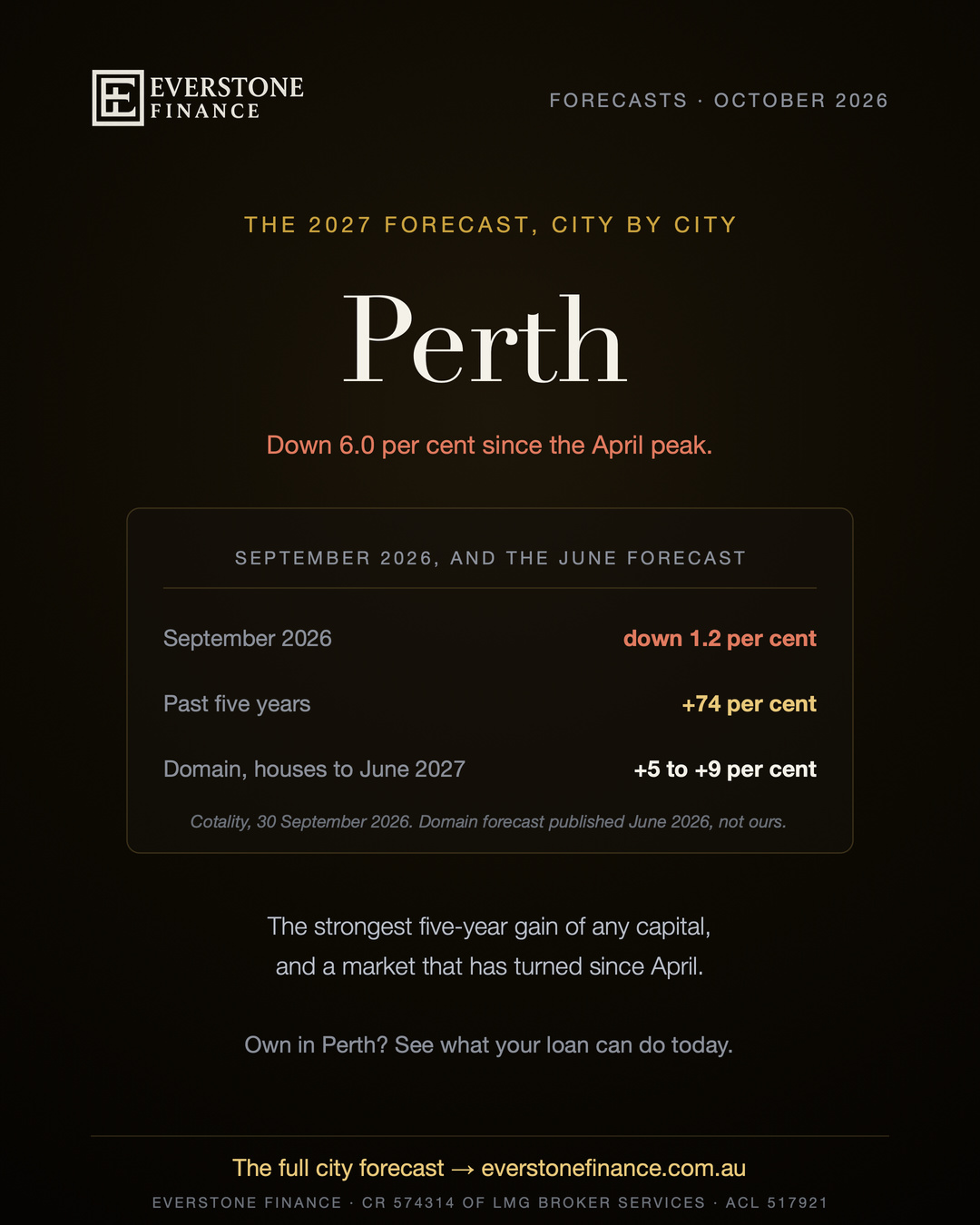
September print, added 1 October 2026. Perth dwelling values fell 1.2% in September and 4.7% over the quarter, to a median of $975,022, and now sit 6.0% below the April 2026 record. The annual figure still reads 10.1% up, second only to Darwin. Nationally, September was the sixth consecutive monthly decline, and the Reserve Bank lifted the cash rate to 4.60% on 29 September. The forecasts below are as they stood in mid-August (Domain published its forecast in June), before the August and September results and before the rate rise (Cotality Home Value Index, results as at 30 September 2026, published 1 October).
- Perth fell 4.7 per cent over the three months to September 2026, level with Brisbane and behind only Sydney, and 1.2 per cent in September. Values are still 10.1 per cent higher than a year ago and 74 per cent higher than five years ago, the strongest five-year gain of any capital, at a median of $975,022 on Cotality figures.
- The Domain FY2027 forecast, published in June 2026, had Perth house prices rising 5 to 9 per cent across the year to June 2027, the strongest forecast of any capital. Commonwealth Bank economists saw growth moderating to around 4 per cent annually by the end of 2027, and the Westpac forecast had the median reaching about $1.09 million.
- The national backdrop: the Reserve Bank lifted the cash rate to 4.60 per cent on 29 September, its fourth rise of 2026, and the four major banks passed it on from 9 October. Sales nationally over the past three months are 19.1 per cent lower than a year ago, and Perth sales are down 24.2 per cent.
- If you already own in Perth: long-term owners hold the largest five-year gain of any capital, while a home bought at the April peak that tracked the index is worth 6.0 per cent less. The two need different things from a lender. See which applies to you.
- Forecasts are the banks’ and portals’ published views, not our predictions, and they change. What they agreed on in August was that the capitals would diverge. In September every capital except Darwin fell.
Bought in Perth years ago, or near the April peak? A former banker checks what each means for your loan, free.
Send your rate, your balance and roughly when you bought. We put your loan next to the market at your equity level.
Review my Perth home loan with a former bankerWhere the Perth market is right now
Perth fell 4.7 per cent over the three months to September 2026, more than the 4.3 per cent across the combined capitals and level with Brisbane, and 1.2 per cent in September. Values are still 10.1 per cent higher than a year ago on Cotality figures, second only to Darwin, and sit 6.0 per cent below the record high of April 2026. Perth sales over the past three months are 24.2 per cent lower than a year earlier. Nationally, dwelling values fell 3.7 per cent over the quarter and capital city homes take a median 39 days to sell against 23 a year ago. In the September Cotality chart pack (data to 31 August) Perth homes were selling in a median 22 days, level with Hobart as the fastest of the capitals and up from 12 a year earlier, with total listings 53.3 per cent above year-ago levels. Perth owners who bought at the top should read what falling values do to your refinance and LVR.
Perth turned later than Sydney and Melbourne: values kept climbing into April, two months after Sydney peaked, and have fallen 6.0 per cent since. The views quoted below, as they stood in mid-August, all had it rising through 2027, on the back of mining-sector incomes and population growth that outruns building capacity. Those views predate the August and September falls and a rate rise, so the forecast question has moved from how long the rise lasts back to which way the market is heading.
The backdrop applies everywhere: the Reserve Bank has lifted the cash rate four times in 2026, to 4.60 per cent, the May budget’s investor tax changes have thinned one cohort of bidders, and both of the country’s biggest lenders have reported double-digit falls in mortgage applications since. The full five-signal picture is in our buyer’s market analysis; this page is about how those forces land in Perth specifically.
What would a lower rate save on your loan?
The comparison starts at your rate minus 0.50. Enter any figure. This is arithmetic, not an offer.
$4,066 a month at 6.40% against $3,855 at 5.90%.
Talk it through with a former bankerRather message first? WhatsApp or text Ahmed your lender, your rate and your rough balance, or call. Buying or selling in Perth instead? Ask about getting the finance settled before you commit. His own mobile, no call centre, and the first chat is free.
The 2027 forecasts, bank by bank
For Perth, Domain’s FY2027 forecast has house prices rising 5 to 9 per cent across the year to June 2027, the strongest forecast of any capital. Commonwealth Bank’s economists see growth moderating to around 4 per cent annually by the end of 2027, while Westpac’s forecast has the median reaching about $1.09 million. These are published institutional views as at August 2026, they differ because their models weight rates, migration and supply differently, and they are revised through the year, which is why the reasoning matters more than any single number.
As published in June 2026, the Domain financial-year 2027 view has Perth house prices rising 5 to 9 per cent across the year to June 2027, the strongest forecast of any capital. Commonwealth Bank’s economists see growth moderating to around 4 per cent annually by the end of 2027, while Westpac’s forecast has the median reaching about $1.09 million. Westpac’s broader forecast across the capitals has medians rising by up to $134,000 by the end of 2027, though the distribution of that rise is anything but even.
One caution on dates: every forecast here is as it stood in mid-August 2026 (Domain published its forecast in June), before two further monthly falls in Perth, including 1.2 per cent in September, and before the September rate rise, so take them as views that predate both. Read the spread honestly: forecasters disagree because the inputs genuinely are uncertain, and last year’s consensus missed in several cities. Treat every number on this page as a published institutional view with a date on it, not a promise. Our national forecast hub compares the full set side by side.
If you already own in Perth: two kinds of owner, two different questions for a lender
Perth owners fall into two groups. Those who have held for years sit on the strongest five-year gain of any capital, 74 per cent, and a refinance can price the loan against that equity or release part of it, subject to valuation and lender assessment. Those who bought near the April 2026 peak have seen values fall 6.0 per cent since, which lifts the loan-to-value ratio. Both groups carry the four cash rate rises of 2026, about $427 a month on a $700,000 loan (25 year principal and interest, average variable rate).
For the long-term owner the arithmetic is generous. A home worth about $560,000 five years ago that tracked the index is worth about $975,000 today, so a loan of $448,000 taken at 80 per cent then would be about 46 per cent of the value now, even with nothing repaid. At 46 per cent the loan sits under the lowest of the 60, 70 and 80 per cent steps some lenders price on, and a rate set when it was at 80 per cent may not reflect that. For the peak buyer it runs the other way, and the table applies the 6.0 per cent fall to four loans written in April.
| Loan-to-value ratio at the April 2026 peak | After a 6.0 per cent fall | What it usually means for a refinance |
|---|---|---|
| 60% | 63.8% | A sub-60 pricing tier may be lost where a lender has one; otherwise little changes |
| 70% | 74.5% | A pricing tier may be lost; comfortably inside 80 per cent |
| 80% | 85.1% | Over 80 per cent, where lenders mortgage insurance usually applies on a switch |
| 90% | 95.7% | Switching is rarely practical; a reprice with the current lender is the usual route |
For scale, the Reserve Bank estimated in its October 2026 Financial Stability Review that less than 1 per cent of borrowers nationally are in negative equity, with recent buyers and those on high loan-to-value ratios more likely to be among them. Even the 90 per cent loan in the table is at 95.7 per cent, not over 100.
The owner example and the table are illustrative arithmetic on the city index, and a single home can value above or below it. Whichever group you are in, the first step is the same and costs nothing: ask the current lender to reprice, which is normally assessed on the loan it already holds without a new valuation. It helps to know what other lenders would offer before you ask, which is what the call below covers. A long-term owner who wants to release equity will need a valuation, and a broker can order those with two or three lenders before any application is lodged, because valuers differ. Our guides to falling prices and your LVR and the September rate rise cover the detail, and the second has a repayment calculator.
Long-term owner or peak buyer. One short call tells you what your loan can and cannot do today.
Bring your lender, your rate and your rough balance. Ahmed, a former banker, estimates where the loan sits on current Perth values, shows what lenders on a panel of more than 40 are offering for a loan like it, and tells you whether a reprice, a switch or an equity release is worth pursuing, including when the answer is none of them. Free either way.
Check my Perth rate and equity, freeWhat actually decides Perth’s path
The drivers are structural rather than speculative: resource-sector employment pays high incomes, interstate and overseas migration keeps arriving, and Perth builds houses more slowly than it forms households. The risk side is equally structural: the market’s fortunes track commodity cycles, and values have been falling since April after a 74 per cent rise in five years.
The drivers are structural rather than speculative: resource-sector employment pays high incomes, interstate and overseas migration keeps arriving, and Perth builds houses more slowly than it forms households. The risk side is equally structural: the market’s fortunes track commodity cycles, and values have been falling since April after a 74 per cent rise in five years. The rate environment has already moved: the cash rate has risen to 4.60 per cent since these forecasts were published, so any forecast that assumed steady or easing rates through 2027 carries that assumption as its biggest risk.
What it means if you are buying or selling
For local buyers the picture has changed: values are 6.0 per cent below the April peak, sales are 24.2 per cent lower than a year ago and the median selling time in the September chart pack was 22 days against 12 a year earlier, which leaves more time to choose. For east-coast investors, our fastest-growing cities piece profiles Perth as a rentvesting destination; the gross yield is 4.0 per cent on Cotality figures and values are now falling, so run the numbers on current prices. Mining and FIFO incomes have their own assessment quirks that reward lender selection, and the sequencing basics hold: pre-approval first, then shortlist.
For local buyers the picture has changed: values are 6.0 per cent below the April peak, sales are 24.2 per cent lower than a year ago and the median selling time in the September chart pack was 22 days against 12 a year earlier, which leaves more time to choose. For east-coast investors, our fastest-growing cities piece profiles Perth as a rentvesting destination; the gross yield is 4.0 per cent on Cotality figures and values are now falling, so run the numbers on current prices. Mining and FIFO incomes have their own assessment quirks that reward lender selection, and the sequencing basics hold: pre-approval first, then shortlist. For Australians buying from overseas, our guide to buying property in Australia from overseas walks the remote version of the purchase step by step.
Held your Perth home for years? Find out how much of that growth a lender will count.
Values are 74 per cent higher than five years ago even after falling 6.0 per cent from the April peak, so a Perth home held through that period is likely to carry more equity than its loan was written against. Released through a refinance, and subject to valuation and lender assessment, part of it can fund an upgrade or the next purchase. It is also the security a bridging loan lends against if the upgrade turns up before the current home is sold. The bank versions differ in how interest is charged and who qualifies: see CBA, Westpac, ANZ, NAB and St.George bridging loans side by side. Start with how to refinance a home loan in Australia and the current cashback offers. A former banker sets out the options, free.
Growth only becomes usable when a lender values the home today, and that valuation now reflects the 6.0 per cent fall since April as well as the gain before it. Valuers differ, so the figure can vary from lender to lender. How much can be released then depends on the loan-to-value limit and on whether the larger loan passes the serviceability test at current rates. Before releasing anything, check the rate on the loan carrying the debt, or ask your current lender to reprice, because equity drawn at an uncompetitive rate costs more for as long as it is owed. The calculator shows what a rate gap costs.
Check my usable equity, freeFrequently asked questions
Will Perth property prices fall in 2027?
No one can say, and we do not predict prices. What is known: Perth values are falling now, down 1.2 per cent in September 2026 and 4.7 per cent over the September quarter, and sit 6.0 per cent below the April 2026 peak on the Cotality index. The forecasts quoted here are as they stood in mid-August 2026, before the August and September falls and before the September rate rise. At that time Domain had Perth house prices rising 5 to 9 per cent across the year to June 2027, the strongest forecast of any capital. Forecasts are revised as rates, migration and supply data land, so read them as dated views.
What do the banks forecast for Perth in 2027?
Domain’s FY27 view: house prices rising 5 to 9 per cent across the year to June 2027, the strongest forecast of any capital. Commonwealth Bank’s economists see growth moderating to around 4 per cent annually by the end of 2027, while Westpac’s forecast has the median reaching about $1.09 million. All are published views as at mid-August 2026, differ on modelling assumptions, and change with the data.
Is Perth still rising while Sydney and Melbourne fall?
No longer. Perth kept climbing until April 2026, two months after Sydney peaked, and has fallen 6.0 per cent since, including 1.2 per cent in September. Capital cities do run different cycles because their drivers differ, and Perth values are still 10.1 per cent higher than a year ago while Sydney and Melbourne are lower, but in September every capital except Darwin fell.
Is Perth still affordable after rising 74 per cent in five years?
Less than it was. The Perth median dwelling value is 975,022 dollars on Cotality figures as at 30 September 2026, the third highest of the capitals, below Sydney and Brisbane and above Melbourne at 780,550 dollars. Values have fallen 6.0 per cent from the April 2026 peak, and the four cash rate rises of 2026 have lifted repayments over the same period.
Is now a good time to buy in Perth?
Timing the market is a forecast bet; readiness is not. Current conditions, below-average clearance rates, more stock and thinner competition, measurably favour prepared buyers, and preparation, finance arranged, budget stress-tested, conditions in the contract, is what converts a soft market into a good purchase whatever 2027 brings.
Should I wait for 2027 before acting?
Waiting is a position too: it bets prices move your way, that rates cooperate, and that the property you want exists when you re-enter. The honest alternative is to get assessed now, watch with finance ready, and let the right property decide the timing rather than the calendar.
How do you access equity after Perth’s price growth?
Through a refinance. The lender values the home at the current market, which now includes the 6.0 per cent fall since April 2026 as well as the growth before it, and prices the loan against that figure. Released equity is new borrowing, so the lender also tests whether the larger loan is affordable at current rates. Within those limits it can fund the next deposit or an upgrade.
Should you refinance before releasing equity?
The two are usually reviewed together, because equity drawn on a stale rate costs more than it should for as long as it exists. Making sure the loan carrying the debt is the sharpest available comes first, and the release is then structured on a loan already working properly.
Is now a good time to refinance in Perth?
For long-held homes the valuation still works in favour of Perth owners, because values are 74 per cent higher than five years ago. For homes bought near the April 2026 peak it works the other way, since values are 6.0 per cent lower. The test is the same as anywhere, whether the saving clears the switching costs, and the savings calculator shows that in a few fields.
Have Perth property prices started falling?
Yes. On the Cotality index Perth dwelling values fell 1.2 per cent in September 2026 and 4.7 per cent over the three months to September, and sit 6.0 per cent below the record set in April 2026. They are still 10.1 per cent higher than a year earlier and 74 per cent higher than five years earlier.
I bought in Perth near the peak. Can I still refinance?
Often, but the starting ratio decides how. A loan that was 80 per cent of the value at the April 2026 peak is about 85.1 per cent after a 6.0 per cent fall, and lenders mortgage insurance usually applies above 80 per cent, so asking the current lender to reprice is normally the first step, because a reprice is normally assessed without a new valuation. A loan that started at 70 per cent is about 74.5 per cent, still under 80, so a move to another lender remains open, subject to assessment by that lender.
What do the 2026 rate rises cost on a Perth mortgage?
About 427 dollars a month on a 700,000 dollar loan across the four rises of 2026, on a 25 year principal and interest loan at the average variable rate, or about 61 dollars a month for every 100,000 dollars owed. The four major banks passed the September rise on from 9 October 2026.
The honest summary
Every forecast on this page carries a date and an assumption set, and all of them will be revised. Read alongside the September data, three things stand out for Perth: the forecasts predate two months of falls and a rate rise, conditions right now favour buyers who arrive prepared, and owners split into those holding five years of growth and those who bought near the April peak. We arrange the finance side of prepared, across more than 40 lenders, and the conversation costs nothing.
Buying in Perth this cycle? Arrive with the finance already solved.
A former banker maps your borrowing power across more than 40 lenders, stress-tests it against the forecasts, and gets pre-approval moving so the market’s timing becomes yours. Free, and honest either way.
Book a chat with a former banker- Domain: FY2027 city-by-city price forecasts
- Cotality Home Value Index, released 1 October 2026 (results as at 30 September 2026)
- Cotality Monthly Housing Chart Pack, September 2026 (selling times and listings, data to 31 August)
- Reserve Bank of Australia: cash rate target, 4.60 per cent from 30 September 2026
- Reserve Bank of Australia: Financial Stability Review, October 2026
- ABC News, 30 September 2026: the four major banks passed the rate rise on from 9 October
- Canstar: Westpac capital-city median forecasts to 2027
- Australian Property Update: ANZ 2026-27 capital city view
About the author. Ahmed Lotfi is co-founder of Everstone Finance and a former banker who now works as a mortgage and finance broker in South Yarra, Melbourne, arranging home, investment and commercial lending for clients across Australia and abroad. Everstone Finance operates under the Best Interests Duty.