

Expats: Australian Property Is Finally Falling, but Your Currency Window Is Closing. The Buy-Back Maths (2026)
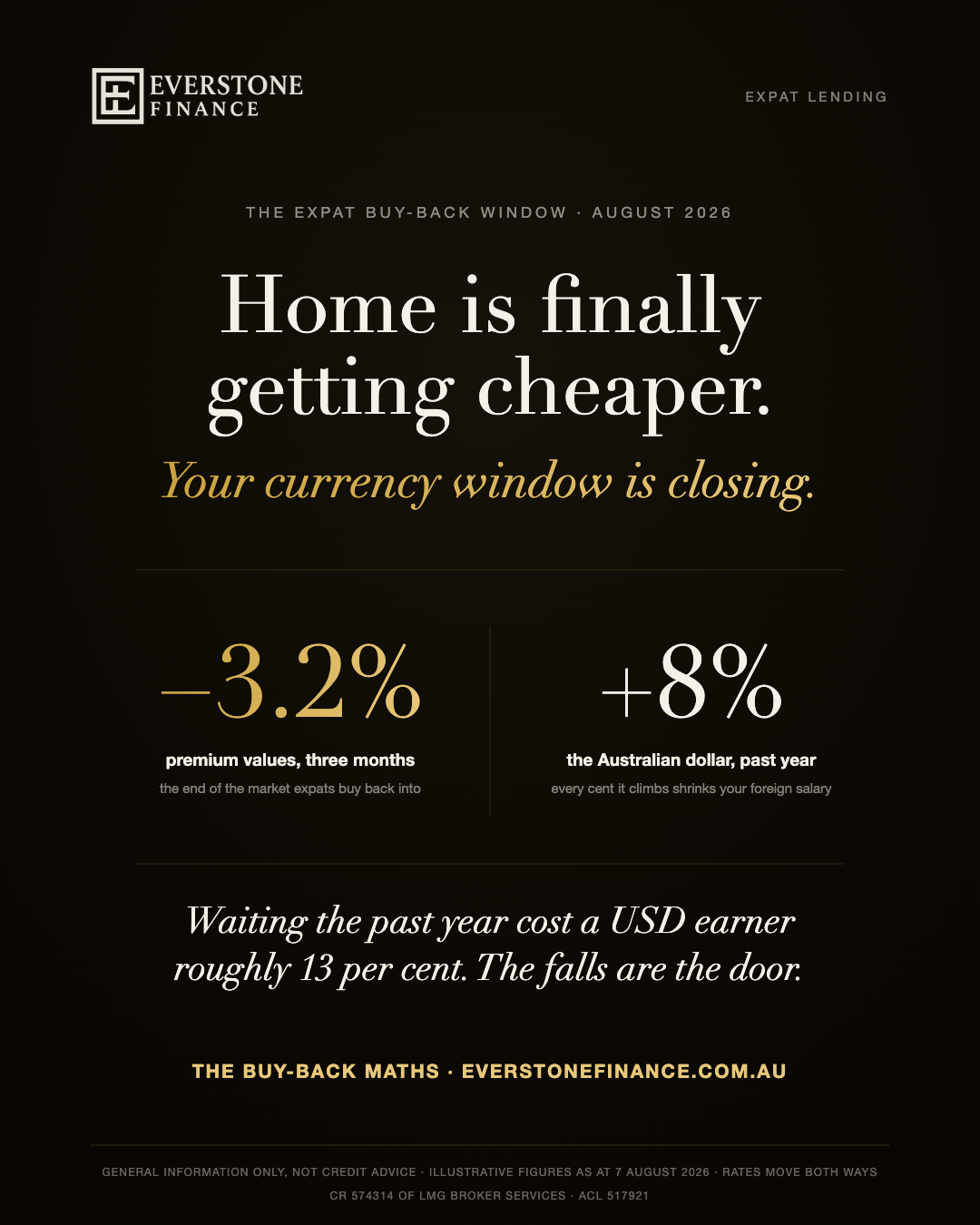
- Australian home values are falling at the fastest pace since 2022, and the falls are concentrated in the upper quartile, down 3.2 per cent in three months: the exact end of the market expats buy back into.
- Working against you: the Australian dollar has recovered roughly 8 per cent over the past year to around 70.3 US cents, near the top of its 52-week range.
- The arithmetic of waiting: over the past 12 months, prices rose about 5.3 per cent in Australian dollars while the currency rose about 7.9 per cent, so a US-dollar earner who waited paid roughly 13 to 14 per cent more for the same home. The price falls now under way are what is holding the door open.
- Expat lending is its own discipline: lenders shade foreign income, and the lender you pick changes your budget by six figures. That part is solved before you look at a single listing.
Two numbers are moving against each other
Australian expats considering buying back home in 2026 face two opposing moves: home values are falling, with the national index down 0.7 per cent in July alone and premium properties down 3.2 per cent over three months, while the Australian dollar has strengthened roughly 8 per cent over the past year to around 70.3 US cents. Falling prices improve expat buying power; the recovering currency erodes it. Over the past 12 months the currency effect dominated, making Australian property roughly 13 to 14 per cent more expensive in US dollar terms for those who waited.
If you are an Australian abroad watching home with one eye, two numbers on your screen are pulling in opposite directions.
The first is finally moving your way. Australian home values fell 0.7 per cent in July, the sharpest monthly drop since December 2022. Sydney fell 1.4 per cent and Melbourne 1.2 in a single month, auction clearances have sat under 50 per cent since May, and the downturn has spread to Brisbane, Adelaide and the regions. The full history of what downturns like this have done next is in our ninth-downturn analysis.
The second is quietly moving against you. The Australian dollar has recovered to around 70.3 US cents, up roughly 8 per cent over the past year and near the top of its 52-week range of 64.1 to 72.8 cents. Every cent it climbs makes your foreign salary and savings worth less in Melbourne or Sydney, regardless of what property prices do.
Put the two together honestly and the story is not “Australia is on sale”. It is sharper than that: the currency discount expats enjoyed for years is disappearing, and the price falls now under way are what is keeping the buy-back affordable. Waiting for the market bottom while the dollar recovers can cost more than it saves, and over the past 12 months it demonstrably did.
The end of the market that is falling is the end you buy
The July data shows Australian price falls concentrated in the upper quartile, down 3.2 per cent over three months nationally while the lowest tier rose 0.3 per cent. Expat buyers returning to premium inner suburbs are buying in exactly the falling segment, and with auction clearance rates below 50 per cent, vendors of premium property are negotiating, including with organised overseas buyers who hold pre-approval and can transact confidently from abroad.
Here is the detail that makes this window specifically an expat window. The falls are not evenly spread: over the three months to July, upper-quartile values fell 3.2 per cent nationally while the cheapest tier actually rose 0.3 per cent. First home buyers at the affordable end are getting no discount at all. The discount is concentrated in exactly the premium inner-suburb bracket that returning expats buy: the $1.2 million to $2.5 million family homes in the suburbs you left.
And with clearance rates under 50 per cent, the premium market has become a negotiation. A buyer with finance arranged, clear terms and the ability to move decisively holds cards that did not exist eighteen months ago, and none of those cards require you to be physically in the country. What they require is preparation, which is the playbook below. The full journey in order, documents to settlement, is our step-by-step guide to buying from overseas.
The buy-back maths, worked in your currency
Worked illustration for a US-dollar earner: a year ago, with the Australian dollar near 65 US cents, a $1,500,000 Melbourne home cost roughly USD $975,000. Today, after a year in which values rose about 5.3 per cent and the dollar climbed to 70.3 cents, the same home costs roughly USD $1,110,000, about $135,000 more. Even if the falls now under way take prices 3 per cent lower over the coming year, a further currency recovery can leave the USD price higher still, which is the argument against waiting for a perfect bottom.
Run one honest example, in round numbers. A premium Melbourne home was $1,500,000 a year ago, when the Australian dollar sat near 65 US cents. In your money: about USD $975,000.
Twelve months on, the honest ledger reads like this: values rose about 5.3 per cent, taking that home to roughly $1,579,500, and at 70.3 US cents it now costs about USD $1,110,000: roughly USD $135,000 more than a year ago. Waiting was expensive on both lines.
Now run the year ahead as a hypothetical. Suppose the premium falls take that home 3 per cent lower, to about $1,532,000. If the dollar keeps recovering, say to 74 US cents, the USD price is about $1,134,000: higher again, despite the fall. The currency can out-run the discount.
That is the whole argument in one table row: price falls help you only while the currency lets them. If values keep sliding and the dollar keeps recovering, the two roughly cancel; if the dollar recovers faster, waiting costs money, which is exactly what the past year did. Earn pounds, euros, Singapore or Hong Kong dollars? Run the same two lines with your own rates: the mechanics are identical even where the numbers differ.
None of this is a forecast. Currencies and prices both move both ways, and nobody times either perfectly. It is an argument for a different target: instead of timing the bottom, decide the price in your currency at which the family home makes sense, get finance ready, and act when a negotiation gets you there. In a sub-50 per cent clearance market, that number arrives more often than headlines suggest.
Where do you live? City-specific guides: London, Dublin, Hong Kong, Auckland, Singapore, Toronto, New York, Mumbai, Bali, Ho Chi Minh City, Tokyo, Dubai, Riyadh, Doha, Santiago, Los Angeles, Amsterdam, Berlin.
Overseas? Start with one email. Time zones make phone tag painful, so do not wait for a call slot: email ahmed@everstonefinance.com.au with a few lines and we reply with an honest read of where you stand, usually within a day. The link above pre-fills a short template, or copy it here:
Hi Ahmed,
I am an Australian living in [city], earning in [currency].
Status: [citizen / permanent resident]
Employment: [job title, full time / contract / self-employed]
Income: [amount per year before tax, in your local currency]
Looking to: [buy a home to return to / invest / refinance]
Target area and rough budget: [e.g. Melbourne, $1.2m]
Loan size needed: [rough amount]
Existing liabilities: [any loans or credit cards, here or in Australia, with limits, or none]
I already own property in Australia: [yes / no]
Timeline: [e.g. next 6 months]
Prefer to talk? Book a time, the calendar shows slots in your time zone, and we happily take your evening calls.
Watching from overseas? Get your number ready before you fly.
Tell us where you are, what you earn and what you are hoping to buy back. We will tell you plainly which lenders take your income at full weight, what your realistic budget is, and how to hold pre-approval so you can negotiate from abroad like you are across the table. We work with expat time zones, not against them.
Book a chat with a former bankerHow expat lending actually works, briefly
Australian lenders assess expat borrowers on foreign income that is usually shaded, commonly counting only 60 to 90 per cent of it depending on the currency and the lender, with different treatment again for tax paid overseas. The spread between the most and least generous lender can change an expat’s budget by six figures on the same payslip. Australian citizens buying from overseas generally avoid foreign-buyer surcharges that apply to non-citizens, and the full mechanics are covered in Everstone’s dedicated expat and foreign-income guides.
The short version, because we keep the deep detail on the dedicated pages: Australian lenders do not take a Singapore or New York salary at face value. Most shade foreign income, counting only a portion of it against the loan, and the portion varies dramatically by currency and lender, as does the treatment of foreign tax. On the same payslip, the gap between the most and least generous lender can be six figures of budget. That single fact is why expat purchases are won or lost at lender selection, before any property is inspected. And the policy winds keep shifting in expats’ favour: as at August 2026 one major-bank-backed lender accepts foreign overtime, allowances and bonuses in servicing and assesses Gulf salaries at their actual local tax rates, zero included; the detail lives in our expat lending guide. And the wider market case has now firmed: our five-signal buyer’s market piece shows why the expat hand is the strongest at the table.
The full mechanics live in two guides built for exactly this: our Australian expat home loans guide covers citizens buying back from abroad, including how shading works currency by currency, and our foreign income and non-resident guide covers visa holders and non-citizens, where surcharges and approvals differ. If you are an Australian citizen, the foreign-buyer surcharges you have read about generally do not apply to you.
The expat playbook: what to do from overseas, in order
An organised expat purchase runs: documents first, since foreign payslips, tax returns and bank statements take longer to assemble from abroad; lender matching before budgeting, because income shading differs; pre-approval before property hunting, so offers can be made decisively from overseas; then representation on the ground, whether trusted family, a buyer’s agent or an inspecting friend, with settlement handled remotely. Currency conversion timing is a separate decision from property timing and deserves its own plan.
- 1. Assemble the file early. Foreign payslips, employment contracts, tax returns and bank statements take longer to gather and verify from abroad. Start the paperwork before the property search, not after.
- 2. Match the lender before you set the budget. Shading rules mean your budget is not a fact, it is a function of the lender. This is the six-figure decision, and it is exactly what we do daily.
- 3. Hold pre-approval before you look. It converts you from a browser fourteen time zones away into a buyer who can sign, and in a sub-50 per cent clearance market, vendors engage with buyers who can sign.
- 4. Solve the ground game. Family for opens, a buyer’s agent for the search, building inspections ordered remotely: all normal, all solvable. Thousands of expats settle Australian purchases every year without a flight.
- 5. Plan the currency conversion separately. When to move your deposit across is a real decision with real money attached, and it is not the same decision as when to buy. Decide both deliberately rather than letting one force the other.
Frequently asked questions
Can Australian expats get a home loan while living overseas?
Yes. Australian citizens living abroad can borrow from Australian lenders for property at home. The difference from a local application is how foreign income is assessed: most lenders shade it, counting only a portion, and policies vary widely, which makes lender selection the decisive step.
Is now actually a good time for expats to buy back in Australia?
Prices are falling, especially in the premium segment expats buy, while the Australian dollar has recovered about 8 per cent over the past year. Over the last 12 months rising values and a recovering dollar compounded, so waiting proved expensive in foreign-currency terms. Whether now suits you depends on your income, plans and horizon; the honest approach is a target price in your currency rather than an attempt to time the bottom.
Do expats pay foreign buyer surcharges?
Australian citizens generally do not, even while living overseas. The surcharges that make headlines apply to foreign nationals, and some visa categories sit in between: our foreign income and non-resident guide covers those cases in detail.
How much of my foreign salary will a lender count?
Commonly somewhere between 60 and 90 per cent, depending on the currency you earn in and the lender’s policy, with foreign tax treated differently again from lender to lender. The spread between lenders on the same income is large enough to change a budget by six figures, which is why the comparison comes first.
Can I complete the whole purchase without flying home?
Yes. Pre-approval, offers, contracts, building inspections and settlement can all be handled remotely, with a buyer’s agent or trusted family covering physical inspections. Expats settle Australian purchases from abroad every day.
Should I wait for the Australian dollar to fall again before buying?
That is currency speculation, and we do not offer it. What the past year shows is that waiting carries its own cost when the dollar recovers. The sturdier approach is deciding what the right home is worth in your currency, preparing finance, and acting when negotiation reaches your number.
Does my foreign tax rate affect my Australian borrowing power?
It can. Some lenders assess foreign income using Australian tax scales, others use the actual tax you pay, and the difference matters most in low-tax jurisdictions like Singapore, Hong Kong and the Gulf. It is one of the policy details that separates the right expat lender from the wrong one.
What deposit do I need as an expat buyer?
Structurally the same as local buyers, commonly 20 per cent to avoid Lenders Mortgage Insurance, though some lenders cap expat lending at lower LVRs. Equity in an existing Australian property can also do the work. The dedicated expat guide covers the combinations.
The honest summary
For years the weak Australian dollar quietly subsidised every expat purchase, and that subsidy is being withdrawn at the same moment the property market is finally offering a genuine discount, concentrated precisely in the homes expats come back for. Nobody can promise which force wins next year. What the past twelve months already proved is that waiting is not free. Decide your number in your currency, get the lending solved by someone who knows which banks respect a foreign payslip, and let a falling, negotiable market come to you.
The dollar is not waiting. Neither are the vendors.
One conversation from wherever you are: which lenders take your income at full weight, your real budget in both currencies, and pre-approval that lets you negotiate from abroad with local confidence. Former bankers, plain answers, expat time zones respected.
Book a chat with a former bankerAbout the author. Ahmed Lotfi is co-founder of Everstone Finance and a former banker who now works as a mortgage and finance broker in South Yarra, Melbourne, arranging home, investment and commercial lending for clients across Australia, including expatriates buying from abroad. Everstone Finance operates under the Best Interests Duty as Credit Representative 574314 of LMG Broker Services Pty Ltd, Australian Credit Licence 517921.