

Rents Hit $705 a Week (Q2 2026): The Arithmetic Every Renter Should See
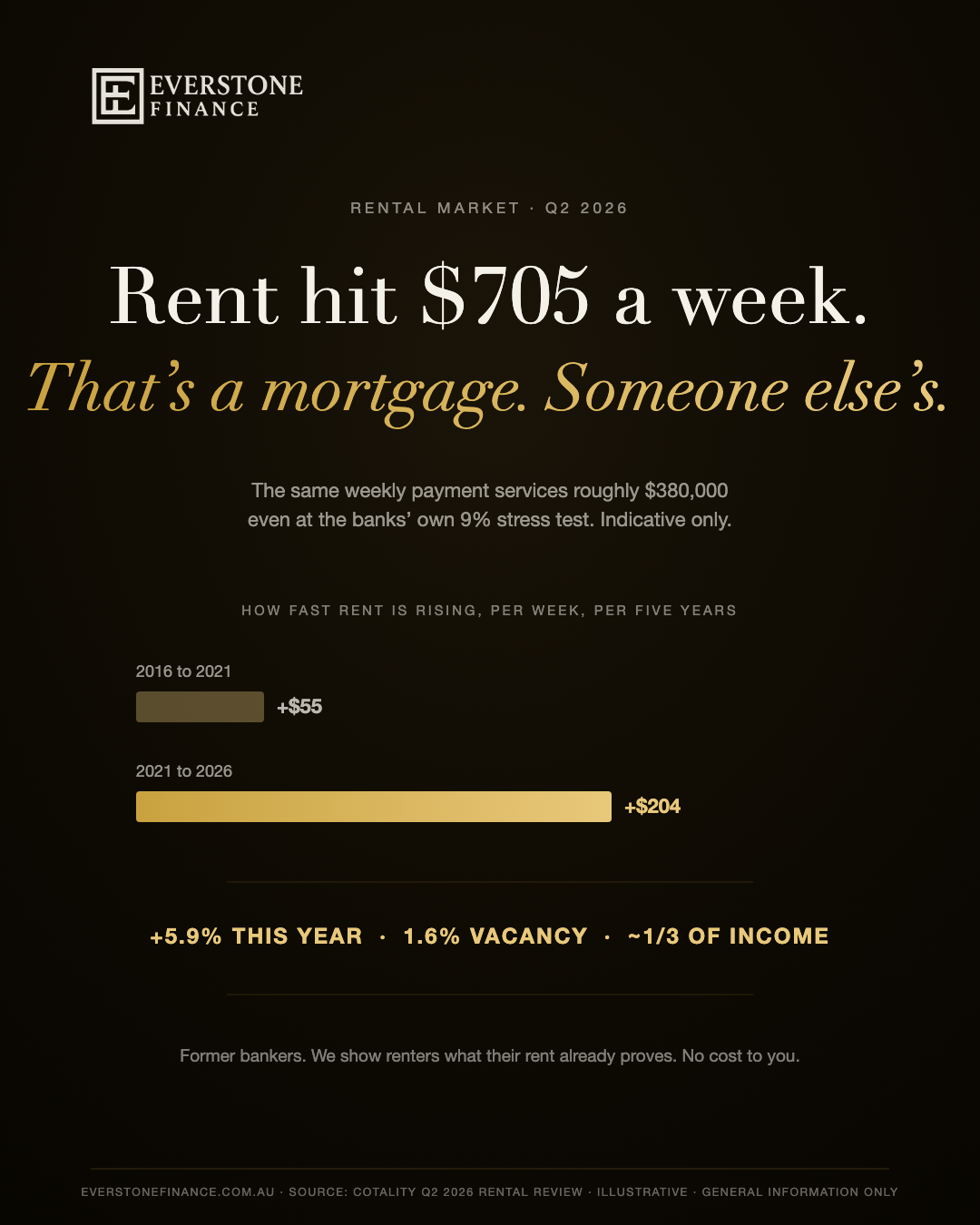
Cotality’s Q2 2026 Rental Review landed this week, and the national numbers are blunt: the median Australian rent is now $705 a week, up 5.9 per cent in a year, with vacancy at 1.6 per cent and listings running about 17 per cent below average. But the figure that stops people is the acceleration: national rents have climbed roughly $204 a week in five years, against about $55 in the five years before that, and the typical renting household now hands over roughly a third of its gross income in rent, up from about 27 per cent five years ago. Every article written about this data this week will tell renters what they already know: it is expensive, and supply takes years to fix. This one does something different. It runs the arithmetic on what that $705 a week actually is, a repayment, currently building someone else’s equity, what the same money would service on a mortgage under today’s lending tests, and what a clean rental ledger is genuinely worth when you sit down with a lender. Written by former bankers, for the people paying the rents in that table. And for renters weighing another path entirely, our rentvesting guide maps buying where the growth is while renting where your life is. For what record rents mean if you are on the ownership side, our step-by-step guide to buying an investment property in 2026 runs the arithmetic. The shortage driving it is quantified state by state in our housing shortfall analysis. Census night on 11 August will ask every renter to write their number down: our piece on the census questions worth checking first covers what five years did to the answers.
- National median rent is $705 a week (Cotality, Q2 2026), up 5.9 per cent in a year; Sydney sits at $841, Melbourne at $641.
- Rents rose roughly $204 a week over five years, versus about $55 the five years prior, and renters now pay about a third of gross income.
- As a repayment, $705 a week services an indicative $380,000 loan even at the 9 per cent testing rate, and around $510,000 at today’s actual rates. Illustrative only.
- A clean rental ledger is evidence lenders can use, and eligible first home buyers can enter with a 5 per cent deposit and no LMI under the federal guarantee.
- Book a chat with a former banker, most renters we help start planning 6 to 12 months before they buy.
- What the Q2 2026 Rental Review shows, city by city
- The acceleration: $55 then, $204 now
- What your rent would service as a mortgage
- What a clean rental ledger is worth to a lender
- The Melbourne wrinkle: cheapest rents, softest prices
- The renter’s exit plan, planned properly
- Frequently asked questions
What the Q2 2026 Rental Review shows, city by city
National median rent reached $705 a week in Cotality’s Q2 2026 Rental Review, up 5.9 per cent annually, with vacancy at 1.6 per cent. Sydney is priciest at $841, Perth ($784, up 7.8 per cent) and Brisbane ($734) are closing fast, Darwin rose 10.1 per cent, and Melbourne is the cheapest capital at $641 a week. And on the buy side, Melbourne now sits closer to affordable than any big capital, per our 2026 affordability league table. Purchase prices have meanwhile turned: our ninth-downturn analysis covers the June fall and the 30-year pattern behind it.
Here are the capitals as Cotality reports them, and the spread matters as much as the headline:
| Region | Median rent | Annual change | Gross yield | Vacancy |
|---|---|---|---|---|
| Sydney | $841 | +5.9% | 3.3% | 1.9% |
| Melbourne | $641 | +4.9% | 3.9% | 1.3% |
| Brisbane | $734 | +6.4% | 3.3% | 1.9% |
| Adelaide | $662 | +4.8% | 3.5% | 1.0% |
| Perth | $784 | +7.8% | 3.7% | 1.3% |
| Hobart | $632 | +8.6% | 4.4% | 1.9% |
| Darwin | $725 | +10.1% | 6.1% | 1.3% |
| Canberra | $706 | +3.2% | 4.2% | 1.7% |
| Combined capitals | $739 | +6.0% | 3.5% | 1.6% |
| National | $705 | +5.9% | 3.7% | 1.6% |
Figures per Cotality’s Q2 2026 Rental Review, all dwellings. Medians are market statistics, not any individual property’s rent. This is general information, not advice.
Two patterns worth naming. First, the growth is broad: every capital rose over the year, with the resource cities running hottest, Darwin at 10.1 per cent and Perth at 7.8 per cent. Second, Melbourne is now the cheapest capital city to rent in, $641 against a combined-capitals figure of $739 and a full $200 a week below Sydney. We will come back to why that matters for Melbourne renters specifically, because it sits next to another fact about this city that almost nobody has put in the same sentence.
The acceleration: $55 then, $204 now
Per Cotality’s review, national rents rose roughly $204 a week across the past five years, against about $55 across the five years before, close to a four-fold acceleration. Vacancy sits at 1.6 per cent against a five-year average of 1.8, listings run about 17 per cent below normal, and the typical renting household now pays roughly a third of its gross income in rent.
Rent has always crept. What changed is the gear. Between 2016 and 2021, national rents added about $55 a week in total, a pace household incomes broadly absorbed. In the five years since, they added roughly $204 a week, and the share of gross income a typical renting household hands to a landlord moved from about 27 per cent to roughly a third. That is not a market blip, it is a structural repricing, and the drivers in the review are stubborn ones: vacancy at 1.6 per cent versus a five-year average of 1.8, and total listings about 17 per cent below average nationally, with Sydney and Darwin more than 24 per cent short.
The uncomfortable implication is the one every renter feels at lease renewal: none of these forces resolve quickly, because the fix is supply, and supply is measured in years. We do not make forecasts, and this article will not pretend to know next year’s number. What we can say as lending people is subtler and more useful: the same squeeze that makes renting harder also changes the maths of leaving it, in ways most renters have never had shown to them properly. That is the rest of this article.
Paying rent and wondering what it would service as a mortgage? WhatsApp, text or call Ahmed and talk it through. His own mobile, no call centre, and nothing touches your credit file until you choose a lender.
What your rent would service as a mortgage
Treated purely as a repayment, $705 a week services an indicative loan of roughly $510,000 at today’s rates around 6 per cent, and still roughly $380,000 at the 9 per cent-plus rate lenders must test you at. Real borrowing power also depends on income, expenses and commitments, but the rent line most renters dismiss is doing mortgage-sized work already.
Here is the exercise almost nobody runs for renters. Take the rent you already pay, every week, through every rate cycle, and ask what it would service if it were a mortgage repayment instead. Two answers matter: what it services at today’s actual rates around 6 per cent, and what it services at the roughly 9 per cent-plus testing rate lenders must apply under APRA’s serviceability buffer, because that second number is the one that decides approvals. Clearly labelled: everything in this table is illustrative only, a straight rent-for-repayment swap over 30 years, before income, living expenses and other commitments enter a real assessment.
| Weekly rent | As monthly repayment | Indicative loan at ~6% | At the 9%+ testing rate |
|---|---|---|---|
| $600 | ~$2,600 | ~$435,000 | ~$325,000 |
| $705 (national median) | ~$3,055 | ~$510,000 | ~$380,000 |
| $841 (Sydney median) | ~$3,645 | ~$610,000 | ~$455,000 |
| $1,000 | ~$4,335 | ~$725,000 | ~$540,000 |
Illustrative only. Assumes 30-year principal and interest, rounded to the nearest $5,000; rates and the APRA buffer change over time; lenders assess income, expenses, debts and deposit alongside repayments. This is general information, not credit advice or a recommendation to buy.
Read the middle row slowly. The median Australian renter is already making, week in and week out, a payment that would sustain a loan of roughly $380,000 under the harshest test in the system, and roughly half a million dollars at the rates actually charged. The difference between those payments is not the amount, it is the direction: one builds the landlord’s equity, the other would build yours. And unlike a mortgage, which ends, the review’s own data shows rent compounding at 5.9 per cent a year with no fixed term and no final payment.
None of this means buying beats renting for everyone, and we refuse to pretend otherwise: deposits, stamp duty, maintenance, rates and flexibility all belong in an honest comparison, and our city-by-city repayment guide and deposit guide put real numbers on both. What it does mean is that “I could never afford a mortgage” deserves an actual test rather than an assumption, because for a growing share of renters, the repayment is the part they are already proving.
What a clean rental ledger is worth to a lender
More than most renters think. A consistent rental history is evidence of payment discipline, at some lenders a documented rental ledger can support the genuine savings requirement, and the federal First Home Guarantee lets eligible buyers purchase with a 5 per cent deposit and no LMI. The deposit hurdle is real, but it is lower and more navigable than rent-trap arithmetic suggests.
The standard renter’s objection to everything above is the deposit, and it is a fair objection: saving while paying $705 a week is precisely the trap. But the lending system has more doors than most renters know exist:
- Your ledger is evidence. Twelve months of clean, on-time rent through an agent is a documented payment history, and at some lenders it can help satisfy the genuine savings requirement that otherwise demands months of visible saving. It also strengthens the overall story an assessor reads. Policies differ by lender, which is exactly the kind of detail we check before an application goes anywhere.
- The First Home Guarantee changes the deposit maths. Under the federal scheme, eligible first home buyers purchase with as little as a 5 per cent deposit and no LMI, because the government guarantees part of the loan. On a $600,000 purchase that is $30,000 of deposit rather than $120,000, a target measured in a year or two of disciplined saving rather than a decade.
- Professionals carry their own key. If you work in one of the occupations on lender eligibility lists, doctors, nurses, lawyers, accountants and more, a 10 per cent deposit with no LMI may be available regardless of first-home status, mapped in our 90 per cent waiver guide.
- Family guarantees skip the cash deposit entirely where parents can offer security, set up carefully with advice.
Stack those honestly and the picture shifts: the renter paying the national median is often not years of deposit away from the loan their rent already services, they are one properly structured plan away from knowing the real distance. Knowing beats assuming, and the check costs nothing.
The Melbourne wrinkle: cheapest rents, softest prices
Melbourne renters hold an unusual double: the cheapest capital city rents in the country at $641 a week, and a property market whose premium end has just printed the nation’s largest monthly falls. Cheapest rent to pay while saving, softer prices to buy into, and the lowest-competition conditions in years, all at once.
Now put the two halves of this week’s data together, because nobody else has. Cotality’s rental review makes Melbourne the cheapest capital city to rent in, $641 a week against Sydney’s $841 and Brisbane’s $734. And Cotality’s June medians, which we unpacked in our price-falls analysis, show Melbourne’s premium suburbs printing the country’s largest monthly declines, with buyers thinned out by the 9 per cent test and vendors meeting the market.
For a Melbourne renter with buying ambitions, that is a rare alignment: the lowest rent burden in the capital-city system while you save, house prices that have drifted rather than sprinted, and a buyer pool at multi-year lows. It will not hold forever, alignments never do, and we make no prediction about which half moves first. But if there were ever a market where the renter-to-owner runway is shortest, the data says it is this one, this year, in this city. Melbourne’s 1.3 per cent vacancy also means the alternative, staying put, keeps getting repriced against you at renewal.
The renter’s exit plan, planned properly
Most renters who become owners with us start 6 to 12 months out, not application-ready. Everstone Finance maps the real gap: what your rent proves, what deposit you actually need under the schemes you qualify for, which lenders read your file best, and the saving runway to get there. Former bankers, no cost, no credit check to plan.
Here is what we actually do for renters, and why the conversation is worth having before you feel ready rather than after. We take your real numbers, rent, income, savings rate, and answer the questions this article can only gesture at: what you could service under the current tests, which schemes you qualify for, whether your profession carries a waiver, how your rental ledger can work for you, and, most usefully, the honest distance between today and a realistic purchase. Sometimes the answer is “you could move now”. More often it is a 6 to 12 month runway with a concrete savings target and a plan, which is exactly the planning-ahead conversation our booking page promises: no documents, no credit check, no obligation.
What you will not get is pressure, or a prediction dressed as advice. Whether buying suits you is your decision, made on your circumstances; our role, under the Best Interests Duty, is making sure the decision runs on real numbers instead of renewal-day resignation. The lender pays us on settlement, so the planning costs you nothing, and if the honest answer is that renting still suits you, you will hear that too.
Find out what your rent already proves
Bring your weekly rent and your income. We will show you what it services under today’s tests, which schemes and waivers you qualify for, and the real distance to a deposit. No cost, no credit check, no obligation.
Book a chat with a former bankerFrequently asked questions
How much did rents rise in Australia in 2026?
Per Cotality’s Q2 2026 Rental Review, the national median rent reached $705 a week, up 5.9 per cent over the year. Every capital rose: Darwin led at 10.1 per cent and Hobart at 8.6, Perth added 7.8 per cent to $784, Sydney remains priciest at $841, and Melbourne is the cheapest capital at $641. Vacancy sits at 1.6 per cent with listings about 17 per cent below average.
Is it cheaper to buy than rent in 2026?
It depends on the property, the deposit and your circumstances, and anyone giving a blanket answer is selling something. What the data supports is narrower: the median national rent of $705 a week matches the repayment on an indicative loan of roughly $510,000 at current rates, so for many renters the repayment side of ownership is already being paid. Deposits, stamp duty and upkeep belong in any honest comparison.
What size mortgage would my rent cover?
As a straight repayment swap over 30 years, roughly $435,000 at current rates for $600 a week of rent, $510,000 for $705, and $725,000 for $1,000, falling to about $325,000, $380,000 and $540,000 respectively at the 9 per cent-plus rate lenders must test against. These are illustrative conversions only; a real assessment adds income, expenses and commitments, which is a check we run at no cost.
Does my rental history help me get a home loan?
Yes, more than most renters expect. A documented history of on-time rent is evidence of payment discipline, and at some lenders a clean rental ledger can help satisfy the genuine savings requirement that applies to small-deposit loans. Policies differ between lenders on how much weight it carries, which is exactly the kind of policy detail worth checking before you apply anywhere.
How can I buy with a small deposit while renting?
Three main doors: the federal First Home Guarantee lets eligible first home buyers purchase with a 5 per cent deposit and no LMI; professional LMI waivers at select lenders let eligible occupations buy with 10 per cent down; and family guarantees can remove the cash deposit where parents offer security. Each has criteria, and matching you to the right one is standard broker work, at no cost.
Will rents keep rising?
We do not make forecasts. What the review shows is the pressure behind recent rises: vacancy at 1.6 per cent against a five-year average of 1.8, listings about 17 per cent below normal, and supply that takes years to build. Those conditions ease slowly, which is why planning an exit on your own timeline tends to beat waiting for the market to provide one.
Does it cost anything to talk to a broker if I am not ready to buy?
No, and not-ready is our most common starting point: most renters we help begin planning 6 to 12 months before a purchase. The conversation involves no credit check and no obligation, the lender pays our commission if and when a loan eventually settles, and the Best Interests Duty binds any recommendation to your interests. Planning early simply means the strategy is ready when you are.
Lease renewal coming up? That is the natural moment to check the other path. Book a time with a former banker before you sign for another year, and make the decision with both numbers in front of you.
Sources
Related guides
About the author. Ahmed Lotfi is co-founder of Everstone Finance and a former banker who now works as a mortgage and finance broker in South Yarra, Melbourne, arranging home, investment and commercial lending for clients across Australia. Everstone Finance operates under the Best Interests Duty as Credit Representative 574314 of LMG Broker Services Pty Ltd, Australian Credit Licence 517921.
Rent is a repayment. Point it somewhere.
One conversation turns renewal-day resignation into a plan with a date on it. Your numbers, the real tests, the honest distance. That is the whole offer.
Book a chat with a former banker