

Alan Kohler Says the Tradie Shortage Is the Housing Crisis (2026): The Numbers, and What 20 Flat Years Would Do to Your Mortgage
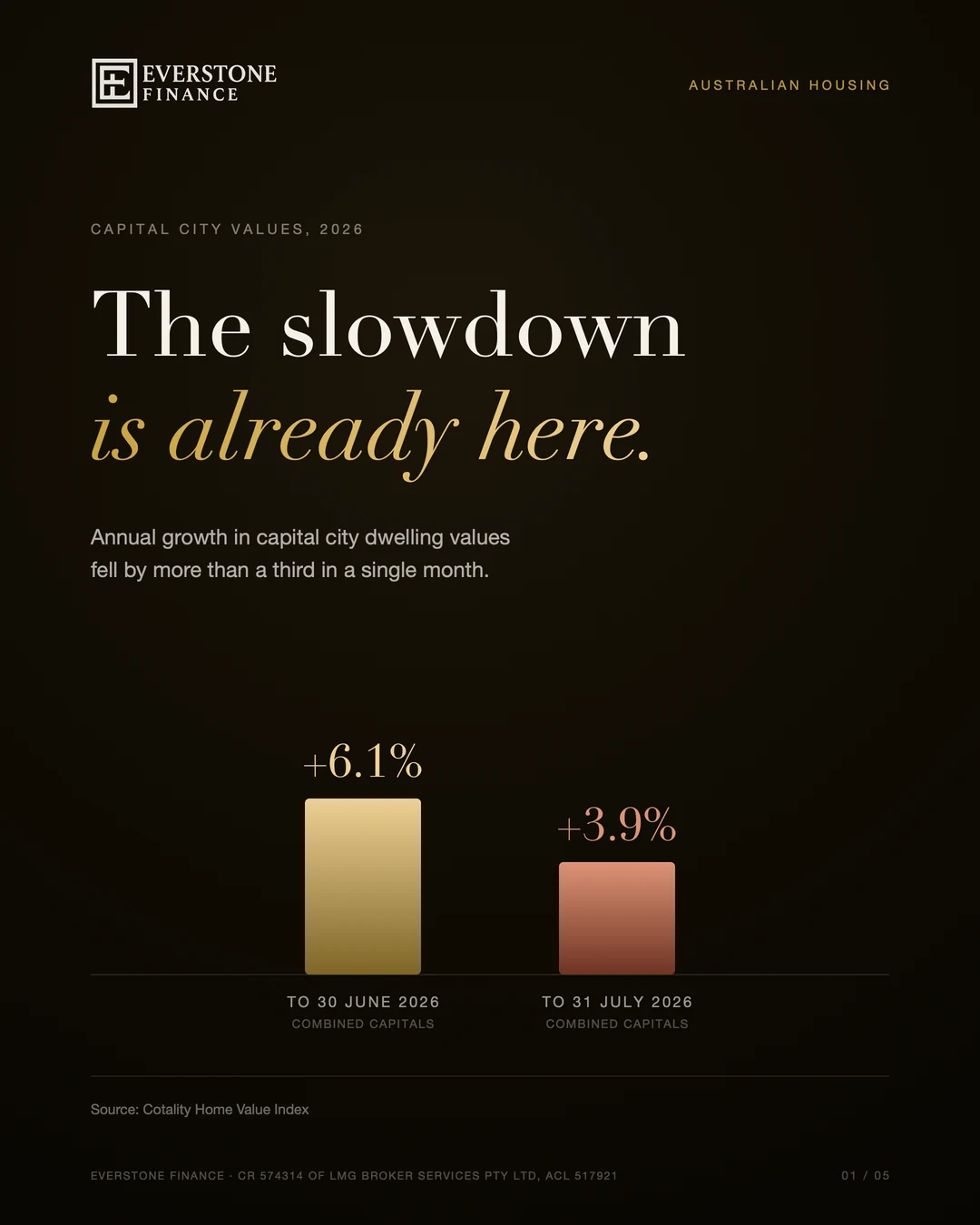
Annual growth in capital city dwelling values, year to 30 June 2026 against year to 31 July 2026. Source: Cotality Home Value Index.
- Alan Kohler told news.com.au on 20 August 2026 that the shortage of construction workers, rather than tax settings or migration numbers, is the single biggest force behind Australia’s housing crisis.
- BuildSkills Australia, the federal Jobs and Skills Council for construction, puts the gap at 116,700 extra residential construction workers beyond business as usual to reach 1.2 million homes by mid 2029.
- The Housing Industry Association estimates more than 83,000 additional skilled trades workers, roughly a 30 per cent lift on current levels.
- Migration is doing less of this work than most people assume. Only about 3 per cent of the 233,601 people on a subclass 482 skilled visa at 30 September 2025 held a home building trade occupation.
- Two claims circulating with this story do not survive checking, and we set out why below.
- If Kohler is right that prices stay flat for a long stretch, the parts of the equation you still control are the rate you pay and how fast you retire the principal.
Alan Kohler has spent decades translating the Australian economy for people who do not read balance sheets for a living. In an interview published by news.com.au on 20 August 2026, he was asked to name the single biggest force behind the housing crisis. He did not say negative gearing. He did not say migration numbers. He said we do not have enough people to build the houses.
That is an unusual answer, and it is worth taking seriously, because it is the one part of the problem that no interest rate decision can fix quickly. It is also worth checking. Two of the specific figures now circulating alongside this story do not hold up against the primary sources, and one of them is contradicted by the very database it came from. We have set out what the numbers actually say below, then answered the question that matters if you already have a mortgage or you are trying to get one.
This article does not forecast prices, and it does not tell you whether to buy. It tests the labour numbers, and it explains what a long flat stretch would mean for the loan you are carrying.
The claim, and what the numbers actually say
The labour constraint is real, and it is large. The most authoritative figure comes from BuildSkills Australia, the federal Jobs and Skills Council for the construction industry. Its 2025 Housing Workforce Capacity Study, published on 18 September 2025, estimates that residential construction needs an extra 116,700 workers beyond the business as usual pipeline if Australia is to reach the National Housing Accord target of 1.2 million new homes by mid 2029.
The Housing Industry Association reaches a similar conclusion by a different route. Its All Hands on Deck analysis, first published in October 2024 and reaffirmed as recently as 26 August 2026, puts the requirement at more than 83,000 additional skilled trades workers across the twelve occupations that matter most in home building, which is about a 30 per cent lift on current employment in those trades.
Worth noting before going further: both are industry estimates tied to a build target, not measured counts of unfilled jobs, and both organisations are actively arguing for expanded construction migration. That does not make the numbers wrong. It does mean they should be read as advocacy-adjacent research rather than as government statistics.
One correction, because it matters and because it is being repeated. The figure attached to this story in much of the coverage is 115,000 workers, attributed to Kohler. The underlying study says 116,700, and Kohler himself has elsewhere cited BuildSkills at about 117,000. The 115,000 version appears to be a rounding that has taken on a life of its own. It is a small difference in magnitude and a meaningful one in sourcing, because quoting a commentator quoting a study is not the same as quoting the study.
There is a thread running through all of this that rarely gets pulled. The proposed fix is largely a migration fix, which means the housing conversation and the moving to Australia conversation are the same conversation. If you are reading this from abroad and weighing a purchase back home, we have a separate guide to buying property in Australia while living overseas, which covers how lenders treat foreign income and what changes when you are not resident.
Australia has among the least housing per person in the developed world, but it is not going backwards
This is where the popular version of the story overshoots, and where we think being accurate is more useful than being dramatic.
The claim circulating is that Australia is one of only five nations going backwards on housing supply. That number cannot be sourced. The Grattan Institute analysis it rests on says four, consistently, across every version of the document we could find. More importantly, the underlying data has moved on. Grattan’s chart draws on the 2022 edition of the OECD Affordable Housing Database. The current edition of that database, last updated on 15 April 2024, shows Australia at 419.99 dwellings per 1,000 people in 2022, up from 402.99 in 2011. The OECD notes the measure rose in all but six countries over that period, and Australia is not among the six.
So the honest version is comparative rather than directional. Australia has just over 400 dwellings per 1,000 people on Grattan’s analysis of OECD and ABS data, which places it 24th of the 30 developed countries on its chart, against an OECD average of about 468. Grattan’s own body text describes this as having stalled, and its “gone backwards” phrasing applies to housing stock per adult, a different denominator that looks worse largely because the population is ageing.
That is still a poor result. Australia builds slowly and owns comparatively little housing per head. It is simply not the same as a stock that is shrinking, and a mortgage broker telling you the sky is falling is a mortgage broker with something to sell. If you want the size of the gap rather than the international comparison, we have covered Australia’s housing gap by state separately, and the dollar version of the affordability problem sits in how far Melbourne and Sydney are from affordable.
The shortage is not an abstraction, either. It is already being paid for, mostly by renters, which we set out in the rent arithmetic every renter should see.
Wondering what a long flat market would mean for your own mortgage or the purchase you are weighing? WhatsApp, text or call Ahmed and talk it through. His own mobile, no call centre, and the first chat is free.
Why the workers cannot simply be imported
If the constraint is people, the obvious answer is to bring in more of them. The data suggests that lever is being pulled far more gently than the debate implies.
On Housing Industry Association analysis of Department of Home Affairs data, submitted to the Joint Standing Committee on Migration in December 2025, only about 3 per cent of the 233,601 people holding a subclass 482 skilled visa in Australia at 30 September 2025 held a home building trade occupation. Read the other way around, in HIA’s March 2026 Trades Report, 482 visa holders sponsored by construction amounted to less than 1 per cent of Australia’s total construction workforce.
The processing settings tell a similar story. Under Ministerial Direction 119, in effect from 25 July 2026, construction occupations sit in the third of five visa processing priority levels, alongside healthcare and teaching, and only where the applicant is already in Australia when they apply. Applicants outside Australia fall to the fifth and lowest priority. It is worth being precise about what that instrument does: it is a direction under section 499 of the Migration Act that sets the order in which applications are picked up, and it states expressly that it does not change the composition of the skilled occupation lists. It is a queue, not a quota.
To put a number on what one worker represents, Master Builders Australia modelling released on 1 August 2026 estimates that a skilled migrant working in residential construction across a 30 year career can contribute to building 21 detached homes, worth roughly $1.9 million in gross value added. That is a modelled figure resting on an uninterrupted career, published by an industry body arguing for expanded construction migration, and it is useful mainly as a sense of scale.
The part that is already visible in the data
Whatever you make of the labour argument, something is already happening to growth. On the Cotality Home Value Index, annual growth in combined capital city dwelling values ran at 6.1 per cent in the year to 30 June 2026. One month later, in the year to 31 July 2026, that had fallen to 3.9 per cent. Over the July quarter itself, combined capital values fell 2.5 per cent.
The selling conditions underneath tell the same story. The median vendor discount across the combined capitals widened to 3.9 per cent in the three months to July, from 3.2 per cent in the three months to April. Median time on market across the capitals stretched to 33 days, from 26. Gross rental yields nationally reached 3.72 per cent, the highest since April 2023, as rents kept rising while values eased.
None of that proves a twenty year thesis. Markets decelerate and reaccelerate, and Australia has been through nine housing downturns in thirty years, which we have documented in what the last eight housing downturns did next. It does mean the flat scenario is not hypothetical arithmetic. It is a description of the market people are transacting in right now.
If Kohler is right about 20 flat years, what actually changes
Kohler’s view, put to news.com.au on 20 August 2026, is that the only tolerable path back to affordability is house prices staying broadly stagnant for around twenty years while incomes catch up. He is explicit that he is not calling for a crash, arguing that a fall large enough to restore historical affordability would do severe economic damage. That is his view rather than a forecast we make or endorse, and the bank economists currently publishing numbers do not all agree with him, as set out in what the banks actually forecast for the next two years.
Take the scenario seriously for a moment though, because it changes the mechanics of a mortgage in a way that is rarely discussed.
For most of the past three decades, capital growth did the heavy lifting on an Australian mortgage. You could pay a mediocre rate on a mediocre structure and still finish well ahead, because the asset moved underneath you. In a flat decade that engine is switched off. What remains are the two things that were always in your control and were easy to ignore while prices were running: the interest rate you pay, and how quickly you retire the principal.
Those are not small levers. On a long loan, the difference between a competitive rate and a lazy one compounds across the full term, and every dollar sitting in an offset reduces the interest calculated daily. When growth is doing the work, that difference is a rounding error against your equity. When growth is not doing the work, it is close to the whole return. This is a statement about how amortisation behaves, not a recommendation about what you should do.
The practical consequence is that a flat market makes reviewing an existing loan more worthwhile, not less. If it has been a couple of years, it is worth understanding when you should actually refinance, and the break even rule before assuming your current lender is still competitive. If you would rather see the arithmetic on your own numbers first, you can run your own numbers on what a lower rate saves.
And if the question in your head is really about timing rather than structure, that is a different question with a different answer, which we have written up in why readiness beats timing the market.
What this means if you are buying from overseas
There is a particular reading of this for Australians living abroad and for foreign buyers, and it follows directly from the supply argument.
A market with constrained new supply, firm rents and subdued capital growth is a different proposition depending on what you are buying for. It is harder work if you are relying on growth. It is more navigable if you are buying for yield, or if you are earning in a currency that is currently strong against the Australian dollar, because the entry price is effectively discounted and the rental side of the equation is holding up. Gross yields at 3.72 per cent nationally, the strongest since April 2023, are a function of exactly the squeeze Kohler is describing.
The mechanics of borrowing from offshore are their own subject, and they are where most of the friction sits. Lenders shade foreign income, and the treatment varies considerably by currency and by lender. Our guide to buying property in Australia from overseas covers how that assessment works, and if you already hold an Australian loan while living abroad, refinancing an Australian mortgage remotely from overseas is usually the faster win.
City capacity matters here too, because the trades constraint is not evenly spread. If you want a conversation grounded in a particular market, we work with clients through a mortgage broker in Melbourne and a mortgage broker in Adelaide, among other cities.
What we would look at with a client
These are the questions a former banker asks when the growth assumption comes out of the model. They are general questions, not recommendations, and the right answer depends entirely on your circumstances.
- When was your rate last actually tested against the market, as opposed to compared with the rate you started on?
- Is your loan structured so that surplus cash reduces interest daily, or is it sitting somewhere it does nothing?
- If values went sideways for five years, would your plans still work, or do they quietly depend on growth?
- If you are buying, is your position strong enough that timing becomes a preference rather than a constraint?
- If you are earning offshore, which lenders treat your currency and income type most favourably?
The market is doing less of the work. Your loan can do more.
We are former bankers. We will look at what you are actually paying, what your structure is costing you, and whether a review is worth your time. No cost to you.
Book an appointmentA conversation with a former banker, not a call centre.
Common questions
How many extra tradies does Australia need to build enough homes?
BuildSkills Australia, the federal Jobs and Skills Council for construction, estimates residential construction needs an extra 116,700 workers beyond business as usual to reach the National Housing Accord target of 1.2 million homes by mid 2029. The Housing Industry Association puts the figure at more than 83,000 additional skilled trades workers, about a 30 per cent lift on current levels. Both are industry estimates tied to that build target, not measured counts of unfilled jobs.
Is housing supply per person in Australia going backwards?
Not on the current data. The OECD Affordable Housing Database, last updated 15 April 2024, shows Australia at 419.99 dwellings per 1,000 people in 2022, up from 402.99 in 2011. What is well supported is that Australia has among the least housing per person in the developed world, just over 400 per 1,000 on Grattan Institute analysis of OECD and ABS data, against an OECD average of about 468, and that growth over the past two decades has been among the slowest of any developed country.
Can skilled migration fix the tradie shortage?
It is doing less than most people assume. Only about 3 per cent of the 233,601 people holding a subclass 482 skilled visa in Australia at 30 September 2025 held a home building trade occupation, on Housing Industry Association analysis of Department of Home Affairs data. Under Ministerial Direction 119, in effect from 25 July 2026, construction sits in the third of five visa processing priority levels, alongside healthcare and teaching, and only where the applicant is already in Australia. Applicants outside Australia fall to the fifth and lowest priority.
If house prices stay flat, does a mortgage still make sense?
The question changes rather than disappears. When capital growth is not doing the work, the parts you still control are the interest rate you pay, the structure of the loan and how fast you retire the principal. That is why a flat market tends to make reviewing an existing loan more worthwhile, not less. Whether buying suits you at all depends on your own circumstances, and this is general information rather than advice.
Does a tradie shortage mean house prices will keep rising?
Not automatically, and Everstone Finance does not forecast prices. A labour constraint limits how quickly new homes can be delivered, which is one input into supply. Prices also respond to interest rates, incomes, credit conditions and population, and Australia has had nine housing downturns in thirty years. Alan Kohler has argued publicly that prices could stay flat for a long stretch. That is his view, not a forecast we make or endorse.