

Home Loans for Police, Firefighters and Paramedics (2026): Your Overtime Counts
Police officers, firefighters and paramedics are among the most reliably employed borrowers in Australia, yet they are routinely quoted less borrowing power than an office worker on a similar package. The reason hides inside lender credit policy: a large share of a first responder’s income arrives as overtime, shift penalties and allowances, and many lenders only count part of it. Select lenders count all of it. This guide explains how first responder home loans in Australia actually work in 2026: how much of your overtime different lenders count, what that means for your borrowing power, and the honest answer on LMI waivers (first responders do not get one), written by former bankers who read credit policy for a living. Whether you are looking for a police home loan, a firefighter home loan or a paramedic home loan, the mechanics below are the same, and so is the fix. Paramedics get a section of their own further down, because paramedic pay is set employer by employer rather than on one national scale.
- Overtime, shift penalties and allowances make up a big share of first responder pay.
- Many lenders count only part of that income, commonly around 80 per cent, and some exclude allowances.
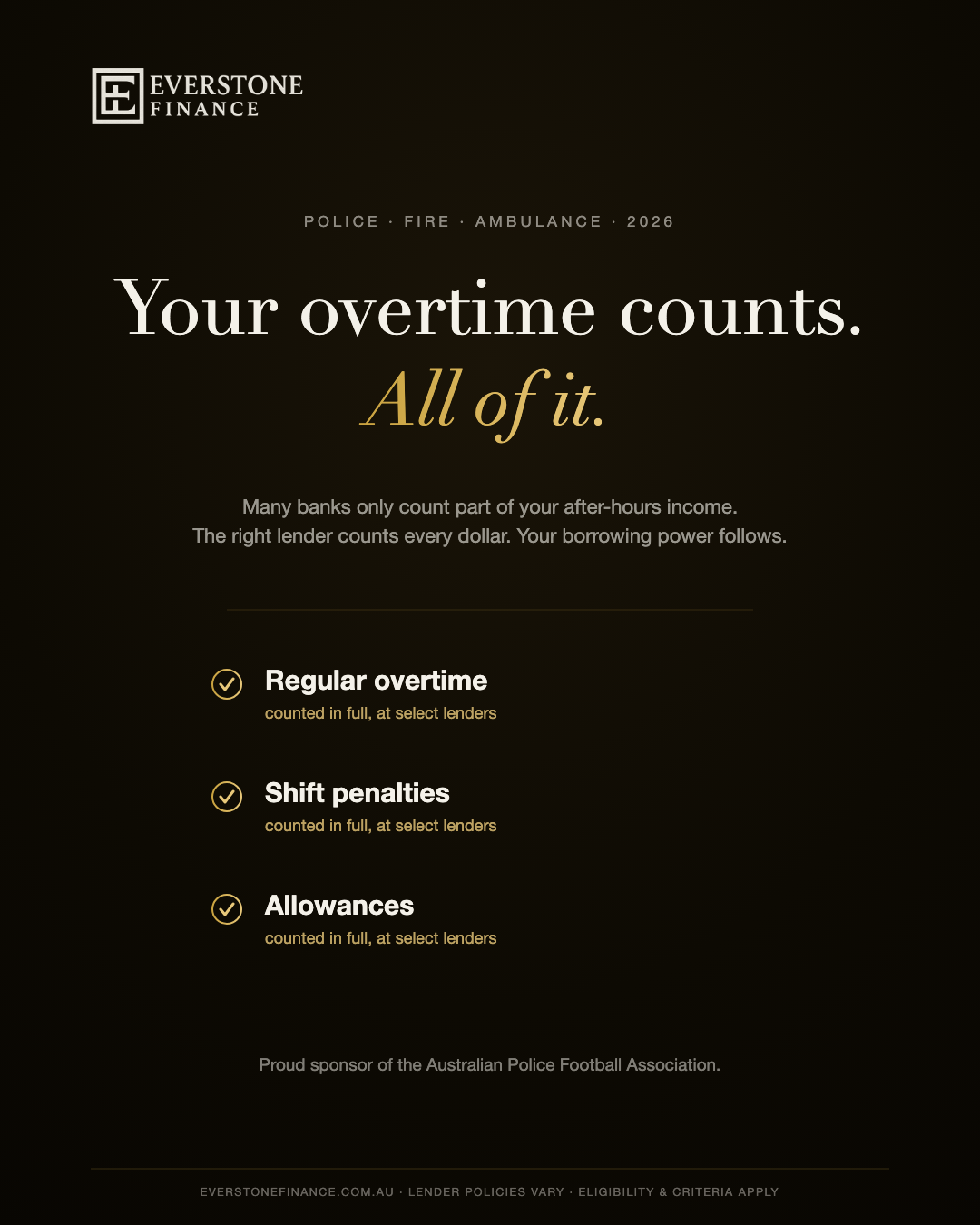
- Select lenders count 100 per cent for essential workers, which can materially lift borrowing power.
- There is no profession LMI waiver for first responders. The real win is income treatment.
- Paramedics are registered nationally but paid under state enterprise agreements, so the payslip a lender reads varies by employer.
Overtime, penalties and allowances: how much of yours would a lender count? A former banker gives you the figure, free.
Two recent payslips and your roster pattern are enough. We compare how lenders treat that income and what it does to your borrowing power.
Check my income with a former banker- Why is first responder income treated differently by banks?
- How much of your overtime do lenders actually count?
- How much borrowing power does full overtime recognition add?
- Do police, firefighters or paramedics get an LMI waiver?
- What documents do shift workers need for a home loan?
- What is different for paramedics?
- Why first responders work with Everstone
- Frequently asked questions
Why is first responder income treated differently by banks?
Because credit policy treats variable income more cautiously than base salary. Overtime, shift penalties and allowances are classed as variable, so many lenders count only part of them, commonly around 80 per cent, and some exclude allowances altogether. Select lenders treat essential worker overtime as reliable and count 100 per cent of it.
Banks price risk, and credit policy is where they write it down. Base salary is contractual, so every lender counts it in full. Overtime, penalties and allowances sit in a different box called variable income, and variable income has historically made credit teams nervous, because for many borrowers it genuinely is variable. A retail worker’s overtime can disappear the month after a loan settles. So a cautious rule found its way into many lenders’ policy manuals: count only part of variable income, commonly around 80 per cent, and treat certain allowances as noise to be excluded from the calculation entirely.
The problem is that first responder pay does not behave like that. If you are a police officer, a firefighter or a paramedic, shift work is not an occasional extra, it is the structure of the job. Overtime and penalty rates are built into rosters, embedded in enterprise agreements, and remarkably consistent from one year to the next. For many first responders they add up to a substantial share of total income, sometimes rivalling the base salary itself. Treating that income as if it might evaporate misreads how emergency services actually pay their people. Mining and FIFO crews face the same shading on an even bigger pay packet, covered in our FIFO and mining home loans guide.
The result is that the same payslip can be read two very different ways. A lender applying a conservative policy sees a modest base salary with some discounted extras on top. A lender with a dedicated essential worker policy sees the full, stable income of someone whose employment is about as secure as employment gets in Australia. Neither lender is breaking its own rules; the rules are simply different, and the difference lands squarely on your borrowing power.
That is why this guide keeps returning to one idea. The win for a police home loan, a firefighter home loan or a paramedic home loan is rarely a special product, a badge or a headline discount. It is having your income assessed by a lender whose policy recognises how you are actually paid. Everything else in this article flows from that single point.
How much of your overtime do lenders actually count?
It varies by lender far more than most borrowers expect. Base salary is counted in full everywhere. Regular overtime and shift penalties are commonly shaded to around 80 per cent by conservative lenders, and some allowances can be excluded altogether. Select lenders count up to 100 per cent of all three for essential workers.
The honest answer is that it depends on the lender, and the spread is wide. Broadly, the market splits into two camps. Conservative credit policies commonly count around 80 per cent of regular overtime and shift penalties, and can exclude certain allowances from assessable income altogether. Other lenders run specific essential worker policies that count regular overtime, penalties and allowances at up to 100 per cent, provided the income is clearly regular and properly documented. How bonuses, commission and allowances are read, and what the regulator says about variable pay, is in our guide to home loans with overtime and shift income.
| Income type | Conservative lender | Select lenders, essential workers |
|---|---|---|
| Base salary | 100% | 100% |
| Regular overtime | Often around 80% | Up to 100% |
| Shift penalties | Often around 80% | Up to 100% |
| Allowances | Can be excluded | Up to 100% |
Indicative only, not a loan offer. How each lender treats your income also depends on how consistent your overtime history is and how it is documented. This is general information, not credit advice.
Two details in that table deserve emphasis. First, the conservative column is framed as commonly and can be, not always, because policies genuinely differ and they move over time. Second, the right hand column is not a special deal you have to negotiate. It is standing credit policy at select lenders that recognise essential workers, a category that typically covers police, firefighters, paramedics and other emergency services and health shift workers. The catch is that you have to know which lenders run those policies, and how each one defines regular overtime, and that is exactly the kind of detail that never appears on a comparison website.
There is also a consistency test hiding underneath the percentages. Most lenders, generous and conservative alike, want to see that overtime and penalties are an established pattern rather than a purple patch. A year or more of consistent history, visible in year-to-date payslip figures and your tax return, is what turns your overtime from a question mark into countable income. We cover the paperwork in detail further down.
How much borrowing power does full overtime recognition add?
Potentially tens of thousands of dollars. If a lender counts only 80 per cent of $30,000 in regular overtime, $6,000 of real income is ignored, and at typical serviceability multiples that can translate into roughly $30,000 or more of lost borrowing power. The example is illustrative only, but the mechanism is real.
Here is the arithmetic, with a clear label on it first: everything in this section is illustrative only. It is not a quote, not an offer and not a prediction of what any lender will approve for you.
Say a paramedic earns a base salary of $85,000 plus $30,000 a year in regular overtime and shift penalties, numbers that would not look out of place on an ambulance roster. A lender that shades overtime to 80 per cent assesses $24,000 of that $30,000, so $6,000 of real, taxed, repeatable income is simply ignored. A lender with a 100 per cent essential worker policy assesses the lot.
Why does $6,000 of income matter so much? Because serviceability, the calculation lenders use to work out what you can repay, effectively translates each dollar of assessable income into several dollars of borrowing capacity. At the multiples commonly produced by serviceability calculators, $6,000 of ignored income can mean roughly $30,000 or more of lost borrowing power, and the gap widens again if allowances are excluded on top of the overtime shading. For a couple who are both shift workers, the effect compounds across two incomes. Illustrative only, every part of it, but the mechanism is real and it moves real purchase budgets.
Two practical points follow. First, none of this requires you to earn a single extra dollar. The income already exists; the question is whether the lender assessing your application is allowed by its own policy to count it. Second, the effect is invisible if you only ever apply to one lender. A low pre-approval from a conservative lender just looks like the truth, and most borrowers never find out that a different credit policy would have read the same payslip differently.
Police, firefighter or paramedic, and unsure how much of your overtime a lender would count? WhatsApp, text or call Ahmed around your shifts. His own mobile, no call centre, and the first chat is free.
Do police, firefighters or paramedics get an LMI waiver?
No. There is no profession-based LMI waiver for police, firefighters or paramedics, unlike doctors and some other professions. Deposit-side help comes instead from the Australian Government 5% Deposit Scheme (formerly the Home Guarantee Scheme) or a family guarantee, both open to eligible buyers generally. The genuine first responder advantage sits in income treatment, not LMI. Senior federal public servants do hold a version, explained in our public servant home loans guide, but it does not extend to police.
This is the point where a lot of marketing content goes soft, so we will be direct: no, first responders do not get a profession-based LMI waiver. Doctors and a short list of other professionals can borrow above 80 per cent of a property’s value without paying lenders mortgage insurance at some lenders. Police, firefighters and paramedics are not on that list. If a page promises you a special 95 per cent no-LMI police deal because of your badge, treat it with suspicion. We have written a full guide to who actually qualifies for an LMI waiver in Australia, and first responders, honestly, are not in it.
That does not leave you without deposit-side options. It just means the options are the same ones available to other eligible buyers:
- The 5% Deposit Scheme. Under the Australian Government scheme, eligible first home buyers can purchase with as little as a 5 per cent deposit and pay no LMI, because the government guarantees part of the loan. It is not profession-specific, but plenty of first responders use it.
- A family guarantee. If a parent can offer part of their own property as additional security, a family guarantee can remove the need for LMI even with a small cash deposit. It suits some families and not others, and it needs to be set up carefully.
- A 20 per cent deposit. At or below an 80 per cent loan-to-value ratio, LMI does not apply to anyone, profession or not.
The reason we are blunt about this is simple. Chasing a waiver that does not exist wastes weeks. Putting the same energy into the thing that genuinely varies for first responders, how much of your overtime and allowances a lender will count, is what actually moves your budget. Trust is also the currency of this job, and we would rather tell you the unvarnished version now than have you discover it at approval time.
What documents do shift workers need for a home loan?
Recent payslips showing year-to-date income, your PAYG payment summary or tax return showing a full year of overtime, and often an employment letter confirming your role and that overtime is regular. Twelve or more months of consistent overtime history makes it far easier for a lender to count your income in full.
Lenders can only count what they can see and verify, and for shift workers the paperwork carries more weight than usual, because the income you most need counted is the variable part. The core set of documents is short:
- Recent payslips with year-to-date figures. Usually your last two or three. The year-to-date line matters most, because it shows overtime and penalties as an ongoing pattern rather than a lucky fortnight.
- PAYG payment summary or tax return. A full financial year of income demonstrates that the overtime is consistent, not a one-off. Lenders commonly compare it against your year-to-date figures to confirm the run rate.
- An employment letter. Some lenders ask for a letter confirming your role, length of service and that overtime or shift allowances are a regular condition of the job. Emergency services HR departments produce these routinely.
The single most useful habit is keeping 12 or more months of consistent overtime history before you apply. Consistency is what converts variable income into countable income in a credit assessor’s eyes, and a clean, well documented year of payslips and tax records does more for your file than any covering letter.
Timing can help too. Early in a financial year, year-to-date figures naturally look thin, and a quiet roster period just before an application can drag your averages down. None of that changes what you actually earn, but it changes what the documents show, and a broker who works with shift workers will time the application, or lean on full-year documents, so the paperwork tells the true story.
What is different for paramedics?
Two things. Paramedics are registered health practitioners, registered nationally with the Paramedicine Board of Australia and listed on the public register that AHPRA maintains, so the credential is the same wherever you work. Pay is the opposite. There is no single national paramedic pay scale, because base rates, penalties and allowances are set by the enterprise agreement covering your employer, and that is the document sitting behind the payslip a lender reads.
Paramedicine became a nationally registered profession on 1 December 2018. Since that date a paramedic must hold registration with the Paramedicine Board of Australia and meet its registration standards in order to practise here, that registration is recognised in every state and territory, and every registered paramedic appears on the public register of practitioners managed by AHPRA. In 2024/25 the Board recorded 26,603 registered paramedics, up 5.0 per cent on the year before, making up 2.8 per cent of all registered health practitioners in Australia.
The national credential is where the sameness ends. Your base rate, your penalty rates, your on call arrangements and your allowances are set by the enterprise agreement that covers your employer, and that agreement is the document a credit assessor is effectively reading behind your payslip. Two paramedics with identical registration, doing the same clinical work in different states, can put very different looking pay documents in front of a lender.
Which agreement sets your pay, state by state
| State or territory | Ambulance employer | Where the pay document is published |
|---|---|---|
| VIC | Ambulance Victoria | Ambulance Victoria Enterprise Agreement 2020 (PDF), hosted by Ambulance Employees Australia Victoria |
| NSW | NSW Ambulance | NSW Ambulance Paramedics (State) Award 2023 (PDF), published by NSW Health |
| QLD | Queensland Ambulance Service | Queensland Ambulance Service Certified Agreement 2022, on the UWU Ambo Hub |
| SA | SA Ambulance Service | Enterprise agreement covering SA Ambulance Service |
| WA | St John WA | St John Ambulance Western Australia officers and paramedics agreement, on the UWU Ambo Hub |
| NT | St John NT | St John Ambulance Enterprise Agreement (NT) 2022 to 2025, on the UWU Ambo Hub |
| TAS | Ambulance Tasmania | Enterprise agreement covering Ambulance Tasmania |
| ACT | ACT Ambulance Service | Enterprise agreement covering ACT Ambulance Service |
These are public documents, linked because they are useful to read. Everstone Finance is not affiliated with, endorsed by or partnered with any union, professional association or ambulance service, and none of them has any part in our lending recommendations. Agreements are replaced periodically, so confirm the current version with your employer or your union.
The United Workers Union Ambo Hub gathers agreements and resources for Victoria, Queensland, Western Australia and the Northern Territory on one public page, including the Queensland Ambulance Service Certified Agreement 2022, the St John Ambulance Enterprise Agreement (NT) 2022 to 2025, a 2024 Ambulance Victoria agreement and the St John Ambulance Western Australia officers and paramedics agreement. Not every paramedic works for a state service either. If you are employed in non-emergency patient transport or elsewhere in the private sector, your terms may instead sit under the Ambulance and Patient Transport Industry Award 2020, published by the Fair Work Ombudsman, which carries its own allowances, overtime and penalty rates clauses.
Why this matters for your overtime
Open one of those documents and the pattern from earlier in this guide is impossible to miss. The NSW award, to take one example, sets out paramedic allowances, a climatic and isolation allowance, employees on call, overtime, penalty rates for shift work and weekend work, and annual leave loading as separate entitlements, each with its own clause. Every one of those lines is real money arriving in your account, and every one of them is the kind of income a conservative credit policy is inclined to shade or exclude.
So the paramedic version of this article’s central point is a practical one. Take your payslip and the agreement sitting behind it, work out how much of your pay is base and how much is penalties, overtime and allowances, and then make sure the lender assessing you reads that split the way your employer wrote it. That is a credit policy question rather than a paperwork question, and it is the same lever described in how much of your overtime lenders actually count above. The night shifts, the weekend work and the on call hours are already in your pay. The only question is whether they are in your assessment.
Why first responders work with Everstone
Because income treatment is a credit policy problem, and we read credit policy for a living. Everstone Finance is run by former bankers, is a proud sponsor of the Australian Police Football Association, and arranges lending for police, firefighters and paramedics across Australia at no cost to you, paid by the lender on settlement.
Everstone Finance is a proud sponsor of the Australian Police Football Association (APFA). That partnership exists because we work with police and other emergency services members week in, week out, and we wanted to back their community properly rather than just write articles about it.
The practical reason first responders come to us is narrower. We are former bankers, and income assessment policy is home ground. We know which lenders shade overtime, which ones count it in full for essential workers, and how each of them wants a shift worker’s file presented, down to the year-to-date reconciliation and the wording of the employment letter. Instead of applying blind and letting a conservative policy read your payslip for you, we match your income to the right lender’s policy before anything is lodged. That is the whole trick, and it is not a trick at all, just preparation.
There is no cost to you for any of this. Like most Australian mortgage brokers, we are paid a commission by the lender when your loan settles, and our recommendation must meet the Best Interests Duty, which legally requires us to act in your interests rather than any lender’s. If you want the broader picture on how lenders treat different occupations, our guide to home loans for professionals in Australia is a good companion to this one.
Find out what your income is really worth to a lender
Send us a payslip and we will tell you honestly how different lenders would assess your overtime, penalties and allowances, and what that means for your budget. No cost, no obligation.
Book a chat with a former bankerFrequently asked questions
Do police get special home loans in Australia?
Not in the way many marketing pages suggest. There is no profession-based LMI waiver for police, and no special police interest rate. What genuinely varies between lenders is how much of your overtime, shift penalties and allowances they count as income. Select lenders count 100 per cent of regular overtime and allowances for essential workers, and that difference in income treatment is the real lever for police borrowing power.
Is overtime counted for a home loan?
Yes, most lenders count regular overtime, but not always in full. Many apply a discount, commonly counting around 80 per cent of overtime income, and some want to see a consistent history before counting it at all. Select lenders count 100 per cent of regular overtime for essential workers such as police, firefighters and paramedics, which is why lender choice matters so much for shift workers.
How much of my overtime will a bank count?
It depends entirely on the lender’s credit policy. Conservative policies commonly count around 80 per cent of regular overtime and shift penalties, and can exclude some allowances altogether. Select lenders count up to 100 per cent for essential workers. The difference can move your borrowing power by tens of thousands of dollars, so it is worth checking policy before you apply anywhere.
Do shift allowances and penalties count as income for a mortgage?
Often, but treatment varies more than most borrowers expect. Some lenders count shift penalties and allowances in full where they are a regular, ongoing part of your pay, others apply a discount, and some exclude certain allowances entirely. Payslips and a tax return showing a consistent history make it much easier to have this income counted. A broker can match your pay structure to a lender that recognises it.
Do first responders get an LMI waiver?
No. There is no profession-based LMI waiver for police, firefighters or paramedics in the way there is for doctors and some other professions. Deposit-side help comes from other routes instead: the Australian Government 5% Deposit Scheme lets eligible first home buyers purchase with a 5 per cent deposit and no LMI, and a family guarantee can remove LMI for buyers whose parents can offer security.
What documents do I need as a shift worker?
Typically your two or three most recent payslips showing year-to-date figures, your PAYG payment summary or tax return showing overtime history across a full year, and sometimes an employment letter confirming your role, tenure and that overtime is a regular part of it. Keeping 12 or more months of consistent overtime history makes your income much easier for a lender to count in full.
Does it matter which ambulance service I work for?
Not for your registration, which is national, but it does change the document behind your payslip. Paramedic pay is set by state enterprise agreements rather than one national scale, so Ambulance Victoria, NSW Ambulance, Queensland Ambulance Service, SA Ambulance Service, St John in WA and the NT, Ambulance Tasmania and ACT Ambulance Service each set base rates, penalties and allowances their own way. A lender still assesses your income from payslips and tax records, so what matters is how clearly the split between base pay and variable pay is documented.
Are paramedics registered health practitioners?
Yes. Since 1 December 2018 paramedics must be registered with the Paramedicine Board of Australia and meet its registration standards in order to practise in Australia, and every registered paramedic appears on the public register maintained by AHPRA. Registration is recognised in every state and territory. It confirms your profession, but it does not set your pay, which comes from the enterprise agreement covering your employer.
Does it cost anything to use a broker?
No. Everstone Finance is paid a commission by the lender when your loan settles, so there is no fee to you for our service, and our recommendation must satisfy the Best Interests Duty, which requires us to act in your interests rather than any lender’s. You get former bankers reading credit policy for you at no cost.
Rostered on nights and short on time? That is exactly what a quick, no-cost chat is for. Book a time with a former banker and we will work around your shifts, look at your payslips and tell you plainly how your income stacks up.
Sources
Related guides
About the author. Ahmed Lotfi is co-founder of Everstone Finance and a former banker who now works as a mortgage and finance broker in South Yarra, Melbourne, arranging home, investment and commercial lending for clients across Australia. Everstone Finance operates under the Best Interests Duty.
Get your overtime counted, not discounted
You know what you earn. The next step is making sure a lender counts it, and that comes down to policy, preparation and presentation. That is what we do, at no cost to you.
Book a chat with a former banker