

FIFO and Mining Home Loans in Australia (2026): Getting Your Full Income Counted
Mining pays better than any other industry in Australia, and mining workers still get some of the strangest outcomes at the bank. A FIFO operator earning well into six figures can be quoted less borrowing power than a city office worker on two thirds of the money, and the reason is never the income itself. It is how the income is read. Site allowances, overtime, shift loadings and bonuses make up a large share of a mining pay packet, and lenders disagree, sharply, about how much of that to count. Add a casual employment contract or a property in a single-industry town and the spread between lenders widens again. This guide covers how FIFO and mining home loans in Australia actually work in 2026: which parts of your payslip different lenders count, what changes with casual and contract roles, where the property itself changes the answer, and the honest word on LMI waivers (miners do not get one), written by former bankers who read lender credit policy for a living.
- Mining tops the ABS earnings tables, yet site allowances, overtime and bonuses are often only partly counted by lenders.
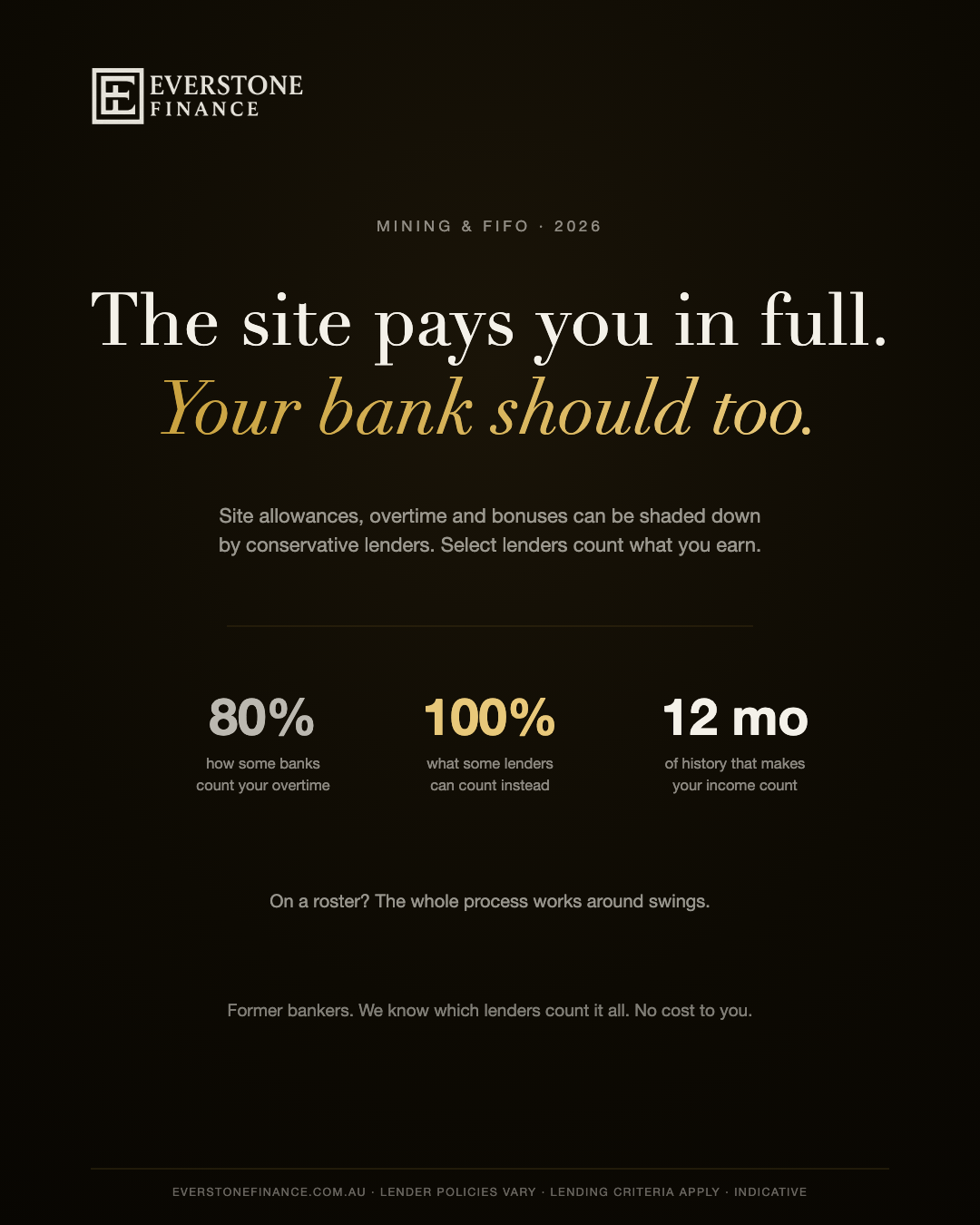
- Conservative lenders commonly shade variable income to around 80 per cent, and some exclude certain allowances entirely.
- At some lenders, regular, well-documented allowances and overtime can be counted in full, which materially lifts borrowing power.
- There is no LMI waiver for mining workers. The real lever is income treatment, plus the deposit paths open to everyone.
- Book a chat with a former banker about how your payslip would be assessed.
Why do lenders read FIFO income differently?
Because a large share of mining pay is classed as variable income, and lenders treat variable income cautiously. Site allowances, overtime, shift loadings and bonuses sit outside base salary, so many lenders shade them down or exclude parts of them, while others count regular, documented components in full. The same payslip can support very different loans.
Mining is consistently the highest-paying industry in the Australian Bureau of Statistics average weekly earnings tables, and FIFO rosters are a big part of why. The compensation for working a 2 and 1 roster in the Pilbara is built from layers: a base salary, then site allowances, remote area uplifts, shift loadings, overtime and, in good years, production bonuses. For many workers those layers add up to a substantial share of total income, sometimes approaching the base itself.
Credit policy was not written with that pay structure in mind. Base salary is contractual, so every lender counts it in full. Everything above it lands in the variable income box, and variable income makes credit teams cautious, because for many borrowers it genuinely comes and goes. So a familiar rule appears in many policy manuals: count only part of overtime and allowances, commonly around 80 per cent, and treat some allowances as noise to be excluded altogether. It is the same conservatism we unpacked for police, firefighters and paramedics, applied to a bigger pay packet.
The problem is that FIFO income does not behave like a retail worker’s occasional Saturday shift. Allowances are written into site agreements, rosters repeat all year, and the so-called variable income arrives with industrial regularity. A lender that reads the payslip mechanically sees a modest base with unreliable extras. A lender that reads it properly sees the actual income of one of the country’s best-paid workforces. Both are following their own policy; only one of them is seeing your real borrowing power.
That is the whole game for a mining borrower. Not a special product, not a discount for hi-vis, just the difference between a lender that counts what you genuinely earn and one that quietly deletes a slice of it. Everything below flows from that single point.
Which parts of a mining pay packet do lenders count?
Base salary is counted in full everywhere. Regular overtime and shift loadings are commonly shaded to around 80 per cent by conservative lenders, site and remote allowances can be excluded entirely, and bonuses are usually averaged across two years and discounted. At some lenders, regular and well-documented components can be counted in full.
Here is the pattern, component by component, with the standard caveat: every lender writes its own credit policy, policies change, and this table describes the market’s shape rather than any one lender’s rules.
| Income component | Conservative lender | At some lenders |
|---|---|---|
| Base salary | 100% | 100% |
| Regular overtime and shift loadings | Often around 80% | Up to 100% where regular and documented |
| Site and remote area allowances | Can be excluded | Counted where ongoing and evidenced |
| Production and performance bonuses | Averaged and discounted | Counted with a consistent history |
| Casual loading | Treated cautiously | Recognised with sufficient work history |
Indicative only, not a loan offer. How each lender treats your income also depends on how consistent the history is and how it is documented. This is general information, not credit advice.
The arithmetic behind that table is worth making concrete, clearly labelled: the following example is illustrative only, not a quote or a prediction. Take a FIFO operator on a $95,000 base with $45,000 a year in allowances, loadings and regular overtime, a perfectly ordinary Pilbara pay packet. A lender that shades the variable component to 80 per cent assesses $36,000 of the $45,000, so $9,000 of real, taxed, repeating income vanishes from the application. At the multiples serviceability calculators commonly produce, that can translate into tens of thousands of dollars of lost borrowing power, before any allowance is excluded outright. For a couple with two mining incomes, the effect compounds.
What turns variable income into countable income is evidence of regularity: payslips showing year-to-date figures that back the pattern, a tax return or payment summary confirming a full year of it, and, when a lender asks, an employment letter confirming the roster and that allowances are a standing condition of the role. Twelve or more months of consistent history is the practical benchmark, and the same documentation logic we set out for nurses and other shift workers applies at mining scale.
On a FIFO roster and unsure how much of your pay a lender would count? WhatsApp or text Ahmed between swings, or call when you are off site. His own mobile, no call centre, and the first chat is free.
Casual, contract or permanent: what changes?
Permanent employees have the simplest path. Casual FIFO workers can absolutely get home loans, but lenders commonly want 6 to 12 months of consistent history in the role, and they differ on how they annualise casual earnings. ABN contractors are assessed closer to self-employed borrowers, with financials or contracts in place of payslips.
Mining runs on a mix of employment types, and the type changes how a lender reads you more than most borrowers expect.
- Permanent full-time. The cleanest file. Base plus documented variable income, assessed as above. If this is you, lender choice is almost entirely about who counts the variable layers.
- Casual. Extremely common in mining services, and entirely financeable, but lenders commonly want to see 6 to 12 months of consistent earnings in the role before relying on the income, and they annualise casual pay differently. A strong year of payslips does more for a casual application than any other document.
- ABN contractor. Many operators and specialists invoice through an ABN, which moves the assessment toward self-employed territory: tax returns, sometimes contracts, and lender-by-lender differences in how the latest year is weighed. Our guide to self-employed home loans covers that terrain in detail.
One pattern worth flagging: workers sometimes switch from permanent to casual or contract for the pay uplift shortly before applying for a loan, and inadvertently reset the history clock a lender wants to see. If a move like that is on your horizon, it is worth a conversation about sequencing first. The income change is usually positive; the timing is what needs managing.
Buying in the city, buying in a mining town
Most FIFO workers buy where their family lives and fly to work, which lenders treat as a standard owner-occupied purchase. Buying in a mining town itself is different: some lenders apply caution to single-industry locations, and policies on specific postcodes vary, so lender choice matters for the property as well as the income.
The most common FIFO purchase is reassuringly ordinary: a family home in Perth, Brisbane, Mackay or wherever home base is, financed as a standard owner-occupied loan while you commute by air. Lenders are entirely comfortable with that shape, the roster does not make the house an investment property, and your buying power in the capital cities is set by the income question above. If you are weighing up where home base should be, our guide to the deposit needed in each capital city is a useful companion.
Buying in a mining town is a different conversation. Towns whose economies ride on one commodity have seen property values swing hard through past cycles, and some lenders respond with location-based caution: lower maximum loan-to-value ratios in certain postcodes, stricter valuation scrutiny, or simple reluctance. None of that is a reason not to buy where you live and work, but it does mean the property itself can narrow the lender field before your income is even assessed.
Put the two together and a mining borrower can face a two-variable puzzle: the lender that reads FIFO income most generously is not automatically the one most comfortable with a house in a single-industry postcode. Matching both at once, income policy and location policy, is exactly the kind of cross-referencing a broker does before anything is lodged, and it is the difference between applying blind and applying where the yes already lives.
On swing this week? The whole conversation works around a FIFO roster. Book a time with a former banker, from site if you like, and we will look at your payslips and tell you plainly how your income stacks up.
Do FIFO workers get an LMI waiver?
No. There is no profession-based LMI waiver for mining or FIFO workers, unlike doctors and a short list of other professions. Deposit-side help comes from the Australian Government 5% Deposit Scheme (formerly the Home Guarantee Scheme), a family guarantee or a 20 per cent deposit, and the genuine FIFO advantage sits in income treatment and raw earning power.
We give every occupation we write about the same honesty, so here it is straight: mining and FIFO workers do not get a profession-based LMI waiver. The no-LMI professional lists at select lenders are built around registered professions like medicine, law and accounting, and we map exactly who qualifies in our guide to the 90 per cent LMI waiver for professionals. Hi-vis is not on the list, no matter what a marketing page implies, and a page promising a special miners’ no-deposit deal deserves your suspicion.
What FIFO workers do have is the deposit-side options open to other eligible buyers, plus an earning power most borrowers cannot match:
- The 5% Deposit Scheme. Eligible first home buyers can purchase with as little as a 5 per cent deposit and no LMI under the Australian Government scheme. Not profession based, and heavily used by mining workers whose incomes clear the repayments easily.
- A family guarantee. A parent offering part of their property as additional security can remove LMI even with a small cash deposit, set up carefully.
- The 20 per cent deposit, faster. This is the quiet FIFO advantage. The same income that deserves proper counting also builds a deposit at a pace most city salaries cannot, especially with site living costs covered on swing.
Chasing a waiver that does not exist wastes weeks. Getting your allowances and overtime counted in full, and picking the lender before the property narrows your options, is what actually moves a FIFO budget.
Why FIFO and mining workers work with Everstone
Because FIFO lending is a credit policy problem twice over, income treatment and location policy, and reading credit policy is what former bankers do. Everstone Finance matches mining incomes to the lenders that count them, works around rosters, and arranges lending Australia wide at no cost to you, paid by the lender on settlement.
A FIFO application done well is mostly preparation. Which lenders count site allowances in full, and what evidence they want. How each one annualises a casual year. Who is comfortable with the postcode, if home is a mining town. How the year-to-date figures should be presented so a credit assessor sees the regularity instead of querying it. None of that is on a comparison website, all of it is in credit policy, and credit policy is home ground for us as former bankers.
The practical experience matters too: mining clients are on site half the time, so we run the process around swings, by phone and video, with documents handled digitally. Distance is not a complication, it is the default. And if your situation spans further, an investment property alongside the family home, or a partner’s business, our guide to home loans for professionals in Australia shows how we think about occupations and lending generally.
There is no cost to you for any of it. Like most Australian mortgage brokers, we are paid a commission by the lender when your loan settles, and our recommendation must meet the Best Interests Duty, which legally requires us to act in your interests rather than any lender’s. Moneysmart’s guide to using a mortgage broker explains how the arrangement works.
The borrowing power check your payslip deserves
One payslip is all we need to map which lenders would count your allowances, overtime and bonuses in full, and what that does to your purchase budget. No cost, no obligation, roster friendly.
Book a chat with a former bankerFrequently asked questions
Do FIFO workers get special home loans in Australia?
Not in the sense of a special product or discount. What genuinely varies is how much of a FIFO pay packet different lenders count as income: site allowances, overtime, shift loadings and bonuses are shaded or excluded by some lenders and counted more fully by others. That difference in income treatment, not any special FIFO product, is the real lever for mining borrowing power.
Is FIFO overtime and site allowance counted for a home loan?
Usually partly, sometimes fully, depending on the lender. Conservative credit policies commonly count around 80 per cent of regular overtime and can exclude some allowances, while at some lenders regular, well-documented allowances and overtime are counted in full. A consistent 12 month history, evidenced by payslips and a tax return, is what makes the income easiest to count.
Do miners or FIFO workers get an LMI waiver?
No. Profession-based LMI waivers at select lenders cover registered professions such as doctors, dentists, lawyers and accountants, and mining occupations are not on those lists. Deposit-side help for FIFO buyers comes from the Australian Government 5% Deposit Scheme, a family guarantee, or reaching a 20 per cent deposit, which strong mining incomes tend to do faster than most.
Can casual FIFO workers get a home loan?
Yes. Casual employment is common in mining and entirely financeable, but lenders typically want 6 to 12 months of consistent earnings in the role, and they differ in how they annualise casual pay and treat the loading. Keeping a clean run of payslips and avoiding job changes just before an application makes a casual file much stronger.
Can I buy a house in my home city while working FIFO?
Yes, and it is the most common FIFO purchase. A home your family lives in while you fly to site is a standard owner-occupied loan; the roster does not make it an investment property. Your borrowing power is set by how the lender reads your income, which is where lender choice matters most for FIFO applicants.
Are properties in mining towns harder to finance?
They can be. Some lenders apply location-based caution to single-industry towns, including lower maximum loan-to-value ratios in certain postcodes or closer valuation scrutiny, and policies differ significantly between lenders. Buying in a mining town is very doable, but the property can narrow the lender field, so it pays to check location policy before applying.
Does it cost anything to use a broker?
No. Everstone Finance is paid a commission by the lender when your loan settles, so there is no fee to you for our service, and our recommendation must satisfy the Best Interests Duty, which requires us to act in your interests rather than any lender’s. You get former bankers reading credit policy for you at no cost.
Sources
Related guides
About the author. Ahmed Lotfi is co-founder of Everstone Finance and a former banker who now works as a mortgage and finance broker in South Yarra, Melbourne, arranging home, investment and commercial lending for clients across Australia. Everstone Finance operates under the Best Interests Duty.
Every allowance. Every loading. Counted.
You earn it on a 12 hour shift in 45 degrees. The least a lender can do is count it. Policy, preparation and presentation, that is what we bring, at no cost to you.
Book a chat with a former banker