

Melbourne’s Premium Suburbs Just Got Cheaper (2026): Inside the Post-Budget Price Falls
Something unusual is happening at the top of the Melbourne market. In the month after the federal budget, the biggest median house price falls in the city landed not in the fringe growth corridors but in Albert Park, Elwood, Malvern and Port Melbourne, some of the most tightly held streets in Australia, with monthly falls of around 3 per cent and dollar falls up to $90,000 on Cotality’s May to June medians. A falling median in a premium suburb is not the same thing as every house getting cheaper, and reading it wrong leads to bad decisions in both directions. This piece walks through what the data actually shows, the mechanics behind it, including the serviceability arithmetic that quietly removed most buyers from these price points, and the practical question that matters more than commentary: who is actually positioned to act while the top end is soft, written by former bankers who finance these suburbs from an office in the middle of them. The flipside of those falls: on 2026 estimates Melbourne is now the closest big capital to affordable, as our affordability league table shows. The national turn has since confirmed it: June printed the sharpest monthly fall since 2022, and our ninth-downturn analysis puts it against 30 years of cycle history. One of those reforms is now law: from 10 August 2026 new residential SMSF loans end, covered in our SMSF ban explainer.
- Cotality’s May to June medians show Melbourne’s biggest falls concentrated in premium suburbs: Albert Park led at -3.6 per cent, roughly $90,000 in a month.
- These are medians on thin winter volumes, moved as much by what sold as by prices themselves. A median is not a valuation.
- The quiet driver is serviceability: with typical variable rates in the low 6s, lenders test repayments around 3 percentage points higher under APRA’s buffer, above 9 per cent.
- Soft, low-competition markets reward buyers with finance already arranged, and that is a lending problem before it is a property one.
- Book a chat with a former banker to find out what you could actually clear at today’s testing rates.
The ten biggest falls, in one table
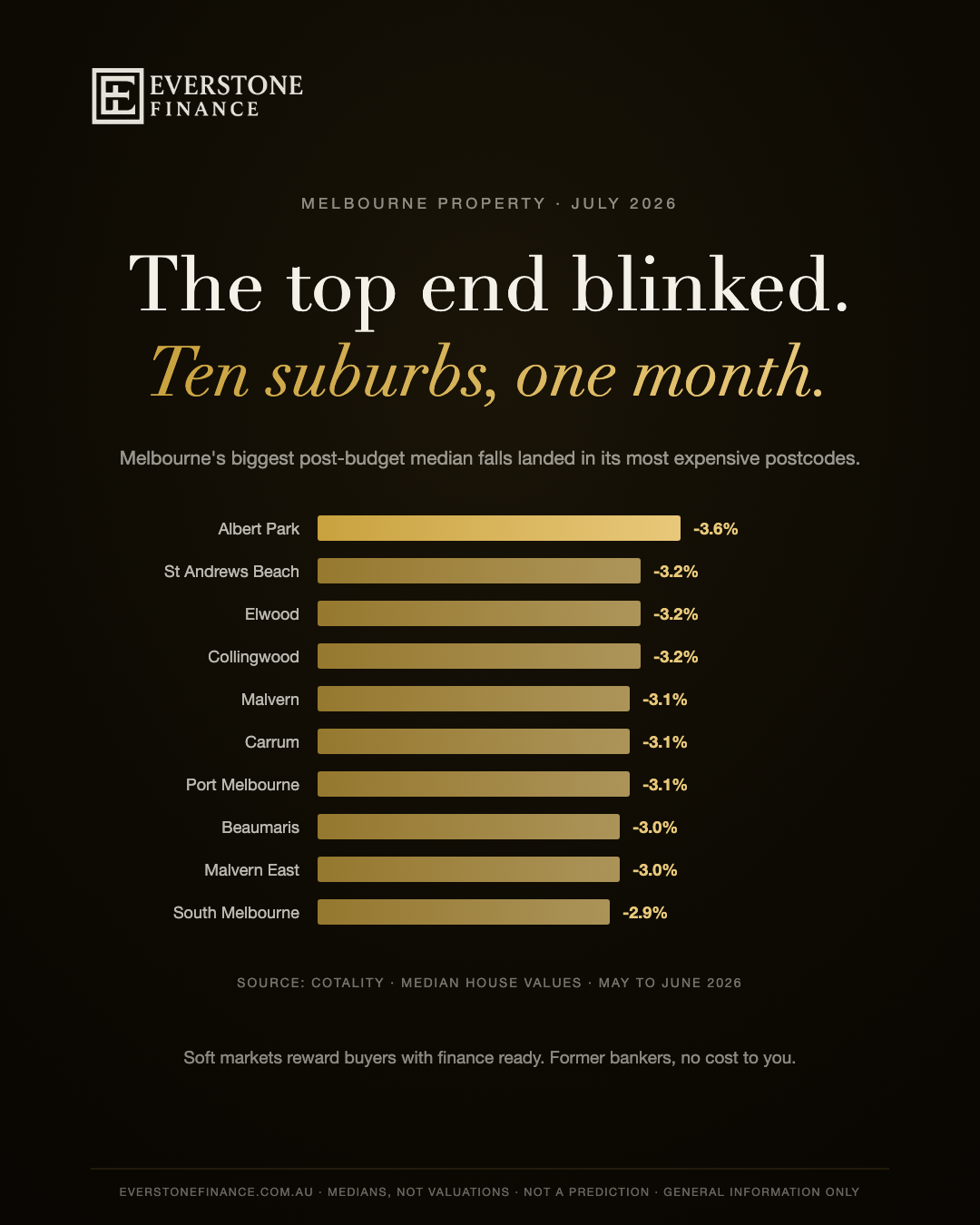
Cotality’s suburb medians for May to June 2026 put Melbourne’s ten largest monthly house price falls almost entirely in premium postcodes, led by Albert Park at -3.6 per cent, roughly $90,000. Most of the list sits between -2.9 and -3.2 per cent, with dollar falls of $39,000 to $90,000 in a single month.
Here is the list as reported, and it reads like a tour of Melbourne’s most desirable streets rather than its most stressed:
| Suburb | May median | June median | Change ($) | Change (%) |
|---|---|---|---|---|
| Albert Park | $2.54m | $2.45m | -$90,000 | -3.6% |
| St Andrews Beach | $1.36m | $1.32m | -$44,000 | -3.2% |
| Elwood | $2.30m | $2.22m | -$74,000 | -3.2% |
| Collingwood | $1.22m | $1.18m | -$39,000 | -3.2% |
| Malvern | $2.67m | $2.59m | -$82,000 | -3.1% |
| Carrum | $1.27m | $1.23m | -$39,000 | -3.1% |
| Port Melbourne | $1.74m | $1.68m | -$53,000 | -3.1% |
| Beaumaris | $2.03m | $1.97m | -$61,000 | -3.0% |
| Malvern East | $2.25m | $2.18m | -$67,000 | -3.0% |
| South Melbourne | $1.75m | $1.70m | -$51,000 | -2.9% |
Monthly suburb medians are volatile, especially on winter volumes, and say nothing about any individual property. Past movements are not predictions. This is general information, not advice.
Before anyone panics or celebrates, hold two ideas at once. First, these are real falls in reported medians, in suburbs where a 3 per cent move is a luxury car’s worth of money. Second, a one month suburb median is one of the noisiest statistics in property: it measures the middle of what happened to sell, and in thin markets that mix can move the number as much as prices do. Both things are true, and the interesting story is in why this particular list, in this particular month.
Why are Melbourne’s premium suburbs falling?
Four forces are stacking: winter stock is thin and skewed toward investor and entry-level sales that drag medians; discretionary sellers in affluent suburbs simply withdraw rather than discount; buyer sentiment is in wait-and-see mode; and the gap between what buyers offer and sellers accept has widened, so fewer sales print, and the ones that do skew soft.
The composition point comes first because it is the least understood. In tightly held suburbs like Albert Park or Malvern, a slow month might see only a handful of houses change hands. If the grand Victorian on the good street sells in May and the unrenovated two-bedroom or the investor’s townhouse sells in June, the median falls, even if nothing got cheaper. What sells moves the median as much as what it sells for, and reports of thinner stock skewing toward investor and first-buyer-grade property are consistent with exactly the pattern in the table.
Second, affluent suburbs have a behaviour all their own: discretionary sellers. Owners in these postcodes rarely have to sell, so when conditions soften they withdraw, volumes shrink further, and the median gets noisier still. What remains on the market skews toward motivated sellers: deceased estates, divorces, investors exiting. Motivated stock prints softer numbers.
Third, sentiment. The post-budget mood is wait-and-see, and premium markets feel sentiment first because nobody is forced to transact at the top end. And fourth, the standoff: buyers arriving with sharpened expectations, sellers anchored to last year’s numbers, and a widened bid-ask gap that fewer deals cross. Low volumes plus soft prints is precisely what a standoff looks like in data form.
All four forces are real, none of them are mysterious, and one of them is doing more quiet work than the rest combined, because it explains where the buyers went. That one gets its own section.
Watching a Melbourne suburb that has softened, or already own there? WhatsApp, text or call Ahmed about what it means for your own purchase or your current loan. His own mobile, no call centre, and the first chat is free.
The 9 per cent test: where the buyers went
Lenders must assess whether you could still afford repayments at your interest rate plus a buffer, currently 3 percentage points under APRA’s settings. With typical variable rates in the low 6s, buyers are being tested above 9 per cent, and at $2 million-plus price points that test removes a large share of would-be buyers from the market.
Here is the mechanism most commentary waves past. Under APRA’s serviceability settings, a lender does not assess your loan at the rate you will pay; it assesses whether you could keep paying if rates rose 3 percentage points higher. With variable rates sitting in the low 6s (the RBA publishes the going rates), that means applications for these suburbs are being stress-tested at above 9 per cent.
Now put illustrative numbers on it, clearly labelled: this example is illustrative only, not a quote or a prediction. Take Albert Park’s June median of roughly $2.45 million. Even with a full 20 per cent deposit, the loan is about $1.96 million, and tested at above 9 per cent that means demonstrating you could sustain repayments in the region of $16,000 a month, before your other commitments enter the calculation. The household income required to clear that test comfortably sits well into the several hundred thousands. That is not a moral judgement about anyone’s finances; it is arithmetic, and it explains why the buyer pool at the top end has thinned to the small group who can clear a 9 per cent test on a seven figure loan.
Two consequences follow. For the market: when the test removes most buyers, the few who remain face less competition than these suburbs have offered in years. For you personally: your borrowing power at a 9 per cent test is not a fixed fact, it is a function of which lender assesses you and how they read your income, and that spread between lenders is the subject of nearly everything else we write.
Who can actually use a soft top end
Buyers whose finance is already arranged, and buyers whose borrowing power is properly maximised: professionals using LMI waivers to buy with 10 per cent deposits, borrowers whose overtime, allowances or equity income is counted in full at the right lender, and upgraders using bridging finance to buy before they sell. Readiness, not bravado, is the edge in a soft market.
We arrange finance, not crystal balls, so this section is not a prediction that premium Melbourne has bottomed; nobody knows that. What we can say from inside the lending process is what a soft, low-competition market rewards: the buyer who can transact. When a motivated vendor meets a hesitant market, the offer that wins is rarely the highest, it is the one with finance already resolved. That is a lending outcome, and it is buildable in advance:
- Pre-approval before the search. A current pre-approval turns you from a browser into a buyer, and in a standoff market vendors’ agents triage enquiries by exactly that distinction.
- The waiver arithmetic at premium price points. For the professionals who dominate buying in these suburbs, doctors, lawyers, bankers, senior public servants, the 90 per cent LMI waiver means a $2 million purchase needs $200,000 of deposit rather than $400,000, with no LMI. At top-end prices, the waiver is at its most valuable in dollar terms.
- Income read properly. Clearing a 9 per cent test is about assessable income, and lenders differ on overtime, allowances, bonuses and equity, the theme running through our professionals hub. The same payslip clears the test at one lender and misses at another.
- Bridging for upgraders. The classic top-end move in a soft market is upgrading, selling a good house to buy a better one while the gap between them has narrowed. Bridging finance lets you secure the purchase before your sale, which is exactly the sequencing a hesitant market punishes you for lacking.
- The prestige toolkit. At these price points, lending has its own mechanics, covered in our prestige home loans guide.
Whether any particular purchase is right for you is a decision for you, made on your circumstances and, where it matters, with your financial adviser. What we can do is make sure that if you decide to move, the finance is not the reason you could not.
If you own in these suburbs
A falling suburb median is not a valuation of your house: composition effects on thin volumes move medians in ways individual properties do not. If you are not selling, the practical response is unglamorous: review the loan itself, since the rate you pay compounds every month regardless of what the median prints.
If you own in Albert Park or Beaumaris and this table rattled you, start with what a median actually is: the middle sale among a small number of transactions, in a month when the mix skewed cheap. Your home was not revalued by this data, and if you are not selling, a monthly print changes nothing about your position. The affluent-suburb pattern described above, discretionary sellers withdrawing, is most owners in these suburbs behaving rationally.
The practical opportunity for owners sits on the other side of the ledger: the loan. The same low-6s rate environment that is testing buyers above 9 per cent is quietly ageing every back-book mortgage in these suburbs, and on seven figure balances, small pricing drift is real money every month. If your loan has not been repriced or reviewed in over a year, that review is free and usually the most profitable hour of the quarter; our piece on why waiting for 3 per cent rates is a strategy that history mocks covers the rate backdrop in more depth. And if the plan is to sell into the next strong market and upgrade through the soft one, the bridging conversation above applies to you from the other direction.
Why Melbourne buyers work with Everstone
Because we are Melbourne-based former bankers who finance these exact suburbs, and soft markets are won on preparation: pre-approvals structured to clear the 9 per cent test, waivers applied where eligibility exists, income presented to the lender that reads it best, and bridging arranged before the auction, not after. All at no cost to you.
Everstone Finance works from South Yarra, a few minutes from half the suburbs in that table, and the buyers we arrange finance for in Albert Park, Malvern and Port Melbourne are the professionals the rest of our guides are written for. That is not a coincidence; at a 9 per cent test on premium prices, the buyers left standing are disproportionately the doctors, lawyers, bankers and executives whose waivers and income policies we map for a living, suburb by suburb across our Melbourne coverage.
What we actually do in a market like this one is unexciting and decisive: test your real borrowing power against current policy at multiple lenders rather than one bank’s calculator, structure the pre-approval so it holds when you need it, apply the waiver if your profession carries one, and have bridging or deposit structures ready before the property appears. When the right house prints at the wrong price for the vendor’s liking, the finance-ready buyer is the only one in the room who can say yes that week.
There is no cost to you for any of it: like most Australian mortgage brokers we are paid by the lender on settlement, and the Best Interests Duty legally requires our recommendation to serve your interests. Moneysmart’s guide to home loans is a good independent primer alongside anything we tell you.
Find out what you could clear at today’s testing rates
One conversation establishes your real borrowing power under the 9 per cent test, whether a waiver applies to you, and what finance-ready would look like for the suburbs you are watching. No cost, no obligation.
Book a chat with a former bankerFrequently asked questions
Why are Albert Park and other premium Melbourne suburbs falling?
Four stacked forces: thin winter listings skewed toward investor and entry-level stock that drags medians down; discretionary sellers in affluent suburbs withdrawing rather than discounting; wait-and-see buyer sentiment; and a widened gap between buyer offers and seller expectations that fewer sales cross. On low volumes, those forces move a monthly median sharply even when individual streets barely change.
How much did Melbourne’s premium suburbs fall from May to June 2026?
On Cotality’s reported medians, the ten largest falls ranged from -2.9 to -3.6 per cent in a month, led by Albert Park at -3.6 per cent, roughly $90,000. Malvern fell about $82,000, Elwood $74,000 and Malvern East $67,000, with the rest of the list between $39,000 and $61,000. Monthly medians on thin volumes are noisy, so single-month figures deserve caution.
Does a falling suburb median mean my house lost value?
Not necessarily. A suburb median is the middle of the handful of sales that happened to occur, and in tightly held suburbs the mix of what sold moves the number as much as prices do. A month where cheaper stock dominated transactions prints a falling median without revaluing anything. Individual property values are established by valuations and actual comparable sales, not by one month of medians.
What does being assessed at over 9 per cent mean?
Lenders must test whether you could still afford your repayments if rates rose 3 percentage points above your actual rate, under APRA’s serviceability settings. With variable rates in the low 6s, that testing rate exceeds 9 per cent. You never pay the testing rate; it determines how much you can borrow, and different lenders reading the same income can reach noticeably different answers under it.
Is now a good time to buy in these suburbs?
No article can answer that for you, and we do not make market predictions. What the data shows is reduced competition and softer prints at the top end; what history shows is that such windows are only usable by buyers whose finance is already arranged. Whether to buy is your decision, made on your circumstances; being financially ready to decide is the part we arrange.
How do buyers increase borrowing power at these price points?
Three levers matter most: lender choice, because income treatment of bonuses, overtime, allowances and equity varies and moves the answer under the 9 per cent test; professional LMI waivers, which let eligible buyers purchase with 10 per cent deposits at select lenders, worth the most in dollar terms at premium prices; and structure, including bridging for upgraders buying before they sell.
Does it cost anything to use a broker?
No. Everstone Finance is paid a commission by the lender when your loan settles, so there is no fee to you for our service, and our recommendation must satisfy the Best Interests Duty, which requires us to act in your interests rather than any lender’s. In a soft market, the free preparation is usually worth more than any discount you could negotiate alone.
Watching one of these suburbs? Get finance-ready before the spring listings arrive. Book a time with a former banker and we will tell you plainly what you could clear, and how to be the buyer who can act.
Sources
Related guides
About the author. Ahmed Lotfi is co-founder of Everstone Finance and a former banker who now works as a mortgage and finance broker in South Yarra, Melbourne, arranging home, investment and commercial lending for clients across Australia. Everstone Finance operates under the Best Interests Duty as Credit Representative 574314 of LMG Broker Services Pty Ltd, Australian Credit Licence 517921.
Soft markets reward the prepared
The window is defined by who can act, not who can talk. One conversation makes you the buyer with finance ready when the right house prints at the right price.
Book a chat with a former banker